Digital jidoka on high-mix low-volume lines — because training one model per variant kills the ROI.
Classical jidoka fails in high-mix because every variant demands its own set-up and, on short runs, the cost of configuring vision per variant kills the ROI. iLEAN applies few-shot vision that learns from a handful of examples on Edge right at the line — the operator labels a few parts on their earpiece and the variant enters jidoka on the next shift.
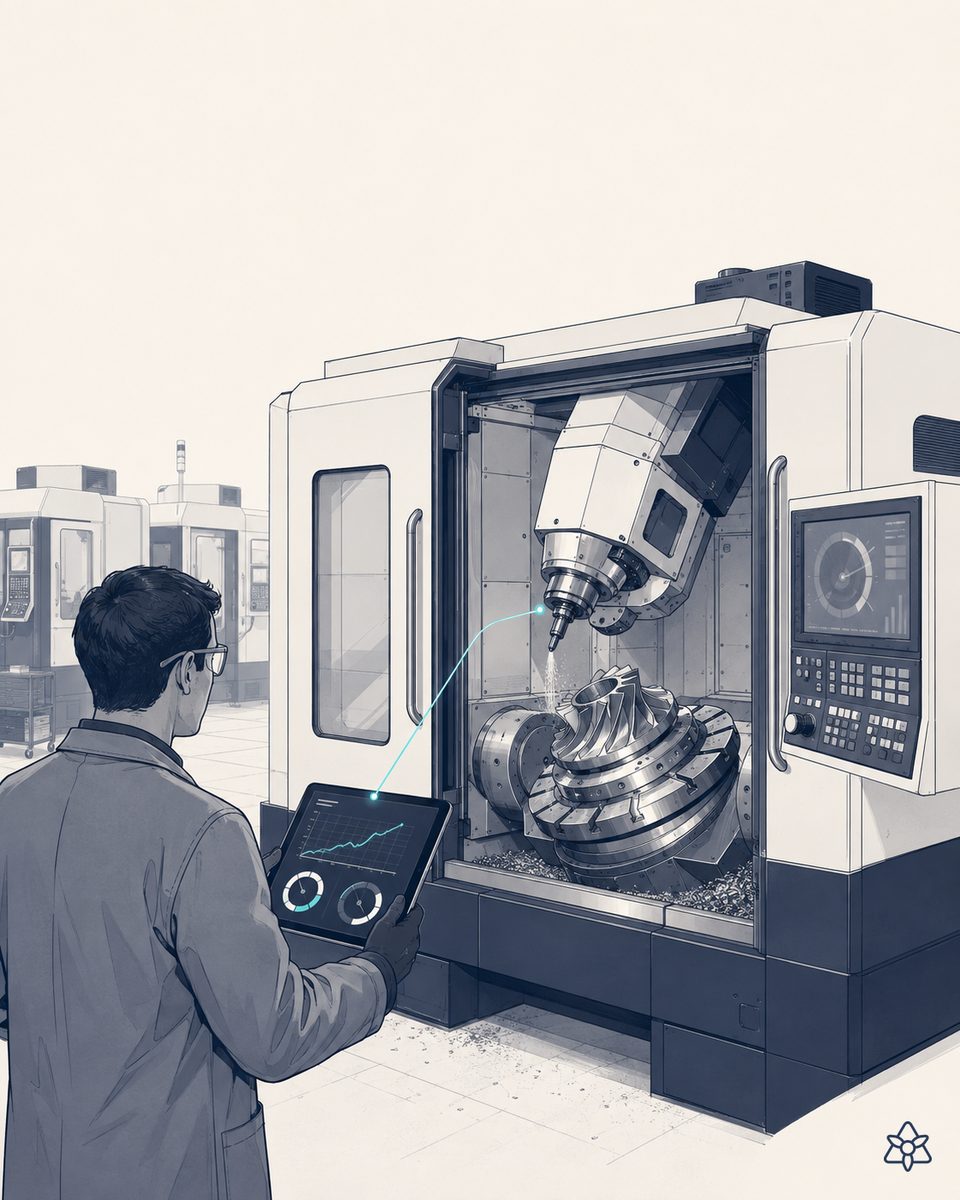
Classical jidoka was built for high-volume with little variety. High-mix was left without jidoka.
Jidoka is one of the two pillars of the TPS, and it works beautifully when the plant makes thousands of the same part with controlled variations: you configure the vision, validate the poka-yoke, calibrate the actuator, and the system runs. But the moment the plant produces 200 variants a year in runs of 50 parts, classical jidoka breaks down — not because of the methodology, but because of the arithmetic.
- A new variant enters production — machine parameters are programmed, one part is made, then two, then ten to validate.
- The vision system needs retraining — several days of an engineer, dozens or hundreds of hand-labelled images, validation against real production.
- The run is 50 parts — by the time the system is ready, the run is over.
- Real outcome — jidoka stays at a basic mechanical poka-yoke (a stop, a presence sensor) and subtle defects slip through to the customer.
Traditional automotive, with its volume, can afford the statistical rigour demanded by the industry's 25 PPM defect standard [2]. A light boilermaking shop machining 200 references a year in short runs cannot — not because it does not want quality, but because the arithmetic of classical jidoka does not add up for it. The result: two industries with the same theoretical technology but very different quality levels.
iLEAN is not one retrained model per variant — it is one base model that learns each new variant from 10-30 images.
The bottleneck of jidoka in high-mix is not the vision algorithm — the algorithms have been more than good enough for years. It is the cost of labelling and retraining per variant. iLEAN acts as the filler between the base vision model (which already understands the family of parts) and today's specific variant, which is learned from a handful of examples the operator labels on their earpiece during the first shift.
Edge sees the part on the line. Vision learns the variant from a few examples. Brain decides whether it passes or is held. The operator labels and signs — never the other way round.
The three iLEAN pieces applied to high-mix low-volume jidoka:
- iLEAN Edge — a physical terminal with a CNN camera over the machining or assembly station. It sees the part at the end of the operation and fires the actuator (light column, ejector) within milliseconds if it detects a defect. It works without a network: if the plant loses WiFi, Edge keeps holding parts. What is critical does not depend on connectivity.
- iLEAN Vision (few-shot) — the vision engine on top of a base model trained with a broad catalogue of industrial parts. When a new variant comes in, the operator photographs 10-30 parts with their earpiece and marks them as "good" or "defect". Vision adapts the base model to the variant from that handful of examples. That is what we call "few-shot": learning from few.
- iLEAN Brain — it coordinates the decision logic: does the part pass, get held for review, or get ejected? It cross-checks Vision's inference against the drawing tolerance and against the variant's history in other plants. The operator validates the borderline cases on their earpiece and signs.
Traditional jidoka vs. few-shot jidoka with iLEAN
| Aspect | Classical jidoka in high-mix | With iLEAN Edge + Vision + Brain |
|---|---|---|
| Cost of introducing a new variant | Several days of engineer retraining, hundreds of images | 1-2h of labelling on the earpiece, 10-30 images |
| Time from new variant to active jidoka | Longer than the short run itself | Same shift or the next one |
| Subtle defects on short runs | Slip through to the customer | Detected on the line, before closing |
| Set-up on variant changeover | Manual, dependent on the veteran | Assisted by Brain with the configuration saved per variant |
| Variant knowledge across plants | Lives in the local programmer's head | Shared variant catalogue — real yokoten |
| Operation without a network | n/a | Edge keeps running on panel power |
Impact estimate for your plant — to be validated against your own numbers.
The block below is an estimate to be validated with your plant's actual data. We put it forward so the committee has an order of magnitude; we refine it during the diagnostic.
- Special machining, light boilermaking, precast or tooling plant, with 150-400 variants a year in runs of 20-200 parts. Today jidoka stays at a mechanical poka-yoke and subtle defects show up at the customer.
- Edge + Vision few-shot pilot on one critical station (the operation with the most customer rejects). First value expected within a few weeks: the first variants enter jidoka and defects are stopped before shipment.
- Indicative payback between 4 and 9 months, hard lever: reduction of customer rejects and of the associated cost of poor quality (rework, reverse freight, lost orders).
- A reasonable reduction in the cost of poor quality to present to the committee: 30% or more. We measure it before and after with your real parts.
And the production manager's fair objection
"What if the AI gets it wrong on a new variant it has barely seen?" — hallucination is a problem of free generation, not of anchored tasks. Vision's inference on a part with 10-30 labelled examples is the anchored task par excellence: on this type of task the best models brought the error below 1.5% [1]. And even so, what is critical is never decided alone: Brain flags the borderline case, the operator validates it on their earpiece and signs. The three rings are there precisely for this.
[1] OpenAI paper "Why Language Models Hallucinate", 2025 — on the reliability of AI in anchored tasks.
[2] Automotive quality standard ~25 PPM — Symestic.
What people ask about high-mix low-volume jidoka with AI
Does few-shot vision really work on the plant floor?
Yes, with three caveats. (1) It works very well for variants that are variations on a known base part (different colour, changed dimension, extra hole); the base model already understands the family and only needs examples of the variant. (2) It works acceptably for entirely new parts if lighting and positioning are controlled; here you need a few dozen examples. (3) It does NOT work if the part can arrive in any orientation under changing light and the defect is subtle — in that case we go back to classical jidoka (mechanical poka-yoke). iLEAN tells you during the immersion which case is yours.
And what about a part that is made only once (one-off)?
For a one-off part, classical jidoka does not apply and few-shot does not either: there is not enough sample. What does work is Edge measuring geometry with lasers, comparing it against the 3D CAD drawing, and warning the operator if the part is out of tolerance. That is jidoka on geometry, not on visual pattern. iLEAN has both modes.
How much does it cost to teach the system a new variant?
In the favourable scenario (a variant of a known family) 10 to 30 images labelled by the operator on their earpiece are enough, 1-2 hours of labelling spread across the first shift with the part. The part enters jidoka production on the second shift. In the less favourable scenario (a new family) it takes several dozen parts and a few more hours from a technician. We measure it on each real variant with your own parts.
Is it useful for niche industries with highly varied production?
Yes — and it is the case where it gives the most leverage. Niche industries such as tooling, prosthetics, custom precast, light boilermaking or special machining suffer particularly: the volume does not justify a traditional vision system per variant, so jidoka stays at a basic mechanical poka-yoke and many defects slip through. Few-shot vision breaks that limit: for the first time digital jidoka becomes viable on short runs.
Is it better than traditional jidoka?
In high-mix low-volume, yes — because traditional jidoka, whether with a vision system per variant or with mechanical poka-yoke, does not scale when the plant makes 200 variants a year in runs of 50 parts. In high-volume with little variety, traditional jidoka remains perfect and there is no reason to change it. The frontier is not between classical and digital — it is between high and low volume per variant.
Tell us your variant mix and within 48h we will send you the estimated ROI of few-shot jidoka in your plant.
We work on your plant's real data, not on ours. Diagnostic with no strings attached.
Request estimated ROI within 48h See the Jidoka guide