Jidoka: autonomation — the machine catches its own error
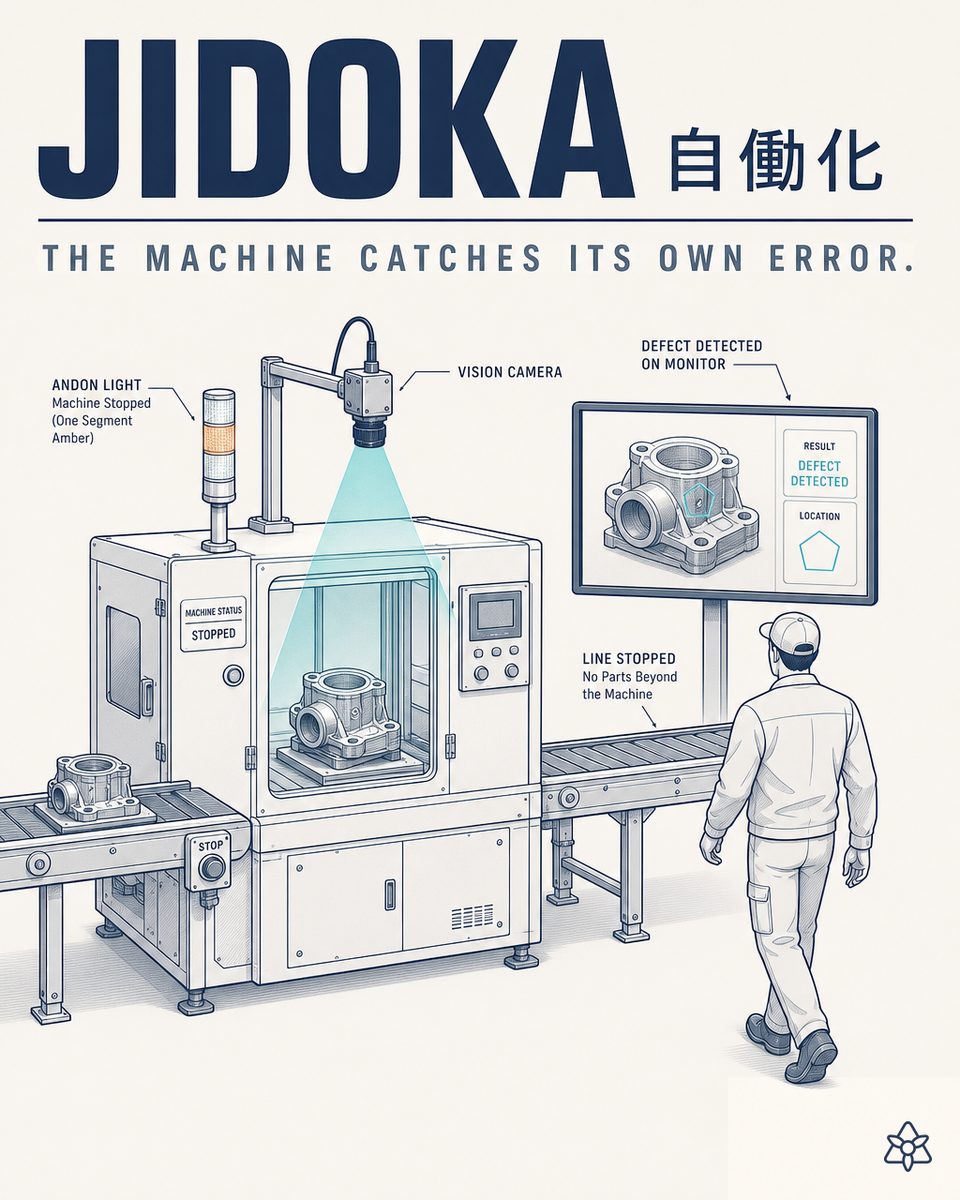
Jidoka is autonomation — one of the two pillars of the Toyota Production System, alongside Just-in-Time. It's the idea that the machine, as soon as it detects an anomaly in what it's producing, stops itself and alerts the operator instead of continuing to make defective parts that would need rework or scrap.
Why the word is 'autonomation', not 'automation'
The Japanese term is 自働化 (jidōka). If you look at the central kanji — 働 — it includes the "person" radical (人). It's not the usual "automation" kanji (自動化), but a modified one that emphasizes the human component.
Sakichi Toyoda (founder of the Toyota group) invented in 1924 a loom that automatically stopped when a thread broke. Before, operators manually watched dozens of looms to stop the break in time. After, a single operator could supervise many looms because each one self-stopped.
The principle generalized: the machine does its work, but has the intelligence to detect when it's failing and the authority to stop. That frees the operator from surveillance and lets them add value in other tasks.
iLEAN doesn't replace the method — it brings it into the 21st century.
Every Lean methodology was born to solve an information problem: where stock is, which machine is failing, what changed shift-to-shift. When information is paper, methods are rituals. When it's live data, they become the actual engine of the plant.
Classical method tells you what to measure. The IRIS system guarantees the measurement reaches whoever decides, the moment they decide — without anyone typing it in.
The three capture layers applied: Connect (photo, voice, email, WhatsApp), Edge (computer vision on the line) and Integrations (ERP/MES/SCADA/PLC). On top of that unified information, specialized agents serve the exact context to each person on the floor.
Classical Jidoka vs. Jidoka with computer vision
| Aspect | Classical Jidoka | Jidoka with iLEAN |
|---|---|---|
| Anomaly detection | Dedicated mechanical/electrical sensor | Multi-purpose computer vision |
| Detectable defect types | Limited to the sensor | Any learnable visible pattern |
| Adapting to new product | Sensor redesign | Model re-training |
| Andon trigger | Physical wiring | Scalable digital notification |
| Incident logging | Only stop logged | Stop + photo + cause classification |
What people ask about Jidoka
What is Jidoka and why is it called 'autonomation'?
Jidoka (自働化) is one of the two pillars of the Toyota Production System (alongside JIT). It translates as 'autonomation' — a neologism combining automation + autonomy. The idea: the machine does its work automatically and has the autonomy to stop when it detects a problem.
What's the difference between Jidoka and traditional automation?
Traditional automation: the machine works full speed regardless of quality — the operator inspects at the end. Jidoka: the machine has the intelligence to detect anomalies and the authority to stop itself. Quality is built into the process, not inspected at the end.
How does iLEAN apply Jidoka with computer vision?
Cameras in the Edge layer watch the part at each critical step. An AI model trained on valid parts recognizes when something is out of normal pattern — a rotated component, a bad weld, a surface defect — and triggers a machine stop along with the Andon alarm. The operator decides to resume or intervene.
Does Jidoka work on old machines not designed for it?
Yes, because iLEAN doesn't require modifying the machine. Cameras and sensors install externally and the stop decision is executed from iLEAN logic — for example, cutting the PLC's advance signal. The machine stays the same; the intelligence is external.
What's the relationship between Jidoka, Andon and Poka-Yoke?
Three related concepts often confused: Jidoka is the principle (the machine detects its error). Poka-Yoke is the concrete mechanism that detects or prevents the error. Andon is the visual signal that alerts the operator when it happens. The three operate together: Poka-Yoke detects → Jidoka stops the machine → Andon alerts.
Tell us about your plant. We'll tell you how we'd do it.
25 years applying Lean in real plants. Free diagnostic conversation.
Request demo See Lean Manufacturing