Operator voice copilot — the person who knows the line best is the one who can never type.
The operator has their hands busy and the knowledge in their head. No one asks them because they cannot write, and what they know stays in the shift. With iLEAN Connect in voice mode — an earpiece with a wake-word — they dictate the incident while they work and ask what they need (“what tolerance does this batch run?”), and get an instant voice answer anchored to the real data of their line and their batch — not to a generic AI. Every dictation is structured and tied to batch, machine and shift, and the right person validates it before it crosses into the system.
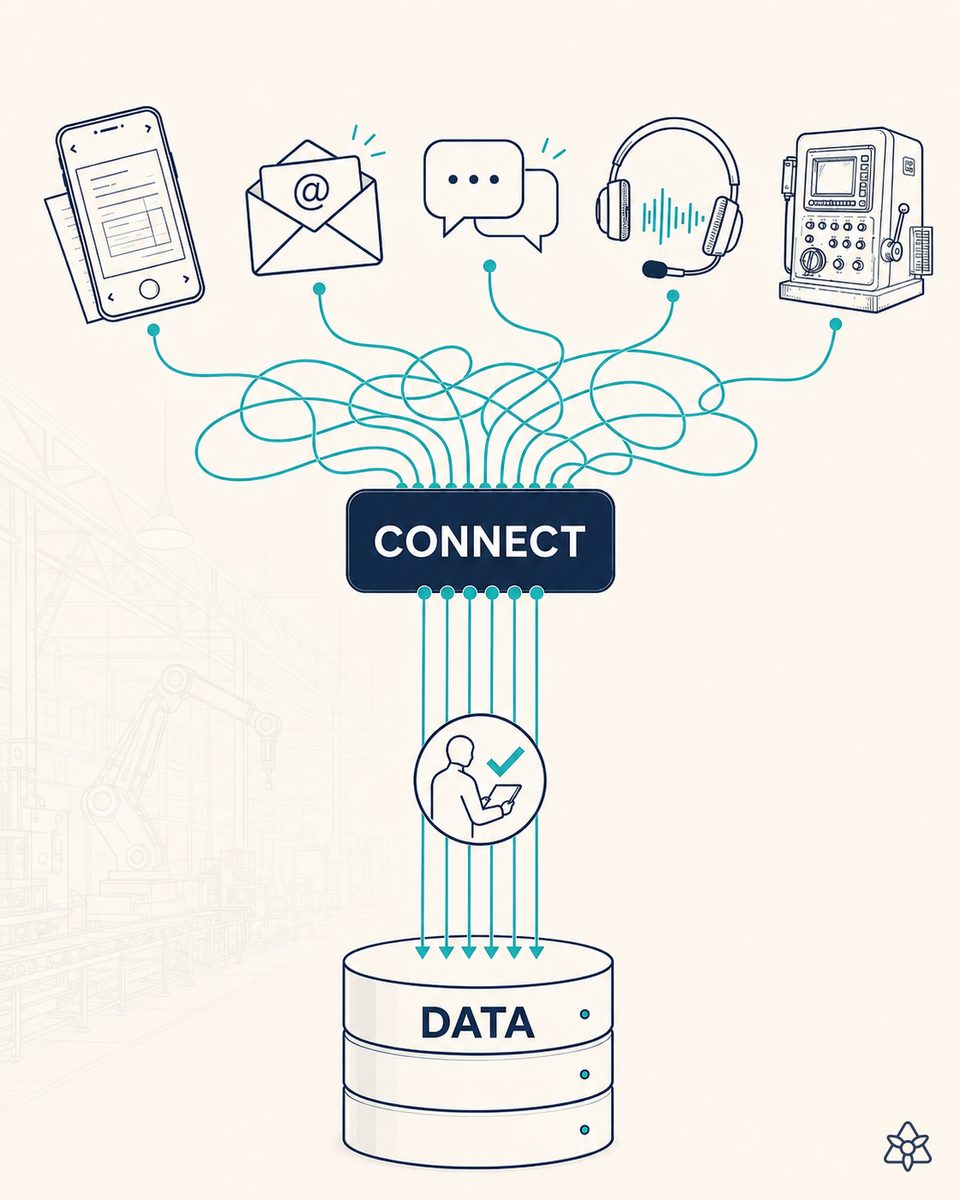
The knowledge is on the floor. The keyboard is in the office. In between there is nothing.
Ask any shift lead who really knows why that machine jams on Monday mornings, and they will point to one specific person on the line. Now ask them where that is written down. It is not — and the reason is mechanical, not cultural:
- Busy hands — the operator is holding the part, adjusting the guide or halfway inside the machine. Any logging that requires stopping, taking off the gloves and typing competes with doing their job. And loses.
- The report at the end of the shift — what gets logged gets logged two hours later, from memory and in three words: “jam on line 4.” The information that would have helped solve it (what it sounded like, with which material, after which maneuver) has already evaporated.
- The questions that never get asked — the operator needs to know that batch's tolerance, the recipe parameter, what was done the last time this same fault appeared. Since they have no one to ask without walking off, they decide from what they remember. Sometimes they are right.
- The invisible micro-stoppages — three minutes here, four there, looking for the technician or the lead over a thirty-second question. They never show up in the OEE because no one declares them, and they are among the most expensive losses a plant has.
The result is a system where the person with the most information about the line is exactly the one who contributes the least to the information system. The voice copilot does not ask the operator to write: it gives them a channel they already know how to communicate through.
iLEAN does not add another screen for the operator — it takes the screen out of the middle.
The voice copilot is genchi genbutsu for real: the data is captured where the event happens, at the moment it happens, with no translation and no delay. Connect is the putty that joins that voice with the MES, the SCADA, the active recipe, the incident history and the work instruction — so the answer that comes back to their ear is the one for their batch, not a textbook recommendation.
The operator stops being the link that never reports and becomes the plant's best source of data. Without typing once.
The iLEAN pieces applied to the voice copilot:
- Connect (voice mode) — an earpiece with a wake-word and a contact microphone. Full duplex: the operator dictates and asks in the same conversation, without pressing anything. It works without a network — if coverage drops, the dictation is stored on the terminal and uploads when it returns.
- Agents — the brain. They turn speech into a structured record (incident type, machine, batch, shift, time, description), resolve the question against the correct data source and return the answer with its citation: which recipe, which version, which earlier report it comes from.
- Edge — supplies the context the operator does not have to say out loud: which machine, which batch is running, which parameters are live at that moment. The operator talks about what they see; the system fills in the rest.
- Three safety rings — nothing dictated enters as a firm record on its own. It is routed as a proposal to the shift lead, quality or maintenance as appropriate, and that person confirms before it crosses into the MES or the CMMS. The operator contributes; the responsible person signs.
End-of-shift report vs. voice copilot with iLEAN
| Aspect | Paper report / terminal at the end of the shift | Voice copilot with iLEAN |
|---|---|---|
| Moment of capture | At shift close, from memory | At the moment of the event, hands on the part |
| Incidents that get logged | Only the big ones; micro-stoppages are lost | Every one the operator names, including the three-minute ones |
| Quality of detail | Three words and a code | Description in the operator's own words, structured by the agent |
| Operator's question | Walk off to find the technician, or decide from memory | Asked by voice, answer anchored to the batch in seconds |
| Traceability | Batch and time reconstructed by hand | Automatically tied to batch, machine and shift |
| Validation | No one reviews what was written | Shift lead, quality or maintenance confirm before it crosses into the system |
| Language barrier | The report is written in the form's language | Each operator dictates in their own language; the record comes out the same |
Impact estimate for your plant — to be validated with your numbers.
The block below is an estimate to be validated with the specific data of your plant. We set it out so the committee has an order of magnitude; we refine it during the diagnostic.
- Plant with manual incident logging (paper or a terminal at the end of the shift) and micro-stoppages that never reach the OEE because no one declares them.
- Connect voice-mode pilot on one line or one full shift: earpieces, wake-word calibrated to the building's noise, plant glossary and validation routing. First value expected within a few weeks.
- Indicative payback between 4 and 9 months, resting on two levers: captured incidents that used to be lost (and now feed root-cause analysis) and micro-stoppages resolved on the spot without going to find the technician.
- Increase in the number of incidents logged per shift in the order of 3× to 5× versus the manual report — not because there are more problems, but because before they were not being counted.
And the production manager's reasonable doubt
“What if the AI answers the operator with a tolerance it made up?” — it is the right question, and the answer is in the design. Hallucination is a problem of free generation, not of anchored tasks. Here the copilot does not compose: it retrieves a value from the active recipe, the history or the work instruction, and returns it citing where it comes from. If there is no source, there is no answer — it says it does not have the data and escalates to someone who does. On this kind of anchored task the best models are below 1.5% error [1]. And no answer acts on the process: it informs the person, who decides. The three safety rings are there precisely for this.
[1] OpenAI paper “Why Language Models Hallucinate”, 2025 — on the reliability of AI in anchored tasks.
You may also be interested in: Multichannel incident capture with AI · Autonomous maintenance TPM with AI · Digital operator rounds with AI
What people ask about the operator voice copilot
Does it work with the noise of a real plant?
Yes, and it is the first thing we test in the pilot. The earpiece uses active cancellation with a contact microphone: it picks up the voice by conduction, not the air of the building, so a press or a packing machine a few yards away does not break the dictation. The wake-word is calibrated against your line's background noise during the first days, so it neither fires on its own nor has to be shouted at. In environments above 90 dB the operator can also close each dictation with a short confirmation the system repeats back through the earpiece — if it got it wrong, it is corrected in two seconds without letting go of the part.
What can the operator ask the copilot?
Whatever is in the data of their line, their batch and their shift: the tolerance or recipe parameter currently running, the history of the last format change, what was done the last time this machine threw this same fault, the status of the order, whether the material on the cart belongs to the right batch, where the applicable work instruction is. They also ask procedural questions — “can I restart this myself or do I need a quality sign-off?”. What it does not do is offer opinions where it has no data: if it does not know, it says so and offers to notify someone who does.
How do you keep the AI from making up an answer?
By design: the copilot does not generate freely, it retrieves. Every answer is built against the line's real data (MES, SCADA, recipe, incident history, work instruction) and comes back with its citation — “tolerance 0.15 mm, recipe R-4412, yesterday's version”. If there is no source, there is no answer: the copilot replies that it does not have the data and escalates. Hallucination is a problem of free generation, not of anchored tasks; on tasks anchored to a source the best models are below 1.5% error [1]. And no copilot answer executes anything on the process — it informs the person, who decides.
Who validates what the operator dictates?
The operator's dictation always enters as a structured proposal, never as a firm record. The agent turns it into a report with its fields (incident type, machine, batch, shift, time, description) and routes it to the right person depending on what it is: the shift lead validates stoppages and micro-stoppages, quality validates anything affecting product or a deviation, maintenance validates the technical alert. That person confirms, corrects or rejects with one tap, and only then does it cross into the MES or the CMMS. The operator contributes the knowledge; the responsibility for the record stays where it was.
Which languages and accents does it work with?
It works in the usual working languages of a plant — Spanish, Catalan, English, Portuguese, French, German, Polish, Romanian, Arabic — and each operator picks theirs in their profile, so two people on the same shift can dictate in different languages and the report comes out equally structured. Regional accents and non-native speech are handled well out of the box; what we do fine-tune in the pilot is your house vocabulary: machine names, line nicknames, part references, internal acronyms and the jargon only your plant understands. That glossary is built in the first days and is what boosts accuracy in one jump.
More cases in lean manufacturing
- Real-time OEE: availability × performance × qualityiLEAN measures OEE in real time: availability × performance × quality, by line, shift, product. The king…
- On-the-job training (OJT) with AI — the veteran teaches once, the plant learns forever.iLEAN turns the veteran's teaching into permanent capability: Connect captures the OJT session, Edge…
- One piece flow in electronics with AI — the single-piece flow your SMT line never managed to sustain.How iLEAN sustains one piece flow in high-mix SMT/PCB plants: Edge catches micro-stops, agents resync…
- Digital operator rounds — completing the round is not the goal. Capturing the deviation is.How iLEAN turns operator rounds into useful capture: hands-free voice and photo, an agent that spots…
- PDCA: the Plan-Do-Check-Act cycle, digitizediLEAN digitizes the PDCA cycle: every Plan hypothesis is tested on the floor (Do), verified with live…
- Poka-Yoke: error-proofing with computer visioniLEAN applies Poka-Yoke with computer vision: catches the defect before the next station. Operators…
Tell us about your case and within 48h we'll send you the estimated ROI of the voice copilot for your plant.
We work on your plant's real data, not on ours. Diagnostic with no commitment.
Request estimated ROI in 48h See Lean Manufacturing