Autonomous maintenance TPM — if it demands paper, it doesn't work. You know it and so do we.
Autonomous maintenance (TPM pillar 1) does not work if it demands that the operator fill in a paper checklist every shift. iLEAN lets the operator report by voice or photo — earpiece, phone, tablet — and the agent does the rest: it cross-references the report with the machine's history, generates the action and leaves it ready to sign off. The person signs; the operator gains time.
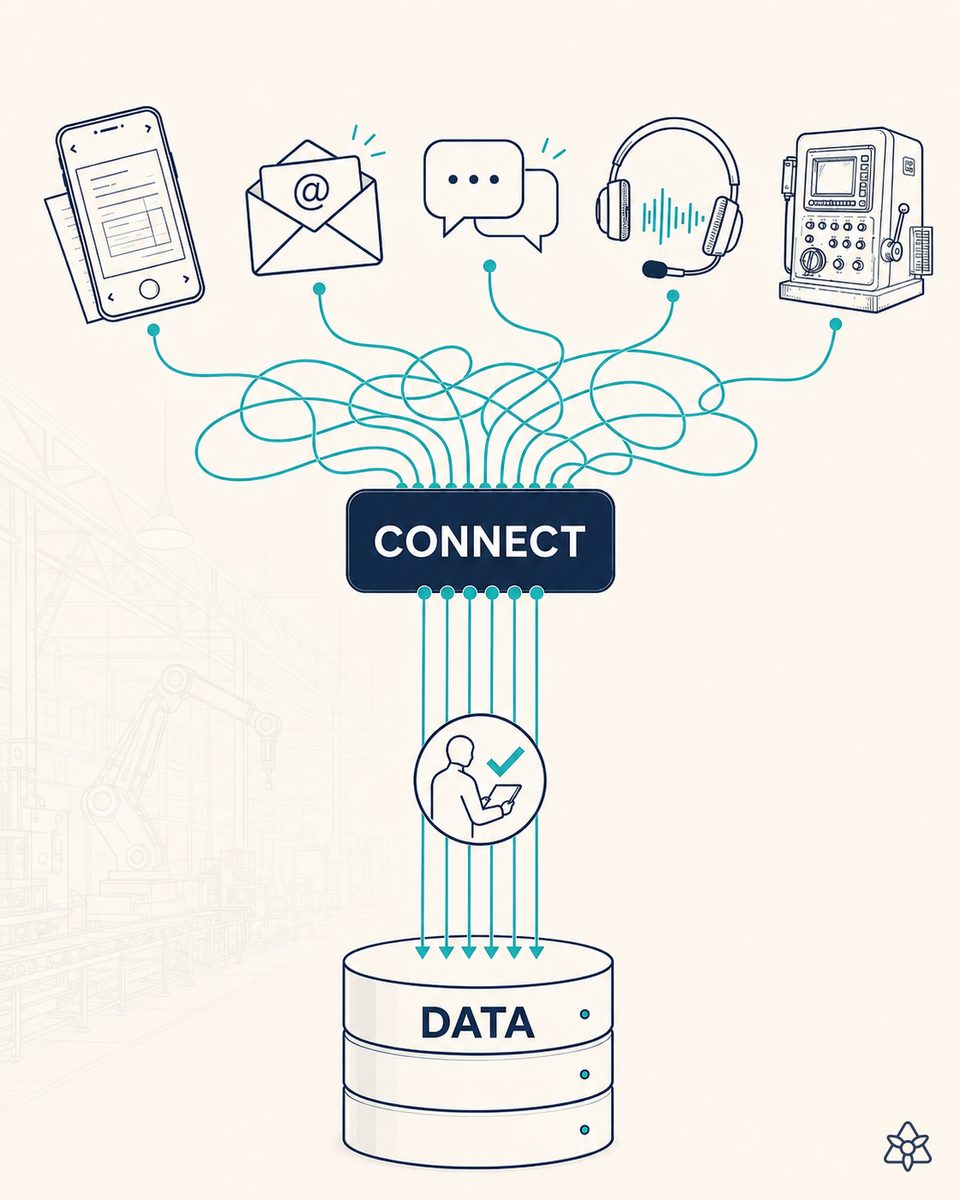
TPM pillar 1 collapses on the floor because the tool weighs more than it gives back.
Any maintenance manager who has tried to roll out TPM pillar 1 knows the pattern. The first weeks there is goodwill: the operator fills in the checklist, ticks the cleaning box, writes down the odd vibration. Three weeks in, the checklist is unsigned. Two months in, the forms get signed at the end of the shift, all at once, without anyone having walked out to the machine. TPM pillar 1 does not collapse out of bad faith — it collapses because the tool asks for paperwork and returns nothing.
- The channel is a barrier — open the CMMS, find the machine, type the issue, close it. Five minutes per report. The operator has a line to run; the report stays in their head and is lost at the end of the shift.
- The report never comes back with an action — the logged issue drops into the CMMS and the operator never finds out what happened to it. Next time they see something odd, why report it?
- The veteran's knowledge is never captured — the veteran operator knows the sound of their machine, tells a normal vibration from an odd one, sees the failure coming two shifts ahead. That knowledge walks out with them the day they retire.
The consequence: unplanned stoppages keep arriving, corrective maintenance eats the preventive budget, and TPM pillar 1 becomes the framed picture on the wall with the committee photos.
iLEAN doesn't ask the operator to become an administrator — it gives them a voice and an agent that listens.
The IRIS category (Industrial Reality Intelligence Systems) starts from one principle: plant reality first, the report afterwards. In TPM that means changing the contract with the operator: you see what happens, I (the system) do the paperwork. iLEAN acts as the filler between the operator, the CMMS and the maintenance technician — without asking you to change CMMS or to touch the certified procedure.
Connect listens through the channel the operator already uses. Writer documents. The agent proposes the action. The person signs off.
The three iLEAN pieces applied to digital autonomous maintenance:
- Connect — listens through every channel: voice into the earpiece, a photo from the phone, WhatsApp, dictation, industrial tablet. Bidirectional: the agent can answer through the same channel (“received, spare part ordered, technician notified, I'll tell you when it arrives”). The operator reports the way they would tell a colleague, not the way they would fill in a form.
- Writer — turns the operator's natural report into a structured event in the CMMS: machine, failure code, description, attached photo, proposed priority. Everything that used to take 5 minutes of typing is prepared by the system and validated by the person.
- Agent — cross-references the report with that machine's history, with recent reports from sister machines, with the preventive maintenance plan and with the spare parts catalogue. It proposes the corrective action (cleaning, lubrication, spare part replacement, work order to the technician). If the customer has granted autonomy for routine actions, it executes; if it touches a critical work order, it waits for the signature.
Paper-based autonomous TPM vs. digital autonomous TPM with iLEAN
| Aspect | TPM pillar 1 on paper / classic CMMS | With iLEAN Connect + Writer + Agent |
|---|---|---|
| Reporting channel | Checklist signed at the end of the shift | Voice, photo, WhatsApp, tablet — whichever channel is already in use |
| Operator time per report | 5 minutes of typing | 15 seconds talking or taking a photo |
| Veteran's knowledge | Lives only in their head | Every voice report becomes a persistent pattern |
| Feedback to the operator | None — the issue disappears | The agent answers through the same channel with the action |
| Load on the maintenance technician | Receives badly filled-in orders | Receives a structured order with photo, history and proposal |
| Adoption at 3 months | Falls to around 30% — the form gets signed in a rush | Rises because the tool stops weighing and starts helping |
Impact estimate for your plant — to be validated with your own numbers.
The block below is an estimate to be validated with the concrete data of your plant. We put it forward so the committee has an order of magnitude; we refine it during the diagnostic.
- Plant with 40-150 critical machines, TPM pillar 1 already existing on paper or in an unevenly used CMMS, real adoption of autonomous maintenance below 50%.
- Connect + Writer + Agent pilot on one pilot area (a line or a machine family). First value in a few weeks: as soon as the operator sees their voice report come back with the action, reporting frequency rises on its own.
- Increase in the number of voluntary reports of the order of 3x to 5x in the first months (estimate to be validated). Reduction in unplanned stoppages of the order of 15%-30% in the first year.
- Indicative payback between 4 and 9 months. The hard lever: unplanned stoppages avoided + operator time freed from paperwork + capturing the veteran's knowledge before they retire.
And the works council's fair question
“Is this about listening in on the operator?” — Connect picks up what the operator chooses to report about their machine, not their conversation. Voice is captured when the operator presses the earpiece button, dictates or speaks to the app — like a WhatsApp voice message, not an ambient microphone. And the rule of the system is a shop-floor rule: the agent proposes, the person signs off. What changes is not oversight of people (a framing that does not fit how we work): what changes is the contract with the operator, who now contributes what they know and gets something back. The agent does not invent either: it works on anchored tasks — this machine, this history, this report — and hallucination is a problem of free generation, not of anchored tasks; on anchored tasks the best models brought the error below 1.5% [1].
[1] OpenAI paper "Why Language Models Hallucinate", 2025 — on the reliability of AI in anchored tasks.
What people ask about digital TPM autonomous maintenance with AI
And internal culture? Autonomous maintenance always runs into “this is not my job”
TPM pillar 1 nearly always dies for one very concrete reason: the operator perceives that reporting the detail of their machine adds workload and gives nothing back. iLEAN changes the contract. The operator contributes what they know (an odd noise, a vibration, a small leak) through the easiest channel — voice into the earpiece, a photo from the phone, dictation — and the agent gives back something useful: the proposed corrective action, the spare part ordered, the maintenance order generated, the technician notified. The operator's workload goes down; recognition goes up. Culture changes when the tool stops asking for paperwork and starts helping.
Can the operator report through WhatsApp?
Yes — and through whatever channel they already use. iLEAN Connect is bidirectional by design: it listens through email, WhatsApp, Telegram, transcribed phone calls, phone photos, voice dictation into the earpiece. The excuse “that doesn't get reported because you have to open the CMMS” stops being valid: the operator reports the way they would tell a colleague (“the dispenser on line 3 makes a click that doesn't sound right to me”) and the agent picks up the message, tags it as an autonomous maintenance event, cross-references it with that machine's history and prepares the action. In plants where phones are not allowed, the flow is identical from an industrial tablet or an earpiece.
Who validates the action? Can the AI create work orders in the CMMS on its own?
It depends on the level of autonomy the customer decides — iLEAN's three safety rings let you configure it machine by machine and action type by action type, without touching code. For routine actions (scheduled cleaning, lubrication, simple adjustment) the agent can generate the order and the person signs it off with one click. For actions that touch a critical work order or that open a cost, the agent proposes and the person decides. The golden rule of the system: Connect transports, the Agents decide, the person signs off. Nothing ever reaches the work order without a human signature wherever the customer has flagged it as critical.
Does it integrate with the CMMS we already have?
Yes. iLEAN sits on top of the CMMS — it does not replace it. It reads from the CMMS through whichever door each one allows (API, ODBC, reading an export) and deposits into it the orders the agent generates and the person validates. It works with the usual maintenance management systems (SAP PM, vertical CMMS packages, enterprise asset management suites or an in-house tool). Integration is neither magic nor free: it is real work, but AI drove its cost through the floor. What used to be an excuse (“that old CMMS doesn't integrate”) no longer is.
How is real adoption of digital TPM measured?
With data the system captures on its own: number of voluntary reports per shift, average time between the operator's detection and the corrective action, percentage of machines with at least one autonomous report per week, ratio of anticipated incidents vs. unplanned stoppages. As an estimate to be validated: in a plant coming from paper-based autonomous maintenance, you typically see the number of reports rise by around 3x to 5x in the first months (because the channel stops being a barrier) and unplanned stoppages fall by 15%-30% in the first year. The serious calculation is done with your data during the diagnostic.
More cases in lean manufacturing
- A3 Thinking: structured problem solving on one sheetiLEAN digitizes A3 Thinking: single sheet, structured hypothesis, live data. The Toyota tool so every…
- Digital Andon: plant signaling with auto-escalationiLEAN digitizes Andon: auto-escalation, every alarm logged, no isolated light columns. When something…
- APM with AI — the critical asset stops being measured at month-end and starts anticipating its own failure.How iLEAN cross-references Edge, MES and CMMS data so APM measures real asset performance and…
- Cellular manufacturing with AI — cells designed with your plant's real data, not with the consultant's spreadsheet.How iLEAN designs, balances and keeps manufacturing cells alive with real plant data: part families,…
- Your CMMS isn’t lying — it’s incomplete. iLEAN completes it with voice, photo and an agent.How iLEAN turns your CMMS into a living tool: voice and photo capture on the floor, work orders…
- Compressed air — the plant's most expensive energy, and the worst governed.iLEAN detects leaks, drops pressure to the real minimum and orchestrates multi-compressor scheduling…
Tell us about your case and within 48h we'll send you the estimated ROI of digital autonomous TPM for your plant.
We work on the real data of your machines and your CMMS, not on ours. Diagnostic with no commitment.
Request estimated ROI in 48h See Lean Manufacturing