A3 Thinking: structured problem solving on one sheet
A3 Thinking is the Toyota methodology for structured problem solving on a single A3-sized sheet — background (context), current condition, root-cause analysis, proposed countermeasures, implementation plan and follow-up. The discipline of the A3 forces thinking before proposing.
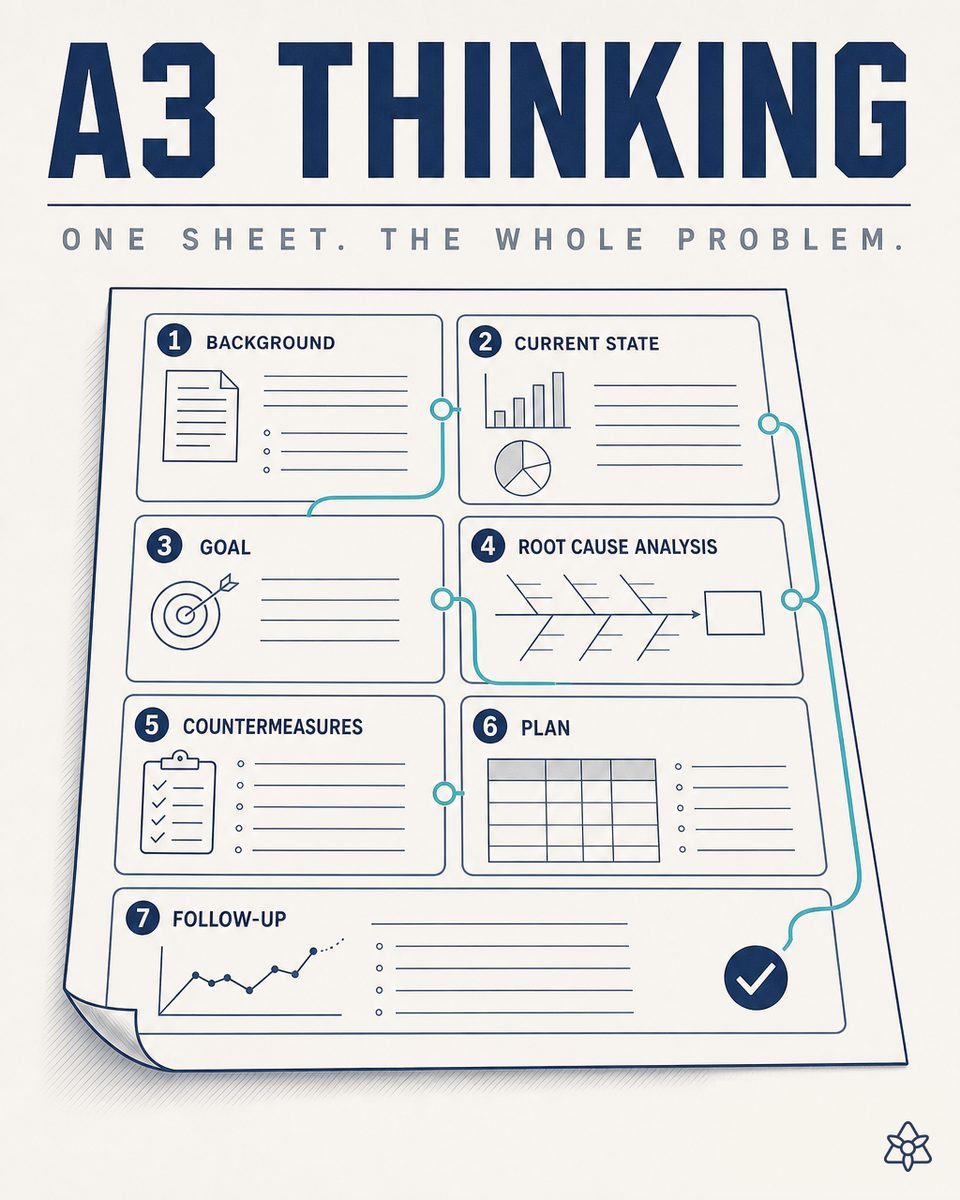
The 7 sections of the A3
The A3 isn't a template, it's a thinking discipline. The A3 size constraint (physically 297×420 mm) forces synthesis: no room for detours, opinions without data, or vague plans.
- Background: problem context. Why does it matter? Who's affected?
- Current condition: how the situation is today, with data. Not opinions.
- Goal: the result you want, measurable.
- Analysis: root causes via 5-Why or Ishikawa.
- Counter-measures: what will be done concretely.
- Plan: who, what, when.
- Follow-up: how success is measured and when reviewed.
iLEAN doesn't replace the method — it brings it into the 21st century.
Every Lean methodology was born to solve an information problem: where stock is, which machine is failing, what changed shift-to-shift. When information is paper, methods are rituals. When it's live data, they become the actual engine of the plant.
Classical method tells you what to measure. The IRIS system guarantees the measurement reaches whoever decides, the moment they decide — without anyone typing it in.
The three capture layers applied: Connect (photo, voice, email, WhatsApp), Edge (computer vision on the line) and Integrations (ERP/MES/SCADA/PLC). On top of that unified information, specialized agents serve the exact context to each person on the floor.
Paper A3 vs. digital A3
| Aspect | Paper A3 | A3 with iLEAN |
|---|---|---|
| Structure | Printed template | Digital template with per-section guides |
| Data in 'Current condition' | Manual capture | Pulled from the AI brain |
| Review / coaching | In-person sponsor meeting | Async comments on each section |
| Closed A3 history | Filing folder | Queryable base by problem/root cause |
| Plan follow-up | Calendar reminder | Live dashboard with associated metrics |
What people ask about A3 Thinking
What is A3 Thinking and why is it called A3?
A3 Thinking is Toyota's methodology for structured problem solving. It's called 'A3' because all the information must fit on a single A3-sized sheet (297×420 mm). The space constraint is deliberate — it forces synthesis and eliminates noise.
What are the sections of an A3 report?
The 7 standard sections: Background (context), Current condition (situation with data), Goal (measurable objective), Analysis (root causes), Counter-measures (actions), Plan (who/what/when), Follow-up (how success is measured).
How does iLEAN digitize an A3 while preserving the format's discipline?
iLEAN has a digital A3 template with the 7 sections. Each section has guides on what to include and length constraints that mimic the physical space. The Current Condition section pulls data from the AI brain. The A3 is shared digitally, reviewed with comments on each section, and automatically followed via metrics.
How does A3 Thinking differ from PDCA?
PDCA is the cycle (4 iterative phases). A3 Thinking is the documentary tool to structure a PDCA cycle — the A3 contains Plan, Do, Check and Act in its sections. One A3 = one documented PDCA cycle.
Who should write an A3 — the problem owner or the expert?
The problem owner (the person affected by the problem, normally at the level closest to the gemba). The technical expert helps in the Analysis section but isn't the writer — A3 discipline trains the owner. An A3 written by an external consultant teaches nothing to the organization.
Tell us about your plant. We'll tell you how we'd do it.
25 years applying Lean in real plants. Free diagnostic conversation.
Request demo See Lean Manufacturing