Cellular manufacturing with AI — cells designed with your plant's real data, not with the consultant's spreadsheet.
The manufacturing cell is one of the best inventions Lean ever produced — and one of the hardest to roll out properly and keep alive when the mix changes. iLEAN Connect reads the real ERP/MES history and the skills matrix; Edge measures workload per station; an agent proposes part-family groupings and rebalances the Yamazumi against today's mix. You decide what moves.
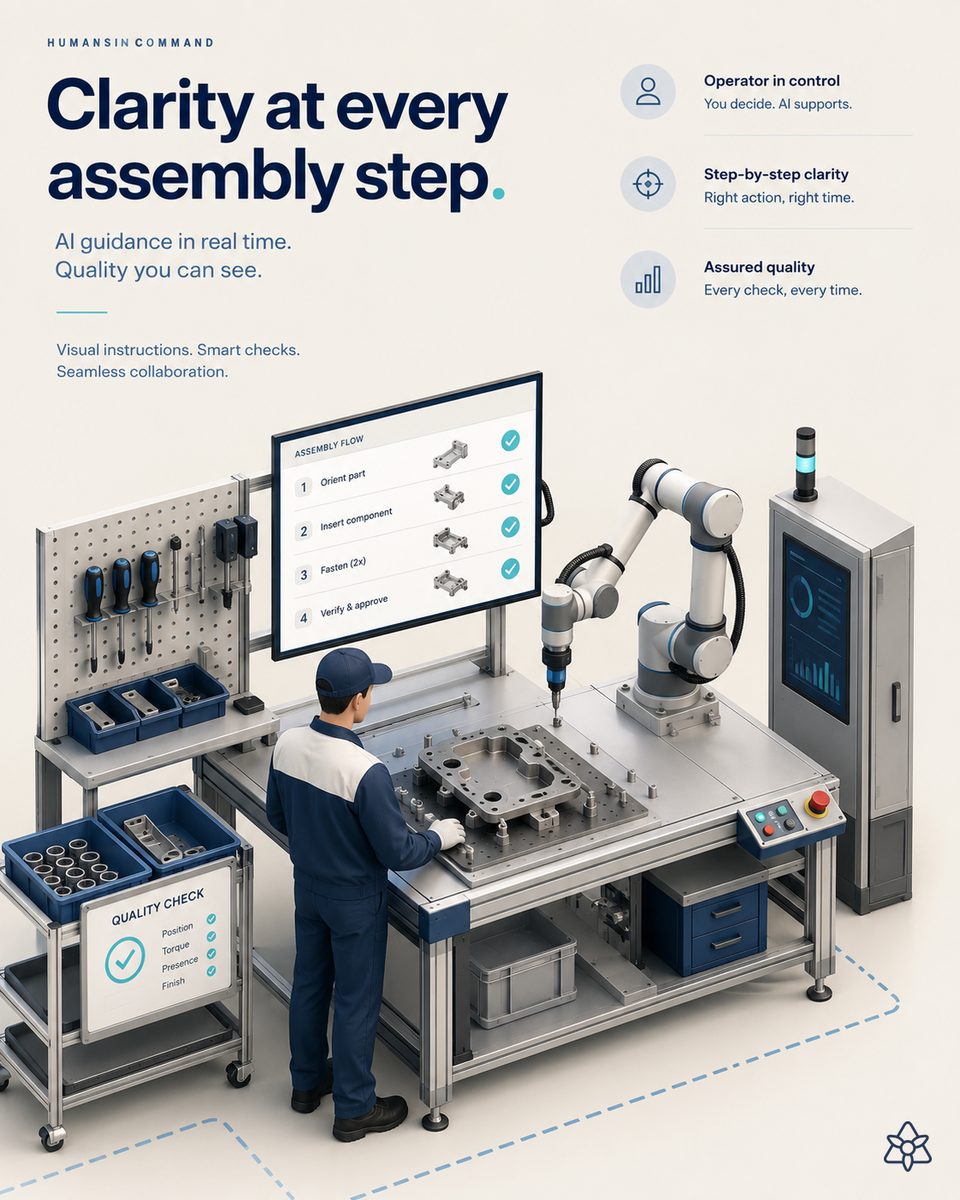
The cell that was well designed two years ago is no longer the cell your plant needs today.
Moving from a functional layout to a cellular layout is the most profitable organizational change in Lean — and the hardest to sustain. Not because the method is weak: because keeping it alive, in the classical version, depends on manual reviews that almost nobody actually runs.
- The initial design takes weeks. Part-family analysis (group technology), volumes per SKU from the ERP, operation times from the MES, physical constraints of the floor plan. A properly done project consumes several months of Lean team time.
- The mix changes and the cell ends up mis-sized. A new SKU comes in from the US customer, an old catalogue item drops out, the ratio between two part families inverts. The cell is still there, but its Yamazumi is out of balance and nobody rebalances it.
- Cross-training erodes silently. The operator who mastered the critical station leaves, a long absence opens a hole in the skills matrix, and nobody sees it until the day the cell cannot start the shift.
- And lead time climbs again — the customer complains, a meeting is held, somebody asks to go back to a functional layout "because the cell does not work". The cell did work: it worked against the old mix.
It is the two-gaps syllogism applied to cell design: the data exists (routings in the ERP, times in the MES, cross-training records in HR, real workload on the floor), but it lives on islands; and even if you joined it all up, there was no agent able to simulate groupings and rebalances continuously. AI has just delivered both missing pieces.
iLEAN does not propose "the perfect cell" — it keeps the one you already have alive.
Here iLEAN acts as the filler that binds the systems you already own (ERP with routings, MES with times, cross-training sheet, CAD floor plan of the shop) into a brain that simulates cells and rebalances continuously. Without throwing away anything you already have.
Connect reads routings, times and skills. Edge measures workload per station live. The agent proposes groupings and rebalances the Yamazumi against today's mix. The person decides the physical change — the agent does not move machines.
The three iLEAN pieces applied to cellular manufacturing:
- Connect — captures the real ERP/MES history (routings, times, volumes per SKU over the last few years), the live skills matrix of the workforce and the mix changes that arrive through external channels (customer email, EDI, a message from the sales rep). The data you need to design the cell properly stops living on five separate islands.
- Edge — in the cells you already run, it measures effective cycle time per station, micro-stops and real workload. It surfaces saturated and under-loaded stations against the current mix. It works offline: it keeps measuring even if the plant loses its WiFi.
- Agent — runs assisted group technology analysis (grouping SKUs by routing similarity and volume) and simulates the Yamazumi of each cell against the current mix. It proposes a physical move (relocate a machine, redistribute tasks) or a cross-training change (train station X on operation Y). You decide; the agent never rearranges the plant on its own.
Classical cellular manufacturing vs. cellular manufacturing with iLEAN
| Aspect | Classical design and upkeep | With iLEAN Connect + Edge + Agent |
|---|---|---|
| Part-family analysis (group technology) | Weeks with a consultant and a spreadsheet | Continuous, on the full ERP/MES history |
| Rebalancing when the mix changes | Reactive, once the customer complains | Proactive, the agent warns before the complaint |
| Skills matrix | Spreadsheet updated once a year | Live, with real data on who ran what |
| Workload per station in the cell | Cell leader's intuition | Measured continuously by Edge |
| On-the-job training plan for a critical station | Manual, once people are already missing | Anticipated, assisted by a voice copilot |
| Evidence for the steering committee | The consultant's slide deck | Real data from your own plant |
Impact estimate for your plant — to be validated with your numbers.
The block below is an estimate to be validated with the specific data of your plant. We put it forward so the committee has an order of magnitude; we refine it during the immersion.
- Machining / assembly plant with a functional layout or partially implemented cells, 3-6 main part families, mix varying quarter to quarter.
- Connect + agent pilot (data-assisted design on ERP/MES) across 2 cells. First value expected within a few weeks: the first grouping / rebalancing proposal the Lean team can actually argue with.
- Internal lead time cut ≥ 30% in redesigned part families. Work-in-process between operations cut ≥ 30%. Hard levers: working capital released plus service level recovered.
- Indicative payback between 4 and 9 months, depending on how much internal lead time weighs in your customer commitment and on the hourly cost of the pilot cells.
Why this works now
An AI model asked to opine in the abstract will fill the gaps; the same model anchored to verifiable data — real routings, measured times, closed training records — stops guessing and starts answering [1]. That is exactly the difference between a cell redesigned every quarter with plant data and a cell that stayed frozen in the consultant's drawing. The plants that win will be the ones whose people are trained to redesign their own cell, not the ones waiting for an outsider to redesign it for them.
[1] OpenAI paper "Why Language Models Hallucinate", 2025 — on the reliability of AI in anchored tasks.
What people ask about cellular manufacturing with AI
What is cellular manufacturing and why is it used in Lean?
Cellular manufacturing organizes the shop floor into cells — groupings of machines and cross-trained operators that build a complete part family from start to finish. It replaces the functional layout (all the milling machines together, all the lathes together, all the paint booths together), where parts travel kilometres between departments. The cell sharply cuts lead time, work-in-process between operations and planning complexity: each cell is a small factory that knows its own family.
Why is it so hard to design a cell properly?
Because a correct design demands part-family analysis (group technology), real volume per SKU, process times per operation, the cross-training actually available in the workforce and the physical constraints of the layout. Doing it well takes weeks with a Lean team and a consultant — and it goes obsolete the moment the product mix shifts or new SKUs come in. That is why many plant “cells” are really sub-departments that never quite end up working as cells.
How does iLEAN help design cells and keep them alive?
iLEAN Connect reads the real history in ERP/MES (routings, times, volumes per SKU over the last few years) and the live skills matrix of the workforce. Edge measures effective cycle time, micro-stops and workload per station in each cell. An agent proposes part-family groupings (assisted group technology), simulates the Yamazumi balance of every cell against the current mix and recalculates when the mix changes. The Lean team gets a living map; you decide the physical change — the agent does not move machines.
What about cross-training? Without multi-skilled operators the cell does not work.
True, and that is why iLEAN keeps each cell's skills matrix alive with real data: who has run each station, which training was completed, where someone is still a beginner and where they are the reference. The agent detects cross-training gaps (“only two people master station 3; if one is out tomorrow the cell does not run”) and proposes an on-the-job training plan with a voice copilot for the new operator — without replacing the human instructor. It assists and simplifies on-station training; it does not automate it.
What does it cost to roll out AI-assisted cells in a mid-sized machining plant?
The order of magnitude of a Connect + agent pilot (data-assisted design) with no physical Edge sits at the low end of iLEAN pilots, because it starts as software against ERP/MES. If the cell includes vision at a critical station (quality or jidoka), Edge terminals come in. A reasonable payback is counted in months: the hard levers are shorter lead time, work-in-process eliminated between operations and service level recovered. Send us your plant data and we send back the estimated ROI in 48 h, with your numbers, not ours.
Keep pulling the thread: Just in time · Toyota TPS · All Lean methods
More cases in lean manufacturing
- Digital Andon: plant signaling with auto-escalationiLEAN digitizes Andon: auto-escalation, every alarm logged, no isolated light columns. When something…
- APM with AI — the critical asset stops being measured at month-end and starts anticipating its own failure.How iLEAN cross-references Edge, MES and CMMS data so APM measures real asset performance and…
- Autonomous maintenance TPM — if it demands paper, it doesn't work. You know it and so do we.iLEAN turns autonomous maintenance into a digital flow: the operator reports by voice or photo and the…
- Your CMMS isn’t lying — it’s incomplete. iLEAN completes it with voice, photo and an agent.How iLEAN turns your CMMS into a living tool: voice and photo capture on the floor, work orders…
- Compressed air — the plant's most expensive energy, and the worst governed.iLEAN detects leaks, drops pressure to the real minimum and orchestrates multi-compressor scheduling…
- Real-time CpK / PpK with AI — the day it drops below 1.33, the auditor should not be the first to know.iLEAN recalculates Cp, Cpk, Pp, Ppk with every measurement in the flow and warns you before capability…
Tell us your case and within 48 h we send you the estimated ROI of this AI project for your plant.
We work on your plant's real data, not on ours. Diagnostic with no strings attached.
Request estimated ROI in 48 h See Lean Manufacturing