Real-time CpK / PpK with AI — the day it drops below 1.33, the auditor should not be the first to know.
Process capability (Cp, Cpk, Pp, Ppk) is what the OEM demands at PPAP and demands again the moment something smells wrong. The problem is not the formula — it is that it is almost always looked at too late. iLEAN recalculates Cp, Cpk, Pp, Ppk with every measurement in the flow, and warns before capability drops below the threshold. The quality manager's signature stays exactly where it belongs.
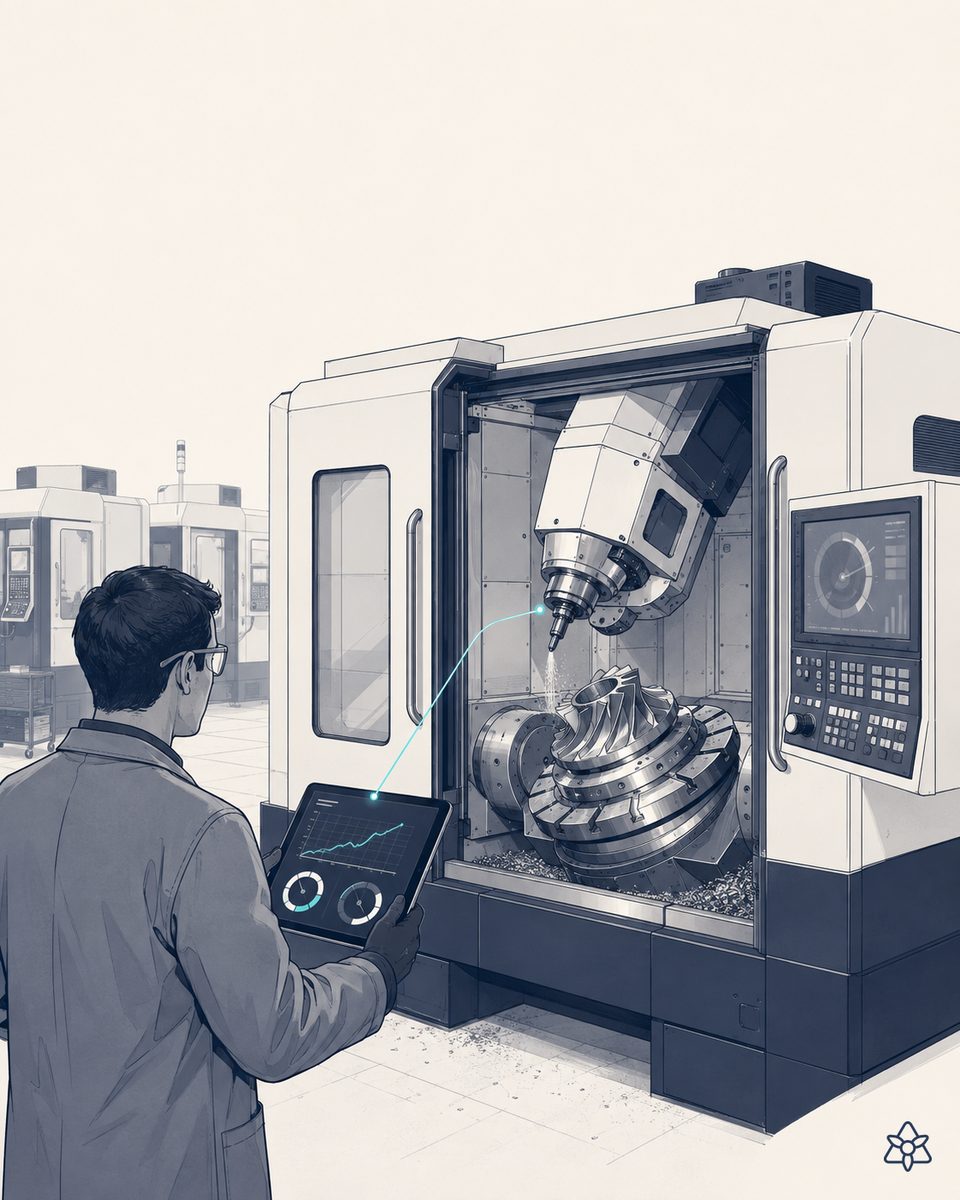
The PPAP Cpk is a snapshot of the day of the run. The serial-production one is a different film.
PPAP requires you to demonstrate process capability with a controlled run: the regular operator, a freshly calibrated gauge, approved raw material, a machine just serviced. A high PpK comes out, the OEM customer accepts, the part goes to serial production. And the real Cpk starts to move — operator rotation, tool drift, electrode wear, a coil from supplier B instead of supplier A, a hot day in July.
Nobody sees it until the next audit, the next customer claim or the next rejected batch. The quality manager knows it — but recalculating CpK at the frequency it would actually take would mean stopping the line or keeping an intern on a spreadsheet full time. The maths do not add up.
The classical system (initial PPAP + periodic Cpk review) works 99% of the time. That 1% is OEM claims and rejections at the customer's plant. Each one with its follow-up PPAP, its escalation and its damage to the commercial relationship — which weighs far more than the technical cost.
iLEAN puts the calculation where the data is — and warns before the threshold.
The Cpk problem is neither the formula (it is trivial) nor the software (statistical packages exist). It is that the data lives on islands: the measuring head on the machine, the operator writing on a sheet, the CMM on another network, the supplier's panel in a spreadsheet that the engineering manager updates on Tuesdays. iLEAN acts as the filler between those systems, without asking you to change your MES or your statistical software.
Connect captures the measurement when it is taken. The Agent recalculates capability on the flow. The person decides to intervene before falling below the threshold.
The iLEAN pieces applied to process capability:
- Connect — captures every measurement at second zero (digital measuring head, CMM, Edge camera, operator tablet) with its context: characteristic, machine, operator, raw-material lot. What used to reach a spreadsheet at the end of the shift now enters the system as it is measured.
- Agents — recalculate Cp, Cpk, Pp, Ppk as a stream over whatever moving window the control plan defines (last 50 parts, last shift, last day). They warn when the index approaches the threshold agreed with the OEM (1.33 / 1.67 depending on the case), describe the drift (a shift in the mean or an increase in dispersion) and propose the most likely special cause from the history of that characteristic.
- Edge — for characteristics measured by AI vision. Every part is a measurement, cadence is 100%, and short-term Cpk is calculated on large samples instead of five parts an hour. Edge needs its own MSA — see the MSA with AI page.
Capability reviewed each quarter vs. capability kept alive with iLEAN
| Aspect | Classical Cpk (PPAP + review) | With iLEAN Connect + Agents |
|---|---|---|
| Calculation frequency | Initial PPAP + periodic review | Recalculated with every measurement in the flow |
| Data capture | Manual note or batch export | Measuring head, CMM or Edge at second zero |
| Drift warning | When the auditor or the customer finds it | Before crossing the threshold agreed with the OEM |
| Cause diagnosis | Next week's meeting | Agent proposal with cross-referenced history |
| Coverage with AI vision | n/a or a separate spreadsheet add-on | Edge measures 100%, the Agent feeds it into Cpk |
| PPAP file | Rebuilt by hand weeks in advance | Continuously ready, with lineage |
Impact estimate for your plant — to be validated against your numbers.
Block flagged as an estimate to be validated with concrete data from your plant.
- Tier-1 / tier-2 machining plant with PPAP on 3-6 critical characteristics, OEM requiring CpK ≥ 1.33 continuously.
- Connect + Agent pilot on one critical characteristic (the one that generated the most claims or rework last year). First value expected within a few weeks.
- Indicative payback between 4 and 9 months, depending on volume and documented claim cost.
- Defensible floor: one OEM claim avoided pays for the pilot. Scrap attributable to undetected drift reduced by ≥30%.
And the CAIO's reasonable doubt
“What if the Agent gets the Cpk evaluation wrong?” — computing Cpk over measured data is an anchored task, not free generation. On anchored tasks the best models brought error below 1.5% [1]. And even so, the decision to stop the line, intervene or report to the OEM is human: iLEAN warns, the person decides. The three safety rings keep AI on the assistance side.
[1] OpenAI paper “Why Language Models Hallucinate”, 2025 — on the reliability of AI in anchored tasks.
What people ask about real-time CpK / PpK
What is the practical difference between Cp/Cpk and Pp/Ppk?
All four measure capability — the difference is which process and which deviation. Cp / Cpk use the within-subgroup standard deviation (short term, potential capability). Pp / Ppk use the total standard deviation (long term, actual performance with every common and special cause included). The OEM customer normally requires PpK ≥ 1.33 at initial PPAP and CpK ≥ 1.33 on a continuous basis. If they read differently it is because there is a special cause between subgroups — and that is exactly what iLEAN catches in time.
Why does a “good” PPAP Cpk degrade in serial production?
Because PPAP is run as a controlled run — the regular operator, a freshly calibrated gauge, raw material from the approved lot, a machine just serviced. Serial production is another story: operator rotation, tool drift, electrode wear, a coil from supplier B instead of supplier A. The real Cpk falls without anyone noticing until the next audit. iLEAN closes that blind window: it recalculates Cpk with every measurement of the day, on the same characteristic, and warns as soon as it approaches 1.33.
What exactly does the Agent do when Cpk approaches the threshold?
It alerts the quality manager through whichever channel they already use (workstation tablet, phone plus earpiece, andon board, email when that suits), describes the drift — a shift in the mean, an increase in dispersion, or both — and proposes the most likely special cause from the history of that characteristic: “the last time the mean dropped like this, it was a coil change to supplier B”. It also prepares the evidence for the next morning meeting. The corrective action remains the quality team's decision.
Does it work when measurement comes from vision (Edge) instead of a gauge?
Yes, just as well. Every part inspected by iLEAN Edge is a measurable data point (dimension, position, colour when calibrated against a standard) and it enters the Cpk calculation exactly as a gauge reading would. The difference is cadence: with Edge you have 100% of the parts measured, not one every hour. And the short-term Cpk subgroup builds itself. The camera's MSA still has to be looked after — but that is the conversation on the MSA page.
What does it cost to start and what do you gain?
A typical pilot covers digital capture of one or two critical characteristics (measuring head, CMM or Edge camera) plus the Agent that recalculates Cp, Cpk, Pp, Ppk on the stream and the capability dashboard. Investment and annual licence in the range of any Connect + Agents pilot. There are two hard levers: one OEM claim avoided (an out-of-capability characteristic found at the customer) and reduced scrap in serial production. Send us your PPAP data and we will come back with the estimated ROI in 48h.
Related topics: X̄-R control charts with AI · MSA with AI · Real-time SPC with AI
More cases in lean manufacturing
- Cellular manufacturing with AI — cells designed with your plant's real data, not with the consultant's spreadsheet.How iLEAN designs, balances and keeps manufacturing cells alive with real plant data: part families,…
- Your CMMS isn’t lying — it’s incomplete. iLEAN completes it with voice, photo and an agent.How iLEAN turns your CMMS into a living tool: voice and photo capture on the floor, work orders…
- Compressed air — the plant's most expensive energy, and the worst governed.iLEAN detects leaks, drops pressure to the real minimum and orchestrates multi-compressor scheduling…
- Cross-training and polyvalence with AI — the rotation plan that actually gets executed.How iLEAN crosses the polyvalence plan with absences, shifts and real line load so the supervisor never…
- Plant digital twin with AI — the twin does not start with the 3D model, it starts with the information existing.The useful digital twin does not start with 3D: iLEAN builds the informational twin of your plant with…
- DMAIC: the structured Six Sigma improvement cycleiLEAN runs DMAIC with live data: every phase with its real metrics, no Six Sigma projects dying in…
Tell us your case and within 48h we'll send you the estimated ROI of live CpK / PpK in your plant.
We work on your plant's real data, not on ours. Diagnostic with no strings attached.
Request estimated ROI in 48h See Lean Manufacturing