Plant digital twin with AI — the twin does not start with the 3D model, it starts with the information existing.
A digital twin without live data is an expensive mockup. iLEAN builds the informational twin first: every machine, batch and process with its real state in the central memory, captured by Connect, Edge and integrations from second zero — queryable in natural language and simulatable before deciding (“what happens if I move this batch up?”). The 3D layer is optional and comes later. The value is in the live data, and the person signs.
The digital twin was sold as a 3D model. That is why so many projects never got past the mockup.
The phrase “digital twin” reached the committees with one image: the plant spinning in three dimensions on a screen. It is an image that gets approved easily and holds up poorly. The reason is simple — the 3D model replicates the geometry, and plant decisions are not made on geometry, they are made on state. Four consequences that keep repeating:
- Disproportionate cost of entry — CAD modeling, kinematics, licenses and weeks of consulting before the system answers its first useful question.
- The twin is born disconnected — the model gets built and then it turns out half the machines report nothing, so the 3D gets fed by hand or not at all.
- It degrades on its own — a line changes, a machine moves, a new part number comes in, and the model stops resembling the plant. Six months later no one opens it.
- Decisions are still made by phone — the production manager asks three people what is going on and decides from what they tell him, while the pretty twin shows a plant that no longer exists.
And underneath all of that sits the real problem, which no 3D layer solves: the plant's information does not exist digitally at the moment it happens. It is in the operator's head, on the paper report, in the night shift's email, on a panel that talks to no one. Without that second zero there is no twin — there is a drawing.
iLEAN builds the informational twin: the plant's state, live and askable.
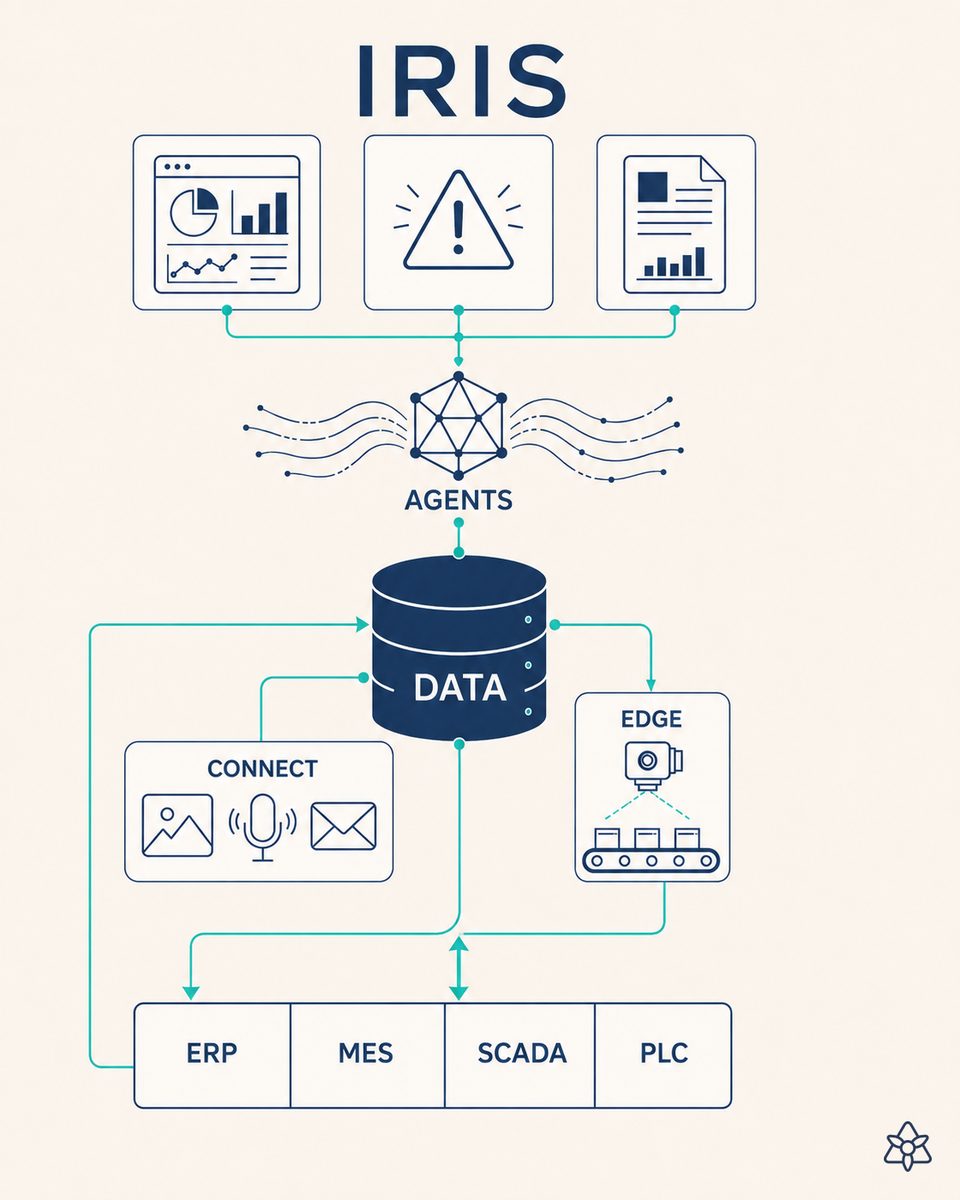
The order iLEAN proposes is the reverse of the usual one. First you make sure that everything that happens on the floor is recorded the instant it happens; on that central memory you build querying and simulation; and only once that is already delivering value, if it makes sense, you put a 3D visual layer on top. Connect is the putty that fills the cracks between the ERP, the MES, the machine's old panel and what only the person standing in front of it knows.
A digital twin is not a drawn plant. It is a plant that can answer what is happening now and what would happen if you changed something. The first part is information; the second, judgment.
The iLEAN pieces applied to the plant twin:
- Connect — captures the state of machines, signals, existing systems and panels that never exported anything, and unifies it in one common model. It is how an old machine enters the twin without being replaced.
- Edge — contributes what no system sees: presence, physical state, counting, in-line quality, the incident captured at the station. It works without a network and syncs afterwards, so the twin has no holes where coverage does not reach.
- Integrations — orders, materials, planning and quality that already live in your systems enter the same model, without duplicating the data master or asking you to switch ERPs.
- Agents — the brain. They keep the state coherent, answer in natural language about what is happening, detect discrepancies between system and plant, and project scenarios: what happens if I move a batch up, if that machine stops, if a rush order comes in.
- Three safety rings — the twin proposes sequences and warns of impacts; rescheduling, stopping or reordering is decided and signed by the responsible person.
Classic 3D digital twin vs. the iLEAN informational twin
| Aspect | Classic 3D digital twin | iLEAN informational twin |
|---|---|---|
| Starting point | CAD modeling and plant kinematics | The data existing at second zero |
| What it replicates | Geometry and motion | The live state of machines, batches and orders |
| First useful value | Once the model is complete and fed | As soon as one line reports its state |
| Old machines | Left out, or modeled without real data | Enter through Connect and Edge, without replacing them |
| How it is queried | Navigating the 3D scene | Natural-language question, answer with the data point |
| Simulation | Physics and layout, in a separate project | Daily decision scenarios on the real state |
| Model maintenance | Manual; degrades with every line change | Continuous through capture; discrepancies get raised |
| 3D layer | The entire project | Optional, on top and after the live data |
Impact estimate for your plant — to be validated with your numbers.
The block below is an estimate to be validated with the specific data of your plant. We set it out so the committee has an order of magnitude; we refine it during the diagnostic.
- Plant with a reasonable ERP and planning, but no real machine state in the moment: sequencing decisions are made by phone, with information that is hours old.
- Start with one area or one line (Connect + Edge + integration with what you already have). First value expected within a few weeks, with no CAD project in between.
- Indicative payback between 6 and 12 months, from two main levers: better batch-sequencing decisions and fewer stoppages caused by information that arrived late.
- Reduction in the time supervisors and planners spend reconstructing the plant's state in the order of ≥30% (conservative estimate), plus fewer emergency reschedules from avoidable surprises.
- The 3D layer, if you decide to build it, comes as a later phase on top of a twin that already works — not as a requirement to get started.
And the operations director's reasonable doubt
“What if the AI tells me something about my plant that is not true?” — hallucination is a problem of free generation, not of anchored tasks. Answering “this batch is running two hours late” by consulting the recorded state is an anchored task: there is a data point, there is a source, and there is traceability of where it came from. On this kind of task the best models are below 1.5% error [1]. On top of that, the twin answers citing the data's source and flags whatever does not match as a discrepancy, instead of inventing a plausible answer. And any action on the plant passes through the three safety rings: the system proposes, the person decides and signs.
[1] OpenAI paper “Why Language Models Hallucinate”, 2025 — on the reliability of AI in anchored tasks.
You may also be interested in: Heijunka and leveled orders with AI · Multi-product MRP and MES with AI · OEE in a 24/7 three-shift plant
What people ask about the plant digital twin with AI
How is this different from a classic 3D digital twin?
The classic 3D twin replicates the plant's geometry: CAD model, kinematics, animated flows. It is expensive to build, expensive to maintain, and its value depends on someone feeding it real data. iLEAN's informational twin replicates the state: every machine, batch, order, stoppage and deviation with its live value in the central memory, updated by Connect, Edge and integrations. It does not draw the plant; it knows what is happening in it and answers questions about it. The 3D layer is an optional visualization added later, once the state already exists — because a 3D model without live data is a mockup, and live data without 3D is already enough to decide.
What does it take to launch an informational plant twin?
Three things, none of them a CAD project. (1) The data must exist at second zero: the machine signal through Connect, the quality or presence data through Edge, and what already lives in the ERP/MES through integration. (2) A minimal plant model: which machines exist, which process each one runs, which batch goes where — usually one or two weeks of work with production, not months. (3) A specific decision case to start with (batch sequencing, impact of a stoppage, part-number changeover). You start with one line or one area, and the twin grows by accumulation.
What exactly can be simulated?
Decision scenarios on the real state, not detailed physics. Questions like “what happens if I move this batch up?”, “which orders slip if this machine stops for three hours?”, “how much does the format change shrink if I group these two part numbers?”, “do I have the material and a qualified person to fit this rush order in today?”. The agent projects the current state forward under the known constraints (capacity, sequence, availability, historical quality) and returns the estimated impact on date, cost and risk. It does not replace a discrete-event simulator for layout design; it covers the daily decision, which is where the money is lost.
How does it stay synchronized with the real plant?
Through continuous capture, not manual updates. Connect reads machine signals and the existing systems permanently; Edge contributes what no system sees (presence, physical state, in-line quality) and keeps working without a network, syncing afterwards; integrations bring in orders, materials and planning. On top of that, the agents reconcile: when what the system says and what the plant says do not match, the twin flags it as a discrepancy and raises it to the responsible person instead of choosing silently. The sync maintains itself; what is not automated is the judgment on the discrepancies.
Does it work for a plant with old machines and no connectivity?
That is exactly the case it was designed for. A twenty-year-old machine with no data output enters the twin through other routes: a dry contact or electrical signal read by Connect, an Edge camera or sensor for state and counting, and operator capture on a terminal or by voice for what only a person knows. The twin does not require the plant to be new; it requires every element to have some way of reporting its state. In most mixed plants, the informational twin is stood up without touching the machine fleet — which is what makes the project affordable.
More cases in lean manufacturing
- Compressed air — the plant's most expensive energy, and the worst governed.iLEAN detects leaks, drops pressure to the real minimum and orchestrates multi-compressor scheduling…
- Real-time CpK / PpK with AI — the day it drops below 1.33, the auditor should not be the first to know.iLEAN recalculates Cp, Cpk, Pp, Ppk with every measurement in the flow and warns you before capability…
- Cross-training and polyvalence with AI — the rotation plan that actually gets executed.How iLEAN crosses the polyvalence plan with absences, shifts and real line load so the supervisor never…
- DMAIC: the structured Six Sigma improvement cycleiLEAN runs DMAIC with live data: every phase with its real metrics, no Six Sigma projects dying in…
- Dynamic takt time with AI — your line's rhythm, not last quarter's.How iLEAN recalculates takt time continuously from real demand, live OEE and shift availability —…
- Industrial ESG and CSRD reporting with AI — the report compiles itself, with the evidence behind every figure.iLEAN captures energy, water and waste data continuously, keeps ESG KPIs live per line and batch, and…
Tell us about your case and within 48h we'll send you the estimated ROI of the informational twin for your plant.
We work on your plant's real data, not on ours. Diagnostic with no commitment.
Request estimated ROI in 48h See Lean Manufacturing