Dynamic takt time with AI — your line's rhythm, not last quarter's.
Takt time is the heartbeat of Lean — and most plants have it frozen in a calculation the planning committee made months ago. iLEAN cross-references real demand (ERP + customer email + EDI), live OEE (Edge) and shift availability (Connect), and recalculates takt per line and per family, continuously. The supervisor decides whether to adjust the rhythm or launch overtime — the agent proposes, the person signs.
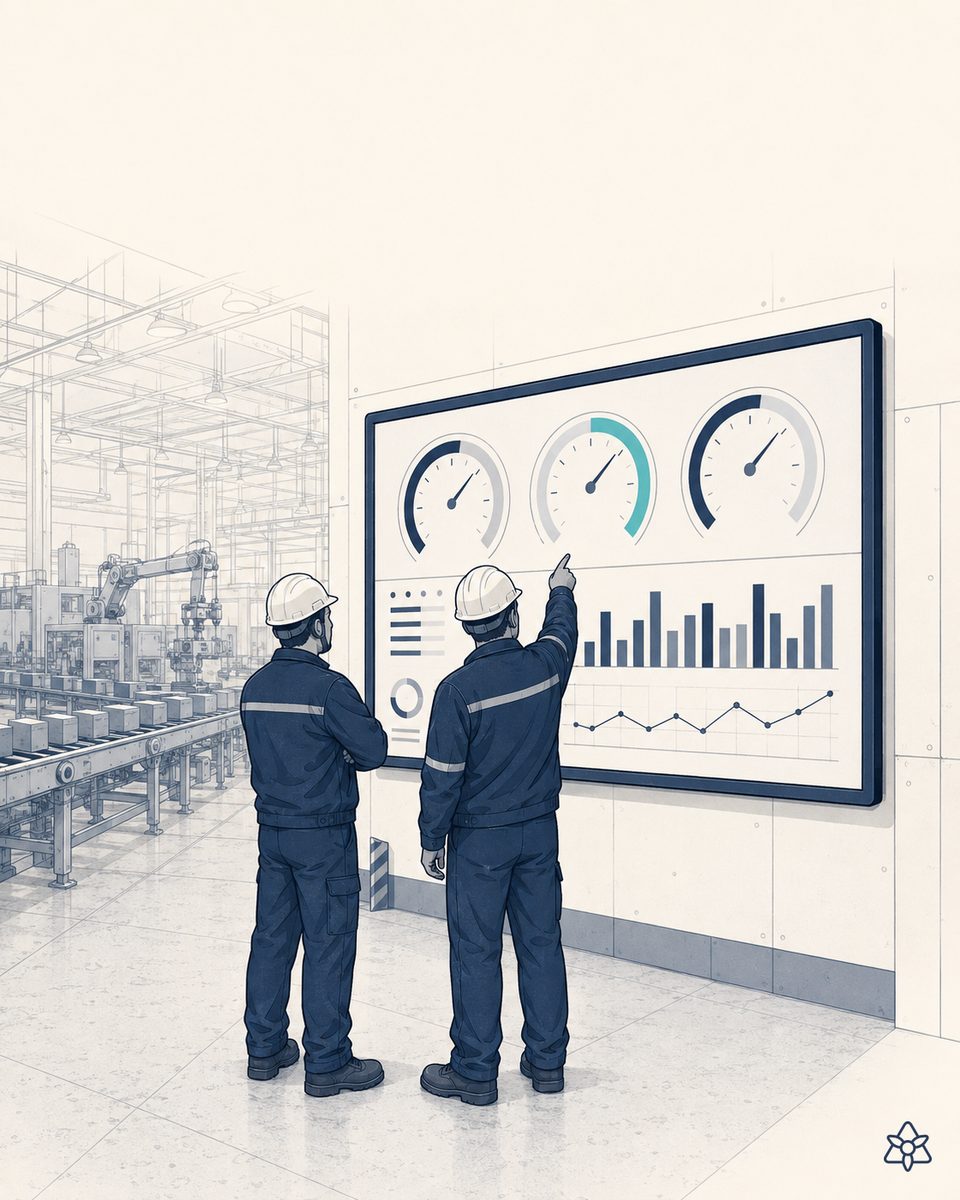
The takt on the whiteboard is not the takt your plant needs this week.
Takt time has a compound problem in most plants:
- Planning calculates it at the start of the quarter with average demand and theoretical availability, writes it on an office whiteboard, and the line obeys it as if it were a law of nature. The plant keeps running at the old rhythm even after reality has changed.
- The mix changes week to week — a US customer drops a large order by email, a European retailer revises its forecast by EDI, sales flags a spike over a messaging app that never reached the ERP. Operations finds out at Monday's meeting — three days late.
- Real OEE is not theoretical OEE. The planner assumed 95% availability; the line is running at 81% because of an intermittent fault at the bottleneck. Nobody readjusts takt to reflect it.
- And the line unbalances itself against that ghost: either you overproduce (dead stock, the worst of the seven wastes) or you miss the date (service failure, overtime, urgent freight premium).
It is the syllogism of the two missing pieces: the three data points needed to recalculate takt already exist (demand, OEE, availability), but they live in islands (ERP + MES + SCADA + email + messaging apps), and even if you joined them, there was no agent to operate them continuously and propose the new takt. AI has just delivered both pieces at once.
iLEAN doesn't impose the takt — it recalculates the data the supervisor needs to decide.
The takt problem is not a calculation problem (any industrial engineer knows the formula); it is a problem of data freshness. Customer demand changes through channels the ERP doesn't listen to. Real OEE is known only to the SCADA. Shift availability is known only to the team leader. iLEAN acts as the filler that binds those islands together at second zero.
Connect captures demand whatever channel it arrives through. Edge measures the real rhythm. The agent recalculates takt per line and proposes an adjustment or overtime. The supervisor decides and signs — the line never reorders itself.
The three iLEAN pieces applied to dynamic takt time:
- Connect — listens for demand across every channel: ERP orders, EDI forecasts, the importer's email, the sales rep's message, the transcribed customer call. Information that almost never arrives through a sensor: it arrives in an email or a phone call, and it almost never reaches the decision-maker in time. Connect puts it into the system in seconds.
- Edge — measures the line's real rhythm (effective cycle times, micro-stops, major stoppages). The OEE that comes out of Edge is not the spreadsheet's OEE, it is the plant's. It works without a network: if the SCADA goes down, Edge keeps measuring.
- Agent — recalculates takt per line, per family, per shift. Cross-references the Yamazumi to detect stations that become saturated at the new rhythm. Proposes an adjustment, overtime or task redistribution. The supervisor decides; the agent never changes the line's rhythm on its own.
Static takt time vs. dynamic takt time with iLEAN
| Aspect | Classical takt time | With iLEAN Connect + Edge + Agent |
|---|---|---|
| Recalculation frequency | Quarterly, in planning | Continuous, on every relevant change |
| Demand | ERP orders, cut-off date | ERP + EDI + email + messaging apps + transcribed calls |
| Availability used | Theoretical 95% from the catalogue | Real OEE measured by Edge on the line |
| Reaction to an unexpected large order | Monday's meeting — 3 days late | Overtime or adjustment proposal as soon as the email lands |
| Overproduction risk | High on SKUs with declining demand | Low: takt loosens on slow SKUs |
| Link to Yamazumi | Manual — revisited every 6 months | Automatic: a new takt triggers a workload recalculation |
Impact estimate for your plant — to be validated with your numbers.
The block below is an estimate to be validated with your plant's actual data. We put it forward so the committee has an order of magnitude; we refine it during the diagnostic.
- Mid-sized plant with 2-4 assembly lines, a 10-15 SKU mix, demand varying >15% month to month.
- Connect + agent pilot on one line (multichannel demand capture + Edge OEE at the bottleneck + takt recalculation). First expected value within a few weeks: the first takt recalculated from real data and proposed to the supervisor.
- Overproduction reduction ≥ 30% on SKUs with declining demand; urgent overtime reduction ≥ 30% on SKUs with unexpected peaks. Hard levers: dead stock avoided + logistics premium saved.
- Indicative payback between 4 and 8 months, depending on what share of revenue flows through channels not integrated with the ERP.
And the CAIO angle
Agents that adjust operating parameters are the flashiest piece — and the scariest. The good news: hallucination is a problem of free generation, not of anchored tasks. On tasks where the AI is limited to recontextualizing data point by data point (crossing demand with OEE to derive takt), the best models brought error below 1.5% [1]. And even so, nothing critical executes on its own: iLEAN proposes the takt; the supervisor signs. The three safety rings exist precisely for this.
[1] OpenAI paper «Why Language Models Hallucinate», 2025 — on the reliability of AI in anchored tasks.
What people ask about dynamic takt time with AI
What is takt time and why does it matter in Lean?
Takt time is the rhythm at which a part must come off the line to match customer demand exactly. It is calculated as available working time divided by the number of units demanded. It is the heartbeat of Lean: if the line runs faster than takt, you build stock nobody buys (overproduction, the worst waste); if it runs slower, you miss the customer. It is the metric that ties operations to demand — and the one almost nobody keeps alive.
Why does last quarter's takt time stop working?
Because demand changes, the mix changes and real available time changes. A takt calculated at the start of the quarter with average demand and a theoretical 95% availability does not survive two real weeks: a large order lands, a breakdown stops a machine, a US customer revises the forecast by email. The plant keeps running at the old rhythm and, depending on the case, piles up stock or loses service level. Takt on paper turns into friction against reality.
How does iLEAN recalculate takt time continuously?
iLEAN Connect captures demand from second zero: orders in the ERP, customer forecasts arriving by email or EDI, changes announced by the sales rep over messaging apps. It cross-references the real OEE of each line (Edge measures effective cycles, stoppages, micro-stops), the open SKU mix and real availability (shifts, absences, planned maintenance). The agent recalculates takt per line, per family, per shift — and shows it to the supervisor on the andon screen. The person decides whether to adjust the rhythm or launch overtime.
Doesn't this create chaos in a plant used to a stable takt?
The opposite. Dynamic takt does not move every minute: it moves when there is a real, significant change — a sizeable extra order, a sustained OEE deviation, a mix shift. What it stabilizes is the rhythm relative to real demand, not relative to a whiteboard number from last month. A plant used to a fixed takt works against a fiction; a plant with dynamic takt works against reality — and the supervisor decides whether to apply it or not.
What happens to line balancing (Yamazumi) when takt changes?
That is the key question. Changing takt without rethinking the balance is like changing a train's speed without redistributing the weight across the cars. iLEAN cross-references the new takt with a live Yamazumi and tells you which stations become saturated and which are underused at the new rhythm. It proposes task redistribution or rotation of cross-trained operators (skills matrix). You decide whether to apply it — and the line ends up balanced to the real rhythm, not to the rhythm in the slide deck.
Keep pulling the thread: Heijunka with AI-leveled orders · OEE · All Lean methods
More cases in lean manufacturing
- Cross-training and polyvalence with AI — the rotation plan that actually gets executed.How iLEAN crosses the polyvalence plan with absences, shifts and real line load so the supervisor never…
- Plant digital twin with AI — the twin does not start with the 3D model, it starts with the information existing.The useful digital twin does not start with 3D: iLEAN builds the informational twin of your plant with…
- DMAIC: the structured Six Sigma improvement cycleiLEAN runs DMAIC with live data: every phase with its real metrics, no Six Sigma projects dying in…
- Industrial ESG and CSRD reporting with AI — the report compiles itself, with the evidence behind every figure.iLEAN captures energy, water and waste data continuously, keeps ESG KPIs live per line and batch, and…
- Extended Value Stream Mapping — your VSM is not badly drawn: it is out of date.The VSM stops being a snapshot: iLEAN measures real times, inventories and waits from supplier to…
- Digital gemba and genchi genbutsu — go to the real place without leaving the place in the dark.Gemba at a distance without losing what matters: go to the real place, see the real thing. iLEAN lifts…
Tell us about your case and within 48h we'll send you the estimated ROI of this AI project for your plant.
We work on your plant's real data, not ours. Diagnostic with no strings attached.
Request estimated ROI in 48h See Lean Manufacturing