Digital gemba and genchi genbutsu — go to the real place without leaving the place in the dark.
The principle of going to the place and seeing the real thing is not replaced by a dashboard: it is scaled. iLEAN lifts the reality of every plant up to the office through bottom-up capture — Edge sees, Connect hears, the agents cross-check — with nothing dressed up on the way. The general manager decides on exactly the same facts as the shift leader.
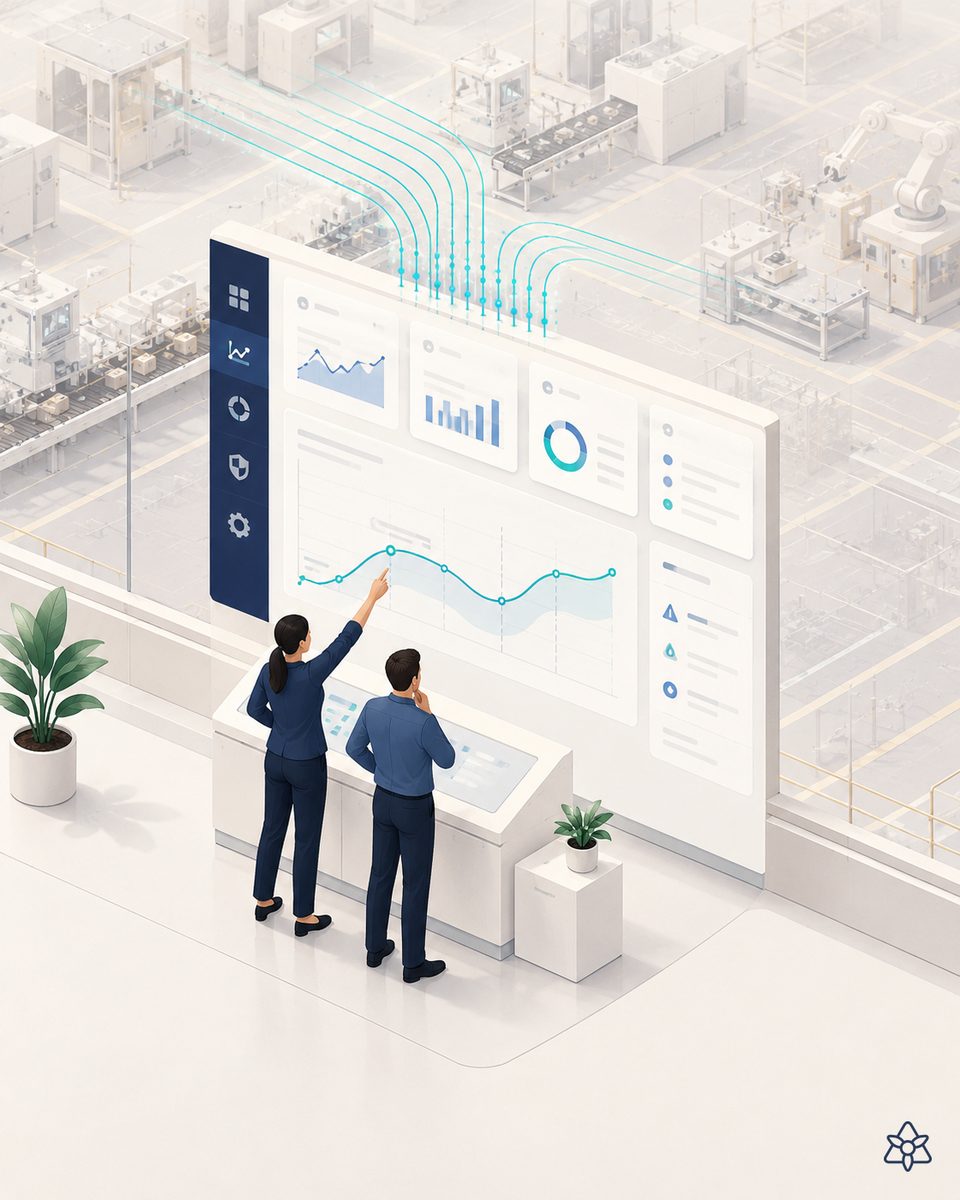
What reaches the office no longer looks like what happens on the floor.
The operations director goes down to the gemba on the first Monday of every month. He walks, he listens, he sees, he goes back to the office. The rest of the month he manages from the reports the plant managers send up — reports that pass through two or three layers of middle management and get cooked, with no bad faith, so they line up with the plan, with the committee's expectations, with the tone of the last board meeting. By the time it reaches the office, the data is no longer the plant. It is the data the plant believes the director wants to hear.
And when there are several plants in several countries, a weekly physical gemba is impossible. The director ends up managing from aggregated KPIs that hide what matters. The veteran operator still spots deviations before they break something — but his intuition never reaches the committee. Reality and decision are disconnected, and that is precisely what genchi genbutsu exists to prevent.
iLEAN scales the gemba — it does not replace it.
A digital gemba done properly is not just a prettier report. It is the materialisation of the first requirement of IRIS: bottom-up reality capture. The R in IRIS means exactly that — Industrial Reality. The system feeds on what actually happens on the floor in real time, not on figures somebody types in, and it lets the executive enter the real place from the office with the same cold eye they would bring in person. The iLEAN filler seals the gap between plant and office that no ERP ever managed to close.
Edge sees the plant as we would see it. Connect lets the operator speak directly to management. The agents cross-check and raise a flag when the ERP says one thing and the plant says another. The director goes down to the real gemba when it is needed — the digital one tells him when.
The three iLEAN pieces applied to digital genchi genbutsu:
- Edge — terminals with vision over critical lines. The camera sees what really happens, not what somebody wants to report. The director can enter the digital gemba and watch the real cycle right now, with the line's own eyes. It works offline: even if the WiFi drops, Edge keeps recording so it can push up to the office once the network returns.
- Connect — the ear and the voice of the plant. Each person carries a phone plus an earpiece (or a tablet where phones are banned), online, full duplex. The veteran operator can say "the dispenser's viscosity is drifting, I'm sending you a video" and that goes up to the system exactly as said. Connect also captures what comes in by customer email or supplier messaging. Nobody filters it.
- Agent — cross-checks what Edge says, what Connect says and what the ERP/MES says. When there is a discrepancy ("the ERP says the batch passed OK, the camera recorded three reworks, the operator said by voice that the part came out borderline") it raises its hand. The director no longer depends on the data surviving the chain of command intact — the agent looks after it.
Classical gemba + report vs. physical gemba + iLEAN digital gemba
| Aspect | Monthly physical gemba + report | Physical + digital with iLEAN |
|---|---|---|
| Frequency of access to the real place | 1-2 times a month per plant | Daily, from the office — physical when it is needed |
| Filters between plant and management | 2-3 layers of middle management | Zero — the data rises uncooked |
| Capture of the veteran's knowledge | Only inside their head | Voice and video captured as it is exercised |
| Detection of ERP vs. reality discrepancy | Later audit, if it ever comes | The agent raises it in the moment |
| Multi-plant scale | Limited by travel | As many plants as management needs |
| Risk of the report that lies | Structural, with no remedy | Broken by bottom-up capture |
Impact estimate for your plant — to be validated with your numbers.
This block is an estimate to be validated against the specific configuration of your group. Order of magnitude, not a commitment.
- Industrial group with 3-6 plants, general management currently doing a physical gemba 1-2 times a month per plant and managing the rest of the time from aggregated KPIs.
- Digital gemba pilot in 1 plant + 1 critical line: Edge over the line, Connect with the shift team, cross-check agent and a management view. First digital gemba running within a few weeks.
- Indicative payback between 4 and 9 months. The hard lever sits in the decisions taken late today because the data arrives cooked — quality deviations, unreported reworks, delays the ERP never picks up.
- Expected reduction of ≥ 30% in the time between something happening on the floor and management knowing about it, depending on your current reporting cycle and the length of the chain of command.
Why this works now
The legitimate question any serious executive asks — "what if the agent just tells me what I programmed it to tell me?" — is answered in the design: the agent does not generate freely, it recontextualises data anchored to captured reality. A model asked to opine in the abstract will fill the gaps; the same model anchored to verifiable evidence — a camera frame, a recorded voice message, an ERP record — stops guessing and starts answering [1]. The digital gemba is not a report touched up by AI; it is raw reality, ordered by an agent that pushes it up exactly as it is.
[1] OpenAI paper "Why Language Models Hallucinate", 2025 — on the reliability of AI in anchored tasks.
What people ask about digital gemba and genchi genbutsu
What do gemba, genchi and genbutsu mean on the plant floor?
Gemba is “the real place” (the plant, the line, the warehouse). Genchi genbutsu is “go to the real place and see the real thing”, a core principle of the Toyota Production System: do not decide from the office with a filtered report, go down to the workstation and observe with your own eyes. iLEAN does not replace that principle — it scales it. Groups running 5 factories in 3 countries cannot do a physical gemba every day in each of them; but they can have continuous reality capture rising from every gemba to the office.
Doesn't a digital gemba contradict the idea of going down to the workstation?
No, not when it is done properly. The usual trap is the report that lies: top-down dashboards with cooked figures that say what the office wants to hear. iLEAN is designed the other way round: reality rises bottom-up (the R in IRIS — Industrial Reality Intelligence Systems), with visual capture from Edge, human capture from Connect (voice, photo, document) and the cross-check against legacy systems. The digital gemba complements the physical one, it does not replace it.
How does iLEAN make sure the data rises unfiltered?
Through three mechanisms. One: Edge captures the image of the line exactly as we would see it, with nobody dressing it up. Two: Connect lets the operator speak (full duplex, voice) and take photos — their voice reaches the system as it was said, not summarised by a middle manager. Three: the agents cross those three sources and raise a flag when there is a discrepancy between what comes up from the floor and what the ERP/MES says. Plant truth stops depending on who writes the report.
Is this useful for general managers running several plants?
Especially for them. When you have 3, 5 or 12 plants, a weekly physical gemba is impossible, and directors end up managing from aggregated KPIs that hide operational reality. With iLEAN, every plant sends its reality continuously: facts, not summaries. Management can enter any digital gemba in minutes, see what is happening right now, talk by voice with whoever is on the line, and travel down physically only when the digital gemba suggests it is worth it.
What happens to the veteran's knowledge that never gets captured?
That is the largest and worst-protected island: the veteran's eye that sees something is about to break before it breaks, and that lives only inside their head. iLEAN captures that knowledge while it is being exercised — the veteran explains by voice to Connect what they are seeing during their own gemba, and the agent cross-checks that observation against Edge data to validate it. The day the veteran retires, half the plant no longer walks out with them.
Keep pulling the thread: Hoshin Kanri · Multichannel incident capture · All Lean methods
More cases in lean manufacturing
- Dynamic takt time with AI — your line's rhythm, not last quarter's.How iLEAN recalculates takt time continuously from real demand, live OEE and shift availability —…
- Industrial ESG and CSRD reporting with AI — the report compiles itself, with the evidence behind every figure.iLEAN captures energy, water and waste data continuously, keeps ESG KPIs live per line and batch, and…
- Extended Value Stream Mapping — your VSM is not badly drawn: it is out of date.The VSM stops being a snapshot: iLEAN measures real times, inventories and waits from supplier to…
- Multi-product golden batch: every SKU has its perfect batch — and today it lives in the veteran operator's head.iLEAN identifies the real golden batch for each SKU and compares the running batch against it in real…
- Heijunka: production leveling with AI forecastingiLEAN levels your production with AI forecasting, optimal sequencing and balanced product mix. Heijunka…
- Hoshin Kanri: digital Lean strategy deploymentiLEAN digitizes Hoshin Kanri: live X-matrix, cascading catchball, drift alerts. Strategy reaches the…
Tell us your case and within 48 h we send you the estimated ROI of the digital gemba for your group.
We work on your plants' real data, not on ours. Diagnostic with no strings attached.
Request estimated ROI in 48 h See Lean Manufacturing