Heijunka: production leveling with AI forecasting
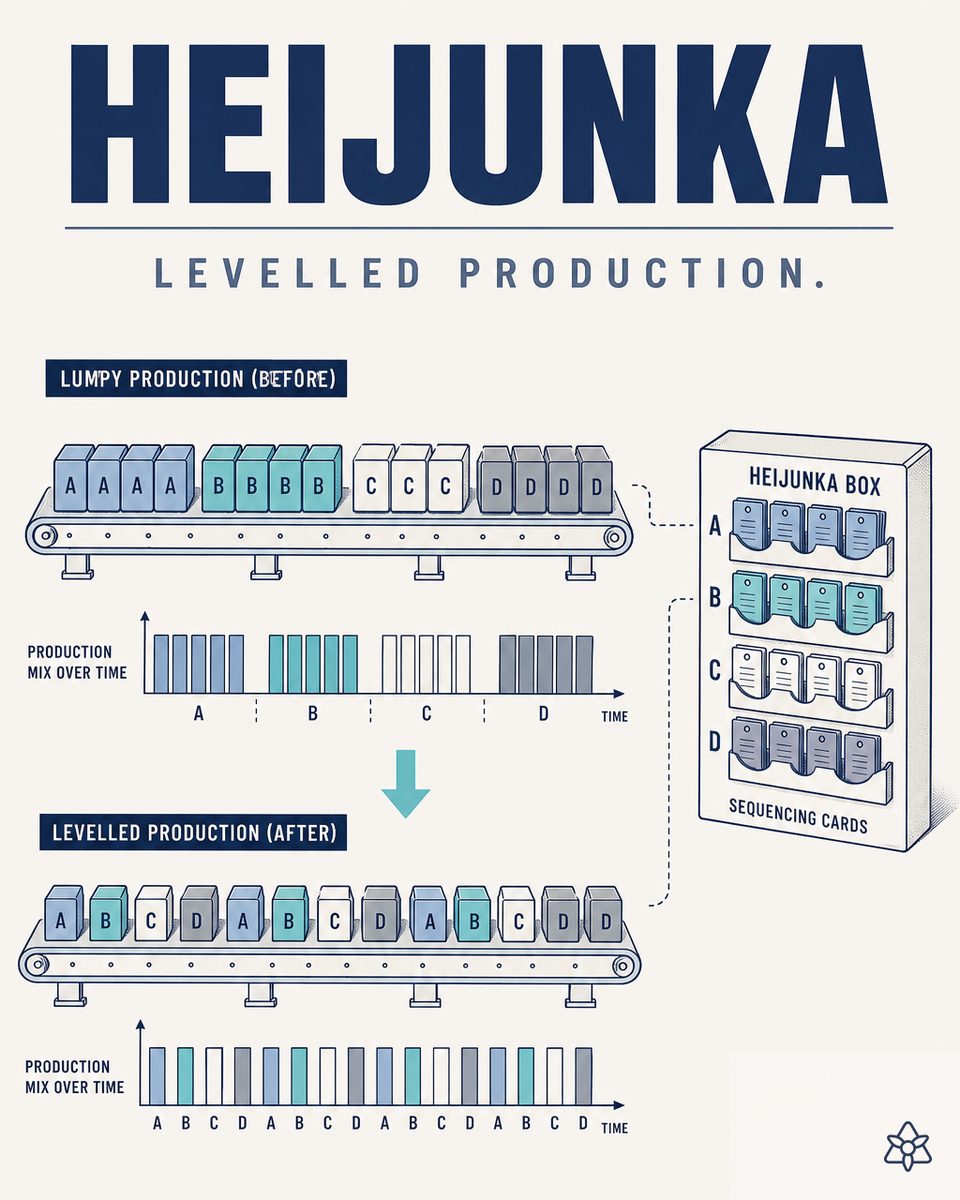
Heijunka is the Lean methodology that levels production by distributing volume and product mix evenly over time, instead of running large batches that cause peaks and valleys (mura) in the system.
Tracking it on paper? Snap a photo and see it digitized
Whatever the sheet —a log, an audit, a shift report— the AI agent learns its boxes from the first photo, reads it and stores it in your plant memory, where you can ask it questions from your phone.
Why leveling pays better than racing
The natural instinct in production is to process large batches of the same product to minimize tool changes. What Toyota discovered is that this strategy shifts waste to the customer and to inventory: to serve variety without infinite stock you need the flexibility to change fast.
Heijunka has two complementary dimensions:
- Volume heijunka: distribute total production constantly over time (not 1000 units Monday and 0 Tuesday — 200 each day).
- Mix heijunka: alternate different products in a repetitive sequence (not AAAA-BBBB-CCCC but ABCABCABC).
iLEAN doesn't replace the method — it brings it into the 21st century.
Every Lean methodology was born to solve an information problem: where stock is, which machine is failing, what changed shift-to-shift. When information is paper, methods are rituals. When it's live data, they become the actual engine of the plant.
Classical method tells you what to measure. The IRIS system guarantees the measurement reaches whoever decides, the moment they decide — without anyone typing it in.
The three capture layers applied: Connect (photo, voice, email, WhatsApp), Edge (computer vision on the line) and Integrations (ERP/MES/SCADA/PLC). On top of that unified information, specialized agents serve the exact context to each person on the floor.
Classical Heijunka vs. with predictive AI
| Aspect | Classical Heijunka | Heijunka with iLEAN |
|---|---|---|
| Sequence calculation | Excel + planner experience | Optimization algorithm tuned to your mix |
| Physical Heijunka box | Whiteboard with plastic cards | Digital board with live cards |
| Demand change | Manual weekly replan | Continuous re-tune when an order arrives |
| SMED coordination | Production planning meetings | Auto-considers changeover time in sequence |
| Floor visibility | Schedule printed on wall | Live screen per cell with next job |
What people ask about Heijunka
What is Heijunka?
Heijunka (平準化) is the Lean methodology of production leveling. It distributes volume and product mix evenly over time to avoid mura (unevenness) and muri (overburden), thus reducing necessary inventory and improving customer response.
What's the difference between volume Heijunka and mix Heijunka?
Volume: produces the same total quantity each day/shift (200 units each day instead of 1000 on Mondays). Mix: alternates products in a repetitive sequence (ABCABCABC instead of AAAA-BBBB-CCCC). Lean plants usually apply both at once.
How does iLEAN compute the optimal production sequence with AI?
iLEAN's Planning agent takes real demand (in-process orders + forecast), per-product cycle times, changeover times and machine constraints. It computes the sequence that minimizes total changeover time while honoring demand. It re-tunes whenever a new order arrives.
Do I need a physical Heijunka box or is it all digital?
Physical (plastic cubicles with cards) works just as well as digital. iLEAN supports both — many plants keep the physical box for operator visualization and use the digital version for optimization and traceability.
Does Heijunka work for make-to-order production?
Yes, with nuances. In pure make-to-order (every order is unique) you can't mix-level in the classic sense. But you can level total load (constant production volume) and group similar orders to reduce changeovers. iLEAN helps find that balance.
Tell us about your plant. We'll tell you how we'd do it.
25 years applying Lean in real plants. Free diagnostic conversation.
Request demo See Lean Manufacturing