Manual heijunka leaves levelling to the veteran planner — and to their spreadsheet.
Classical heijunka asks one person to balance stock, demand and capacity by hand across dozens of SKUs. iLEAN does it hour by hour with an agent that cross-checks ERP, MES and real demand, proposes the levelled plan and replans in minutes whenever something changes. The planner signs off — and stops managing a spreadsheet.
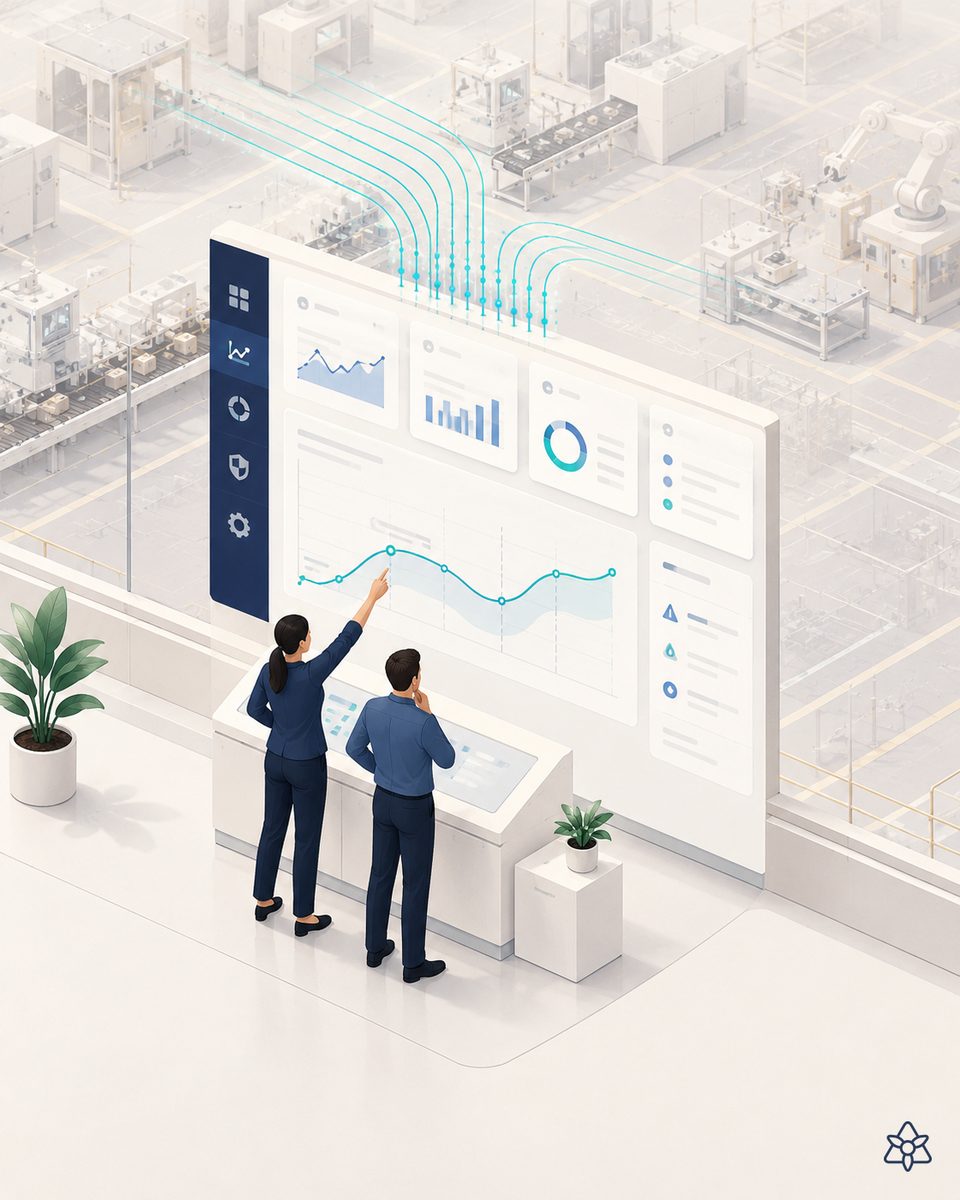
Levelling lives in the planner's head. And in their parallel spreadsheet.
Heijunka is a beautiful concept on paper: level production so there are no peaks and valleys, spread the mix across the hours, smooth the load upstream. In practice, in a multi-SKU plant with no AI, what actually happens is this:
- The planner builds the best levelling they can on Friday afternoon, in a spreadsheet only they understand.
- On Monday sales pushes in an urgent order, on Tuesday a critical raw-material supplier flags a delay, and on Wednesday a line stops for 2 hours with an unplanned breakdown. Friday's plan is already worthless.
- The planner re-levels by hand whenever they can — and meanwhile the plant runs on the old plan, with overstock in some families and an imminent stockout in others.
- The day the planner goes on holiday or retires, half the plant leaves with them.
The problem is not the method: it is that nobody can sustain heijunka by hand in a modern multi-SKU plant where things change every hour. You need an industrial nervous system that keeps levelling alive — and that gives the planner back the judgement, not the arithmetic.
iLEAN doesn't replace the planner — it gives them an agent that never tires of recalculating.
IRIS (Industrial Reality Intelligence Systems) is the category; iLEAN is the system. Applied to heijunka the principle is clear: data joined together with no agent on top is a library without a librarian. Levelling needs someone to cross demand, capacity and stock in real time — and that is exactly what a well-designed agent does, without ever running out of stamina.
Manual heijunka levels once a week. AI-augmented heijunka levels hour by hour, with every change. The planner stops managing a spreadsheet and goes back to deciding.
The iLEAN pieces applied to digital heijunka:
- iLEAN Brain (Central) — the multi-agent brain that runs 24/7 and keeps the levelled plan alive. This is where the multi-objective optimization logic lives (lead time, stock, OEE, changeover cost) and where APS/ERP outputs are crossed with plant reality.
- iLEAN Agent (the planner's) — an assistant dedicated to the planner. It proposes the levelled plan for the coming day with the best achievable balance, flags critical SKUs and their constraints, and reworks the sequence when a change comes in. The planner validates, adjusts and signs off. It proposes; the person decides.
- iLEAN Connect — it captures the changes that break the old plan: a customer email with an urgent order, a supplier message about a delay, a breakdown logged by maintenance, a manual adjustment in the MES. At second zero the agent knows something changed, with nobody forwarding anything or calling a meeting.
Manual heijunka vs. digital heijunka with iLEAN
| Aspect | Manual heijunka + spreadsheet | With iLEAN Brain + Agent |
|---|---|---|
| Levelling frequency | Weekly (sometimes monthly) | Hour by hour, with any relevant change |
| Manageable SKU mix | 5-10 comfortable, 50+ unmanageable | 50, 500 — the agent carries the complexity |
| Rush order change | Half an afternoon of the planner recalculating | Rework proposed in minutes, person signs off |
| Planner's knowledge | In their head and their spreadsheet — it leaves with them | Captured in the agent, stays in the company |
| APS/MES integration | Manual export/import | Native read/write, nothing to rewrite |
| Total inventory | Inflated by psychological safety margin | Optimized per SKU with equal or better coverage |
Impact estimate for your plant — to be validated with your numbers.
This block is an estimate to be validated with the real data from your plant. It works as an order of magnitude for the steering committee; we refine it during the diagnostic.
- Plant with 50-300 active SKUs, a veteran planner running levelling on a spreadsheet plus a classical APS that recalculates at end of day.
- Immersion of 3-5 days, first planner agent operating within a few weeks, replanning in minutes the changes that arrive by email or messaging.
- Total inventory reduction between 15% and 30% in the first measurable cycle, with equal or better service level.
- Reduction of the planner's monthly hours spent on repetitive calculation ≥ 40%, releasing those hours to campaign decisions and customer negotiation.
- Indicative payback between 4 and 9 months depending on volume and the cost of tied-up working capital. The hard lever is releasing working capital without touching service level.
And the CAIO's doubt — does the AI invent the plan?
"What if the agent proposes an absurd plan based on a hallucination?" — hallucination is a problem of free generation, not of anchored tasks. In tasks where the AI merely recombines and optimizes data from existing systems (crossing demand with capacity, recalculating a sequence), the best models brought error below 1.5% [1]. And even then, the plan does not come out of the AI — it comes from the planner who validates the agent's proposal. The three safety rings exist precisely for this.
The underlying data point — digitalization vs. survival
Between 2000 and 2021, the least digitalized sectors barely improved productivity; the most digitalized ones raised it by up to 40% [2]. Digitalization separates those who survive from those who fall — and digital heijunka is one of the most profitable entry points because it has a clear owner (the planner) and a measurable KPI (working capital / service level / OEE).
[1] OpenAI paper "Why Language Models Hallucinate", 2025 — on the reliability of AI in anchored tasks.
[2] Fundación BBVA / Ivie — productivity and digitalization, 2000-2021.
What people ask about digital heijunka with AI
What if a rush order change comes in mid-morning?
The rush change is where the difference shows most. With manual heijunka, an email arrives from sales asking to pull forward 200 units of SKU X and the planner needs half an afternoon recalculating by hand — and meanwhile the line keeps running the old plan. With iLEAN Connect the email reaches the system at second zero, the agent recalculates the levelled sequence in minutes with the updated demand, proposes the adjustment to the planner, the planner signs off and the line has the new plan before the shift change. The person decides; the system takes away the dumb arithmetic.
Does it integrate with an existing APS or planning suite?
Yes — iLEAN sits as a layer on top of your existing APS, not as a replacement. Whatever advanced planning suite you run, iLEAN Connect reads its outputs, cross-checks them against plant reality (real hourly capacity, unplanned downtime, measured actual stock) and writes the readjustment back to the APS when it is relevant. What iLEAN adds is the filler between what the APS predicts and what is actually happening on the line. The APS remains the master source of truth; the agent keeps it anchored to reality.
Does it work with a complex mix (dozens or hundreds of SKUs)?
That is exactly where it pays off most. Manual heijunka with 5 SKUs works on a whiteboard; with 50 or 500 SKUs the planner runs it on a spreadsheet plus a parallel kanban they keep in their head. iLEAN Brain treats the complex mix as a multi-objective optimization problem (lead time, stock, OEE, changeover cost) and proposes a levelled sequence by family and by hour. The person validates; they do not have to calculate. The planner's agent becomes a colleague that never gets tired of recalculating when something changes.
Does AI-levelled heijunka reduce total inventory?
Yes — the mechanism is that dynamic levelling lets you cut safety stock per SKU without increasing stockouts. As an estimate to be validated in your plant, the reduction in total inventory usually lands between 15% and 30% in the first cycle, with equal or better coverage. The hard lever is releasing working capital tied up in finished goods and raw material without touching service level. We send you the calculation with your numbers — not ours — within 48h.
Does it work in an SME plant with a single planner?
Especially there. In an SME the planner is usually the human bottleneck — if they are on holiday or off sick, levelling breaks down. The iLEAN planning agent covers that bottleneck: it sustains hour-by-hour levelling while the planner is away and hands back a tuned system when they return. This is not about replacing the planner; it is about freeing them from repetitive calculation so they can spend time on judgement (campaign decisions, customer negotiations, strategic priorities). That is exactly the iLEAN model: assist and simplify, never automate the person out.
Tell us about your case and within 48h we'll send the estimated ROI of digital heijunka with AI in your plant.
We work on your plant's real data, not ours. Diagnostic with no commitment.
Request estimated ROI in 48h See JIT