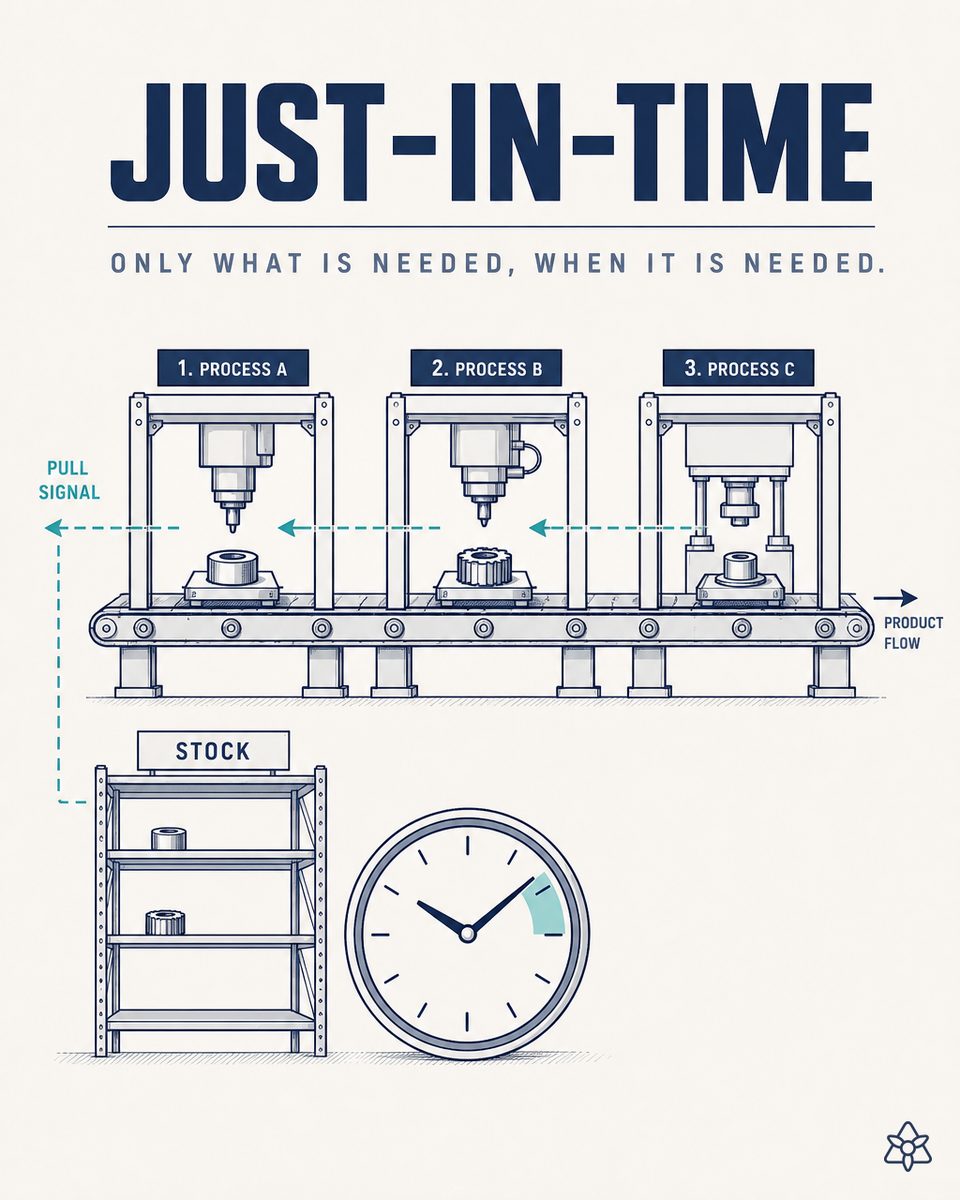
JIT — Just-in-Time: produce only what's needed, when it's needed
JIT (Just-in-Time) is the Lean methodology where every part arrives at the cell exactly when it's needed — not before (dead stock) nor after (line stop) — by coordinating suppliers, transport and production in a single pull chain.
Tracking it on paper? Snap a photo and see it digitized
Whatever the sheet —a log, an audit, a shift report— the AI agent learns its boxes from the first photo, reads it and stores it in your plant memory, where you can ask it questions from your phone.
Why zero-stock is theory — and pull coordination is the practice
JIT doesn't literally mean zero stock — it means the minimum stock possible without stopping the line. The difference with the traditional "push" system is radical:
- Push: the plan says we need 1000 units in April → we make 1000 in March → if demand changes, we have surplus or shortage.
- Pull (JIT): every part produced pulls the next → pace is set by real customer demand.
JIT only works when suppliers, transport and production are coordinated as a single system. A part that doesn't arrive = a line stopped.
iLEAN doesn't replace the method — it brings it into the 21st century.
Every Lean methodology was born to solve an information problem: where stock is, which machine is failing, what changed shift-to-shift. When information is paper, methods are rituals. When it's live data, they become the actual engine of the plant.
Classical method tells you what to measure. The IRIS system guarantees the measurement reaches whoever decides, the moment they decide — without anyone typing it in.
The three capture layers applied: Connect (photo, voice, email, WhatsApp), Edge (computer vision on the line) and Integrations (ERP/MES/SCADA/PLC). On top of that unified information, specialized agents serve the exact context to each person on the floor.
Classical JIT vs. AI-coordinated JIT
| Aspect | Classical JIT | JIT with iLEAN |
|---|---|---|
| Supplier comms | EDI + email + phone | Through their usual channels (email, WhatsApp, EDI) |
| Need calculation | Weekly MRP | Continuous calculation per real consumption |
| Stop-risk detection | Panic call from planning | Early alarm when a supplier slips |
| Transport coordination | Email with carrier | Suppliers agent coordinates with all |
| In-flight order tracking | Purchasing manager's whiteboard | Live board per order + ETA |
What people ask about JIT
What is JIT and how does it differ from zero-stock?
JIT (Just-in-Time) is the Lean methodology of producing and provisioning right when needed. It's not literally zero stock — that's theory — but the minimum stock that allows operating without stops. The key difference with traditional production is that pace is set by real customer demand, not a theoretical plan.
How does iLEAN coordinate with suppliers who still work by email or WhatsApp?
iLEAN's Suppliers agent connects to whatever channel each supplier uses — some modern EDI, others email, others WhatsApp. It unifies all those conversations in a single internal view and fires notifications through each supplier's preferred channel. The plant doesn't change its suppliers; the supplier doesn't change how they work.
Does JIT work if my suppliers aren't digitized?
Yes. How the supplier operates (digital or not) is the supplier's problem, not yours. iLEAN adapts to what the supplier uses. What you need for JIT is reliable suppliers in lead-time and quality — digitization helps but isn't critical.
What's the risk of JIT in a supply chain disruption?
High risk if not managed. The 2020 pandemic exposed that many classical JIT plants had no buffer for the unexpected. Modern Lean plants run JIT with dual sourcing and a strategic buffer for critical components — JIT doesn't mean 'one source, no stock', it means 'just-right stock, with full visibility'.
How do you calculate the optimal JIT lot size?
Optimal lot size in JIT depends on changeover time (SMED) and demand volume. The classical EOQ formula is replaced in JIT by an iterative calculation: minimize changeover time until producing any lot is economical. iLEAN tunes the lot size by real consumption.
Tell us about your plant. We'll tell you how we'd do it.
25 years applying Lean in real plants. Free diagnostic conversation.
Request demo See Lean Manufacturing