Standard work with AI vision — the standard stops being a laminated sheet on the wall and comes back to the station, alive.
Standard work exists, it is written and it is laminated — and nobody looks at it. The deviation shows up weeks later: in the audit or in the defect. iLEAN Edge compares the station's real sequence (steps, order and times) against the standard and catches the deviation in the moment, while one sentence still fixes it. What is verified is the process, not the person: no identity, with data aggregated by station. And the living instruction on the tablet is updated the same day the standard improves. The person signs.
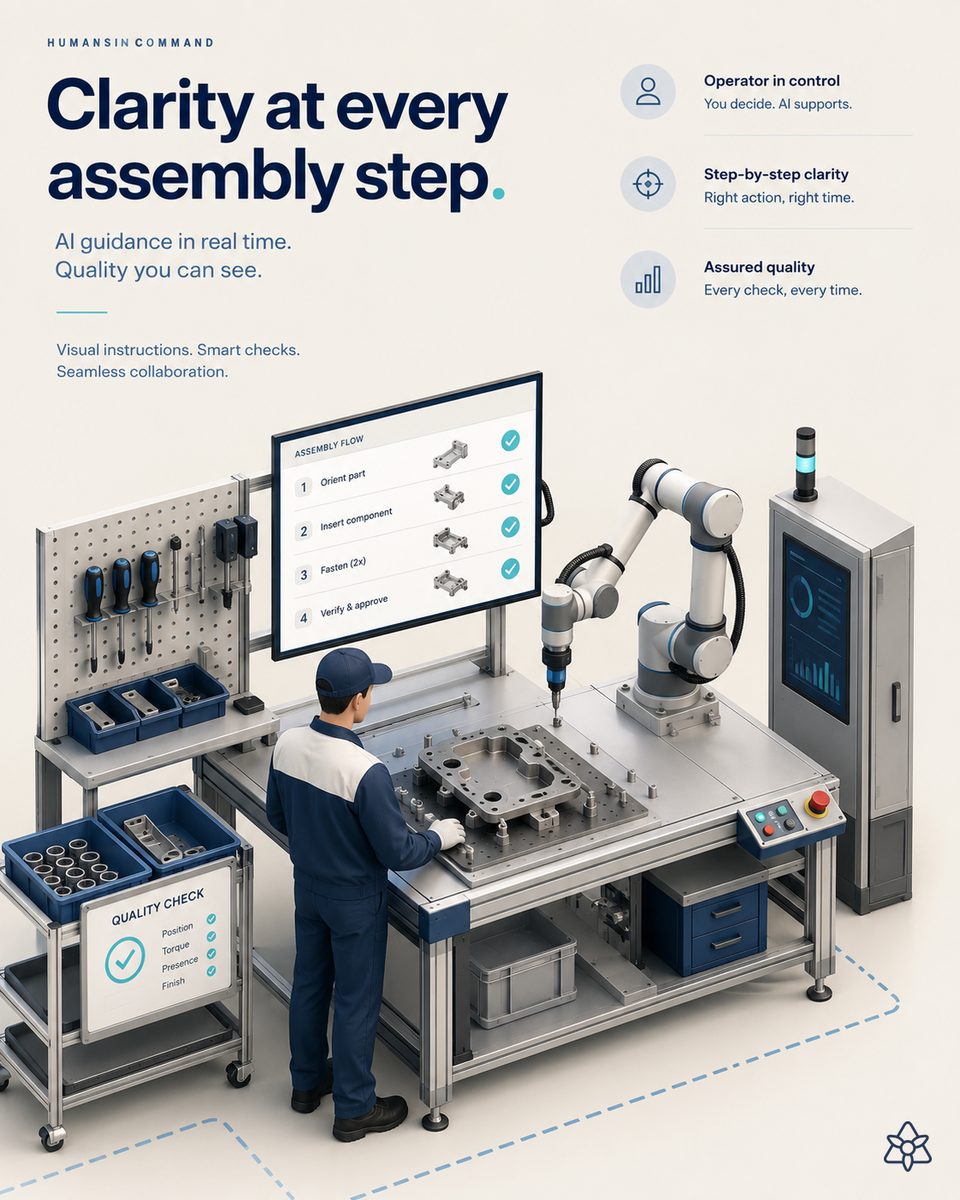
The standard is written, laminated and hanging on the wall. And nobody has read it since day two.
Standard work is one of lean's best ideas: fix the best-known sequence so that quality does not depend on who happens to be at the station that day. The idea is still good. What fails is the medium — a laminated sheet on the wall — and it always fails in the same four places:
- Nobody looks at it — the veteran has it in their hands and does not need to look; the new operator looks at it for two days and then copies whoever is next to them, which may or may not match the written standard.
- The deviation is discovered late — at final inspection, in the customer claim or in the process audit. That is, when parts have already been made, cost is already sunk and an investigation is reconstructing after the fact something nobody recorded.
- The standard ages on the wall — the team improves the method in a kaizen, the improvement stays in three people's heads and the laminate keeps describing how the work was done two years ago. Updating it means drafting, approving, printing, laminating and replacing it at every station: days. At that cost, it almost never happens.
- The drift is silent — nobody decides one Tuesday to skip a step. Steps get lost through an accumulation of small, reasonable shortcuts, and each one on its own looks harmless until the defect appears that can only be explained by combining three of them.
The result is a paradox familiar to any certified plant: the standard is impeccably documented for the audit and, at the same time, nobody can state with data that it is being executed. Documenting the standard and verifying the standard are two different problems, and until now we had only solved the first one.
iLEAN does not rewrite your standard — it puts it back at the station and checks that it is followed.
Standard work always asked for two things that in practice never held up: that the instruction live where the work happens, and that someone check continuously that the real sequence matches the standard one. iLEAN does not change the methodology: it gives it the support it was missing. The instruction lives on the station tablet and updates itself; the checking is done by Edge on every cycle, without tiring and without interrupting anyone. Connect is the putty that fills the cracks between the MES, the smart tooling and what the camera sees.
The process is verified, not the person. If a step is systematically skipped at a station, the problem is almost never the person executing it: it is the standard, the tooling or the instruction. That is exactly the finding we are after.
The iLEAN pieces applied to standard work:
- Edge — a camera over the station recognizes process events (part present, tool picked up, component inserted, tightening completed) and orders them on a timeline. All processing happens at the station itself, and what leaves the terminal are events, not images of people. It works without a network.
- Connect — brings the signals vision cannot see on its own: the work order in progress, part number and variant, screwdriver torque, weight, readings from smart tooling. With this the system knows which standard applies on each cycle, not just whether the cycle resembles one.
- Agents — compare the observed sequence against the standard sequence, classify the deviation (skipped step, altered order, time outside the window), filter out the operation's normal noise and alert in the moment through the area lead's channel. They also aggregate by station and by part number, so the team sees where the standard meets resistance.
- Living instruction — the standard rendered step by step on the station tablet, with the correct variant loaded automatically. When the team improves the method, it is published and is at every station that same shift: knowledge SMED.
- Three safety rings — no deviation stops a line by the machine's decision. The system proposes; the responsible person decides and signs.
Laminated standard vs. standard work with AI vision
| Aspect | Laminated standard on the wall | Standard work with AI vision |
|---|---|---|
| Where the instruction lives | Sheet on the wall, the same for every part number | Tablet at the station, with the current order's variant |
| Compliance verification | Sampled: a process audit every X weeks | Continuous: compared against the standard sequence on every cycle |
| When the deviation appears | At final inspection, the claim or the audit | In the moment, while one sentence still fixes it |
| Updating the standard | Draft, approve, print, laminate, replace: days | Edit and publish: the same shift, versioned and signed |
| Training a new operator | Constant shadowing by a veteran, variable duration | Living instruction + sequence confirmation; the veteran steps in where needed |
| Unit of analysis | Nonexistent, or noted by hand during the audit | Aggregated by station and part number — never by individual |
| Audit traceability | Reconstructed after the fact | Version and compliance history, already prepared |
Impact estimate for your plant — to be validated with your numbers.
The block below is an estimate to be validated with the specific data of your plant. We set it out so the committee has an order of magnitude; we refine it during the diagnostic.
- Manual assembly station or cell with several part numbers, a standard documented on paper and sequence defects that today are caught at final inspection or downstream.
- Edge pilot on 1-2 representative stations: the standard loaded as a sequence, living instruction on the tablet and comparison on every cycle. First value expected within a few weeks.
- Indicative payback between 5 and 10 months, resting on two levers: fewer sequence defects (less rework, less scrap, fewer claims) and faster training of new operators, which frees up veteran staff hours.
- Reduction in the time a new operator takes to reach the veteran's quality in the order of ≥30% (a conservative estimate), and standard update time down from days to minutes.
And the production manager's reasonable doubt
“What if the system flags deviations that are not deviations, and we end up with noise at the station?” — it is the right objection, and the answer lies in the type of task. Hallucination is a problem of free generation, not of anchored tasks. Comparing an observed sequence against a declared standard sequence is a textbook anchored task: there is a list of steps, an expected order, a time window and a deterministic comparison. In this class of tasks the best models are below 1.5% error [1]. And where a specific check does not reach sufficient reliability, it is not forced: it is flagged as non-verifiable and generates no alert. We prefer a standard covered at 85% with solid signals to one at 100% with false alerts the station learns to ignore in two weeks.
[1] OpenAI paper “Why Language Models Hallucinate”, 2025 — on the reliability of AI in anchored tasks.
You may also be interested in: Operator skills matrix with AI · Poka-yoke with machine vision · Yamazumi and line balancing with AI
What people ask about standard work with AI vision
How does the camera compare the real sequence against standard work?
The standard is loaded once as a sequence of steps: which operations there are, in what order, with which tooling and with a reasonable time window for each one. Edge observes the station and recognizes process events — part present, tool picked up, component inserted, cover placed, tightening completed — and orders them on a timeline. It then compares that timeline against the standard's and flags three types of deviation: skipped step, altered order and time outside the window.
There is no model guessing intentions: there is an expected sequence and an observed sequence, and the difference between the two. It is one of the most anchored tasks in industrial vision, and that is why it is reliable.
What about the operator's privacy? Isn't this about controlling people?
No — and the design rules it out by construction, not by promise. The process is verified, not the person. The system runs no facial recognition or biometrics, stores no identity, links no deviation to a name and keeps no image of anyone's face: processing happens on the Edge, at the station itself, and what comes out are process events (step 4 skipped, order inverted between 6 and 7), not video of people. Data is aggregated by station and by part number, never by individual, and the dashboards have no person dimension: that query does not exist. It is not a configuration setting someone could flip back on a Tuesday — it is what the system is capable of emitting.
And there is an operational reason on top of the ethical and legal ones: when the standard is systematically not followed at a station, the honest conclusion is almost never that this person does it wrong. It is that the standard is awkward, the tooling is badly placed or the instruction is not understood. That is the finding we are after, and it is exactly the one you lose the moment the data is viewed by individual.
How is the standard updated when the team improves it?
You edit the sequence and publish it: the living instruction on the station tablet is updated within the same shift, with the new version, its images and its times. No reprinting, no laminating, none of the classic risk of three different versions coexisting at three stations in the same shop. Every publication is versioned and signed by whoever approves it, with a date, so audit traceability holds up on its own.
We call it knowledge SMED: changing the standard goes from days to minutes. And the effect is the same one SMED had on tooling changeovers — when changing the standard is cheap, the team improves it genuinely and often, instead of living for years with one that no longer describes how the work is done.
Does it help train new operators faster?
It is one of the clearest return levers. The new operator works with the living instruction in front of them — step by step, with the image of the correct motion and the exact spot where each part goes — and gets immediate confirmation when the sequence is completed correctly. That replaces a good part of the constant shadowing by a veteran, which today is the shop's most expensive and scarcest resource.
The system also shows in which specific steps hesitation appears during the first days, and that information directs training to the real point of difficulty instead of repeating the whole course. The goal is not for the new operator to take less time to produce: it is for them to get sooner to producing with the veteran's quality.
Does it work at complex manual stations, with many part numbers and variants?
Yes — and in fact that is where it contributes most; a station with a single repeated motion does not need this. At stations with many part numbers the real problem is not dexterity, it is remembering which variant takes which sequence: the living instruction automatically loads the one for the current order, and the error of applying the previous part number's standard disappears.
In operations with lots of handling, or parts that end up hidden, it pays to combine vision with complementary signals Connect already collects (smart tooling, torque screwdriver, scale, voice confirmation by the operator). And where a check is not 100% reliable, the system does not force it: it flags it as non-verifiable and generates no alert. A standard covered at 85% with solid signals is worth far more than one at 100% with false alerts the station learns to ignore in two weeks.
More cases in lean manufacturing
- Lean Manufacturing softwarethat doesn't ask you to learn it.Lean Manufacturing software with industrial AI: 5S, Kanban, TPM, SMED, Six Sigma digitized.…
- Spaghetti diagram with AI vision — the operator's real route, not the one on the floor plan.How iLEAN builds the spaghetti diagram continuously with Edge vision plus Connect — no stopwatch, no…
- Real-time SPC with AI — statistical process control that reacts while you can still correct, not once you are already out.iLEAN Edge + Agents bring SPC to real time: live Xbar-R charts, automatic Western Electric rules,…
- Toyota Production System — the origin of Lean ManufacturingThe Toyota Production System (TPS) is the foundation of modern Lean. Its two pillars — Jidoka and…
- TPM: Total Productive Maintenance with predictive AIiLEAN digitizes TPM with real-time OEE, autonomous and predictive maintenance. The 6 pillars serving…
- Shopfloor TV visual management with AI — from the dead board to the board the operator looks at again.Your shopfloor screens are dead boards showing yesterday's data. iLEAN connects every TV to live shift…
Tell us about your case and within 48h we'll send you the estimated ROI of standard work with AI vision for your plant.
We work on your plant's real data, not ours. Diagnostic with no commitment.
Request estimated ROI in 48h See Lean Manufacturing