Incident capture — the one that dies in a chat message is the one that happens again.
A plant incident dies in an unread email or in a chat message to the shift leader — and comes back a month later. iLEAN captures them all through whichever channel they are born in (voice, photo, email, chat), categorizes them in seconds and triggers the prioritized action in MES, CMMS or Andon. A person signs off every step.
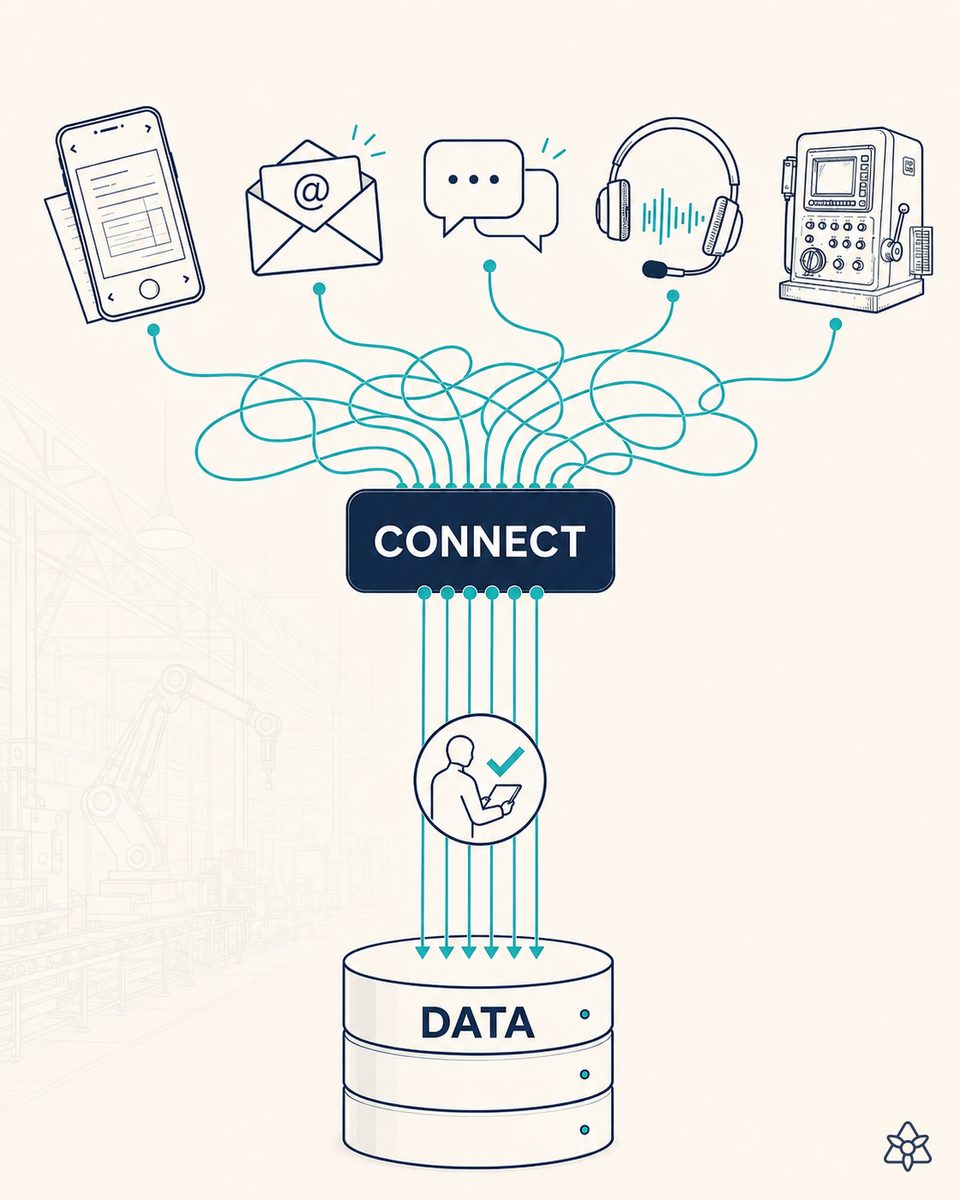
The plant reports through every channel except the official one.
The official incident system in most plants is a screen in the MES or a module of the CMMS that people do not use. And it is not bad faith: asking someone to stop the line, walk to the computer, open the form, look up the machine code and fill in seven fields to report that "the filler is vibrating oddly" means that incident never gets reported. It gets told to the shift leader over chat, it ends up in an unread maintenance email, in a note in a notebook — and it shows up again a month later, the same or worse.
The result is paradoxical: the plant reports through every channel except the official one. The MES says there were 12 incidents last month; the shift leader, looking at their phone, knows there were 60. The gap between what happens and what gets recorded is the most expensive gap in the plant: without a record there is no 5 whys, without 5 whys there is no continuous improvement, and without continuous improvement the same incident comes back.
The classical system works 20 % of the time — the rest gets told however people can.
iLEAN does not impose a new channel — it listens to the one people already use.
The problem with incident capture is not a lack of software: it is that the software forces the person to come to it, and the person does not come. iLEAN acts as the filler that listens across every channel where the plant already talks (voice, photo, email, chat, transcribed phone call) and turns it into usable data — without asking you to change MES, CMMS or Andon.
Connect listens through the channel the plant already uses. The agent categorizes and prioritizes. The Writer writes the order into the MES, CMMS or Andon with the evidence behind it. A person validates — the line does not restart on its own when the incident is critical.
The iLEAN pieces applied to incident capture:
- Connect — listens through the channel the plant already uses: the operator's full-duplex earpiece, a photo of the panel, the maintenance email, the shift leader's chat message, the corporate messaging group, a transcribed phone call. The capture setup adapts to each zone (in heavy pressing with extreme noise, photo capture; in packaging with moderate noise, voice).
- Agent — transcribes, reads, sees, categorizes against the plant master data (line, machine, code, severity), asks back through the same channel when information is missing, prioritizes using history and proposes the escalation. The literal quote from the message stays embedded in the incident, for audit.
- Writer — writes the downtime with code and duration to the MES, the work order with its evidence to the CMMS, and the supervisor alert to the Andon with the configured SLA. Write autonomy is configured plant by plant — from proposing a draft to opening an order with automatic sign-off for low-criticality incidents. Anything critical always goes through a person.
Classical incident system vs. multichannel capture with iLEAN
| Aspect | Classical system (MES/CMMS/Andon) | With iLEAN Connect + Agent + Writer |
|---|---|---|
| Capture channel | A screen on the shift leader's computer | Voice, photo, email, chat — the channel people already use |
| Operator effort | Stop + walk + open + fill in 7 fields | Dictate what they see through the earpiece, without stopping |
| Real capture rate | 20 % of what actually happens | >90 % — because it is captured through the channel the person already uses |
| Categorization | Manual, depends on how tired the shift leader is | Automatic, with the literal quote from the message as evidence |
| Multilingual | Everything in one language, friction for subcontractors | Each person in their own language, reply in their own language |
| Traceability | An incident in the MES without the conversation that started it | Incident + literal quote + photo + similar history |
Impact estimate for your plant — to be validated with your numbers.
The block below is an estimate to be validated with the actual data from your plant. We lay it out so the committee has an order of magnitude; we refine it during the diagnostic.
- A standard industrial plant with 3-6 lines, MES + CMMS + Andon already installed, and structural under-reporting (20-30 % of what happens reaches the official system).
- Connect pilot on one pilot line (earpieces + integration with MES/CMMS). First value expected within a few weeks — the rise in the incident capture rate shows up very fast.
- Indicative payback between 4 and 9 months, depending on the current cost of MTTR and the frequency of recurring incidents.
- Hard levers: MTTR reduction on the order of 30-50 % (prioritized action in seconds instead of minutes), 4-5× more incidents captured (which feeds the 5 whys far better), and recurrence reduction on the order of ≥30 %.
And the plant manager's fair objection
"What if the AI categorizes it wrong and opens an order for something it wasn't?" — every categorization carries the literal quote from the message that justifies it. The shift leader validates it with one tap (the quote is right there, not hidden in a black box). On anchored tasks such as reading a message and cross-referencing it with the plant master data, the best models brought the error rate below 1.5 % [1]. And the system lets you configure autonomy by incident type: low-criticality ones can be opened with automatic sign-off; critical ones always go through a person. That is what the three safety rings are for. The over-validation that kills the system (everything goes through a human and nobody signs in time) is the antipattern iLEAN avoids by design — autonomy graduated by criticality, not uniform.
[1] OpenAI paper "Why Language Models Hallucinate", 2025 — on the reliability of AI in anchored tasks.
What people ask about multichannel incident capture with AI
Does voice capture work on a noisy plant floor?
Yes, with the right chain. iLEAN Connect equips the person with a phone + full-duplex earpiece (or a rugged tablet where phones are banned) — the earpiece carries a close-to-mouth microphone and noise cancellation, which filters out presses, motors or jets of air. Transcription runs locally on the clean voice, not on the ambient noise. In extreme zones (forging, heavy presses) it is complemented with photo capture of the panel plus dictation outside the noisy area. The operating rule: the plant chooses the channel, not the system.
Does it work multilingually, across a multi-country plant?
Yes. An incident written in Spanish by the morning operator, in Portuguese by the afternoon one and in Arabic by the subcontracted maintenance technician is categorized exactly the same — the models are natively multilingual. More important: the reply comes back through the originating channel, in the person's own language. The operator gets the follow-up in Spanish; the corporate engineer reads it in English on the dashboard. What matters is not that everyone writes in English; it is that each person uses their own language and the system takes care of bridging.
How is an incident categorized automatically?
The agent reads the content (transcribed voice, photo, email or chat text) and cross-references it with the plant master data (line, machine, shift, operator, defect or breakdown code) and with the history of similar incidents. It returns a category, an estimated severity and a suggested owner. When the incident is ambiguous (the photo of the panel lacks context), the agent asks back through the very channel it came in on — it does not wait for someone to guess. Categorization is not a black box: it carries the literal quote from the message that justified it, for audit.
Does it integrate with existing MES, CMMS and Andon systems?
Yes, in both directions. iLEAN writes the downtime with code and duration to the MES, the work order with its evidence (photo + transcript + similar history) to the CMMS, and the supervisor alert to the Andon system following the escalation each SLA requires. And it reads the active production line from the MES for context, and the status of previous orders from the CMMS. Write autonomy is configured plant by plant — from proposing a draft to opening an order with automatic sign-off for low-criticality incidents.
How much MTTR reduction can be achieved?
Response time to an incident has three pieces: capture time (the person reports it), transit time (from their head to the person who acts) and action time (resolving it). Multichannel capture with AI attacks the first two: the person reports it however they can (voice, photo, text, chat message) and the agent escalates it instantly with categorized evidence — what used to take 20 minutes to reach the maintenance manager now arrives in seconds. MTTR reductions on the order of 30-50 % are a conservative target to be validated, depending on the maturity of the current system.
More cases in lean manufacturing
- The classic MES replans at the end of the day. Your plant changes every hour.iLEAN augments your existing MES/MRP with dynamic planning and replanning in minutes when something…
- MSA with AI — the study that ages in a drawer comes back to life.iLEAN assists MSA (R&R, bias, linearity, stability): Connect captures the real measurement and Agents…
- Muda, mura and muri detection with AI — the 3M before they cost money, not after.The 3M (waste, variability, overload) stay invisible until they explode. iLEAN detects them continuously…
- Near misses with AI — the warning the plant gives itself, captured before the hit.iLEAN Edge sees the near miss on the line, Connect captures it by voice and an agent classifies it to…
- Real-time OEE: availability × performance × qualityiLEAN measures OEE in real time: availability × performance × quality, by line, shift, product. The king…
- On-the-job training (OJT) with AI — the veteran teaches once, the plant learns forever.iLEAN turns the veteran's teaching into permanent capability: Connect captures the OJT session, Edge…
Tell us about your case and within 48h we will send you the estimated ROI of multichannel capture for your plant.
We work on your plant's real data, not on ours. Diagnostic with no strings attached.
Request 48h ROI estimate See all Lean methods