DMAIC: the structured Six Sigma improvement cycle
DMAIC (Define – Measure – Analyze – Improve – Control) is the structured improvement cycle of Six Sigma: five phases to move a problem from 'we know something is wrong' to 'we've fixed it and the result is controlled', with clear gate criteria between phases.
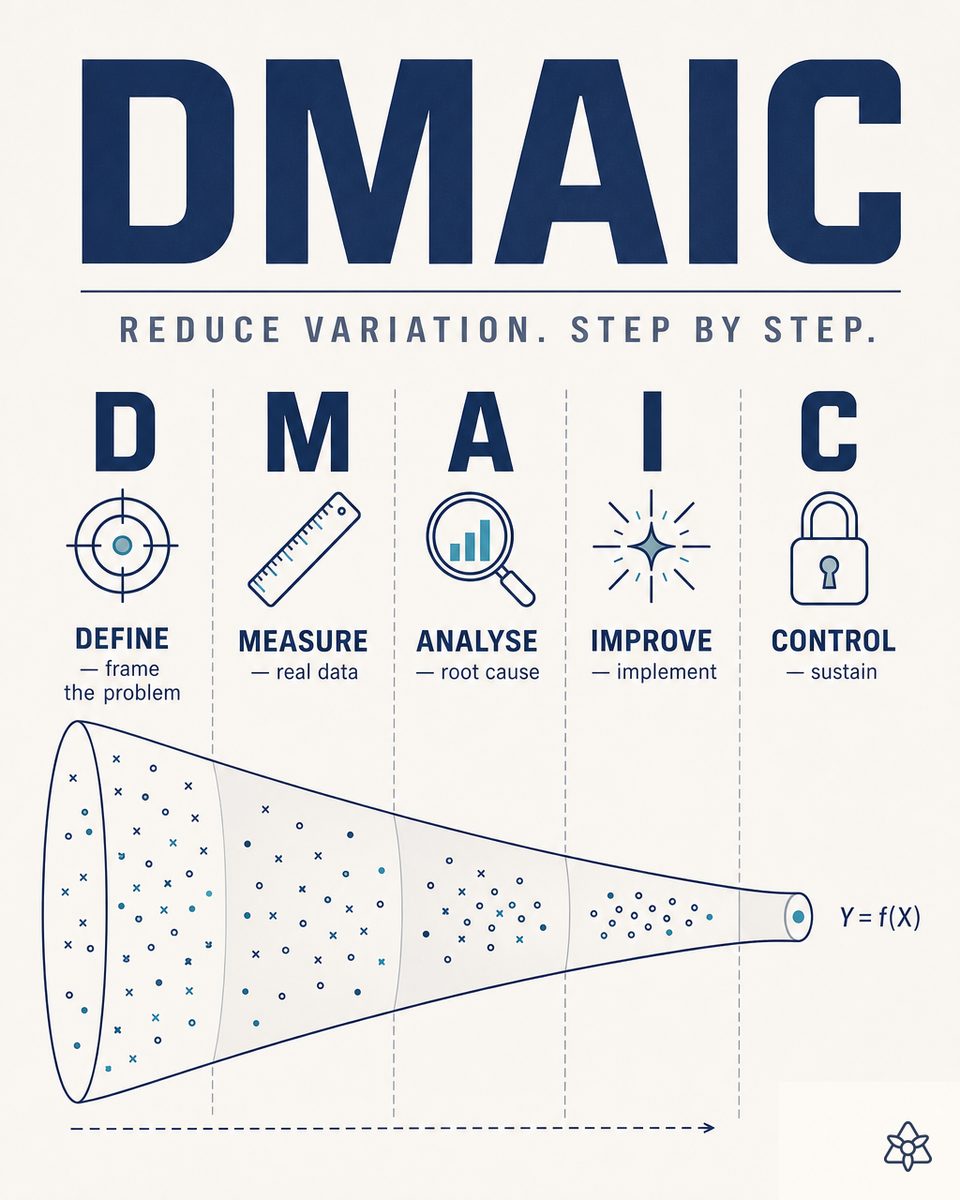
The 5 phases with their exit gates
DMAIC has gates between each phase — you don't advance until objective criteria are met. This discipline differentiates DMAIC from PDCA, which is freer.
- Define: what concrete problem do we solve? Who's the customer? What's the SIPOC? Gate: approved project charter.
- Measure: how do we measure today? What's the baseline? Gate: validated measurement system.
- Analyze: what's the root cause? Statistical analysis, not intuition. Gate: root causes validated with data.
- Improve: what do we change? Piloting, test and verification. Gate: improvement confirmed with data.
- Control: how do we ensure the change is sustained? Permanent SPC. Gate: operational control plan.
iLEAN doesn't replace the method — it brings it into the 21st century.
Every Lean methodology was born to solve an information problem: where stock is, which machine is failing, what changed shift-to-shift. When information is paper, methods are rituals. When it's live data, they become the actual engine of the plant.
Classical method tells you what to measure. The IRIS system guarantees the measurement reaches whoever decides, the moment they decide — without anyone typing it in.
The three capture layers applied: Connect (photo, voice, email, WhatsApp), Edge (computer vision on the line) and Integrations (ERP/MES/SCADA/PLC). On top of that unified information, specialized agents serve the exact context to each person on the floor.
DMAIC in PowerPoint vs. DMAIC with live data
| Phase | DMAIC in PowerPoint | DMAIC with iLEAN |
|---|---|---|
| Define | Charter in Word | Project charter connected to target KPI |
| Measure | Manual data capture | Sensors + vision, automatic baseline |
| Analyze | Excel + Minitab | AI agent auto-correlates variables |
| Improve | Pilot without measurement | Live-measured pilot, A/B compare |
| Control | Quarterly reviews | Permanent SPC, alarm on drift |
What people ask about DMAIC
What does DMAIC mean and what is it for?
DMAIC = Define – Measure – Analyze – Improve – Control. It's the structured improvement cycle of Six Sigma. Its 5 phases take a problem from 'we know something is wrong' to 'we've fixed and controlled it'. Each phase has objective exit criteria.
What's the difference between DMAIC and PDCA?
PDCA is light, fast, for daily continuous improvement (4 phases). DMAIC is structured, rigorous, for 3-6 month Six Sigma projects (5 phases with gates). Both are cyclic; DMAIC is more disciplined and requires statistical validation.
How does iLEAN run DMAIC with real-time data, no Excel?
Each DMAIC project is managed on an iLEAN board with its 5 phases. Measure activates with real sensors (not manual capture). Analyze uses the AI agent to correlate variables. Improve auto-compares pre/post performance. Control maintains permanent SPC with alarms. No Excel or Minitab — and data doesn't go stale.
Do I need Six Sigma certification to lead a DMAIC?
To lead a serious Six Sigma project, Green Belt (200h training + project) or Black Belt (400h+) is recommended. But participating in DMAIC without leading doesn't require it. iLEAN doesn't replace training — it eases execution.
How long does a typical DMAIC project take?
A typical DMAIC lasts 3-6 months with partial Belt dedication (typically 20-40% of their time). Short projects (1-2 months) are usually Lean Kaizen, not DMAIC. Long projects (>9 months) are usually split into sub-projects.
Tell us about your plant. We'll tell you how we'd do it.
25 years applying Lean in real plants. Free diagnostic conversation.
Request demo See Lean Manufacturing