Shellfish cold chain control with AI — from boat to shelf, no jumps in the curve.
The shellfish cold chain rarely breaks in the cold room — it breaks on the dock, in the cross-dock, in the overloaded tunnel. iLEAN cross-checks transport, dock and cold room with probes, vision and agents; it anticipates the jump before it arrives, and closes the per-batch dossier ready for FSMA 204 and US/UK retailers. The person decides — the system warns with time to spare.
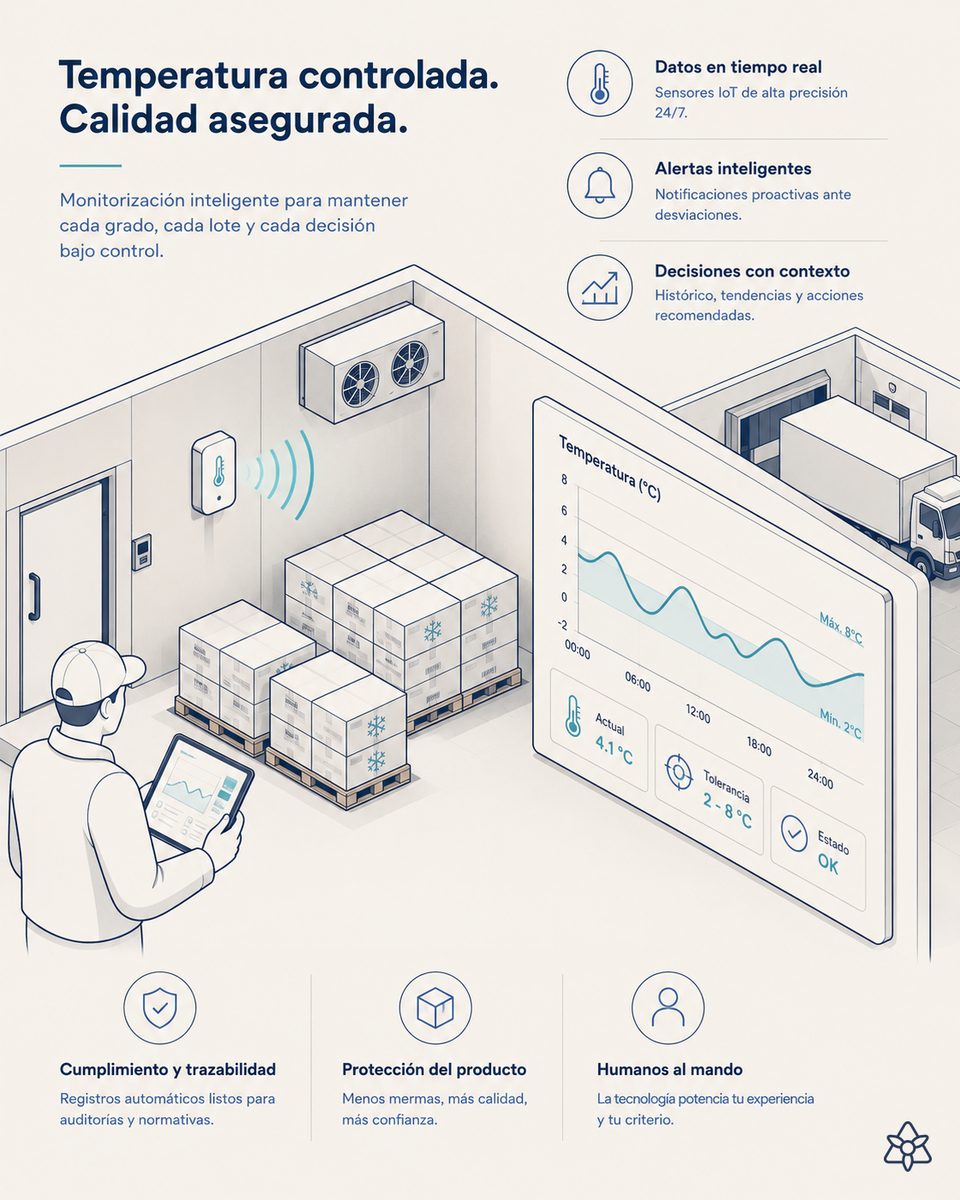
The cold room is under control. The gray zone is not.
In shellfish, a well-managed cold chain in the cold room and in refrigerated transport is the rule. The cold room has a PLC, the truck has a data logger, the tunnel is calibrated. And still, the problem keeps coming back in places almost nobody instruments with the same intensity:
- The unloading dock. The truck arrives, the forklift driver is on another order, the pallet sits fifteen minutes on an open dock at 20°C. The cold room's probe never notices; the pallet does.
- The urgent cross-dock. Product that comes in and goes out in the same shift jumps from one truck to the distribution truck without passing through the cold room. The new truck's data logger curve starts from a temperature the old truck had already let rise.
- The overloaded tunnel. Peak load — Christmas, Easter, export season. The tunnel's nominal capacity is at its limit, and the core of the piece does not reach -18°C within the nominal cycle time. The record says “cycle complete”; the core thermometer does not believe it.
- The data lives in four systems. The logistics operator sends you a monthly PDF from the data logger. The cold room has its chart. The cross-dock, a notebook. The tunnel, its screen. Nobody has the batch's complete curve on a single screen.
And when a retailer arrives with an alert or the inspector asks for traceability under FSMA 204, someone starts piecing fragments together. They do it against the clock, and in the best case, a dossier comes out. In the worst case, it comes out late.
iLEAN does not buy new cold rooms — it stitches the chain at the points where it breaks.
The problem in shellfish is not investing more in cold rooms: it is that the chain has gray zones between the well-instrumented links, and that the batch's curve lives in four systems that do not talk to each other. iLEAN is the putty that fills those joints: wireless probes where there were none, Edge on the dock, integration with the logistics operator's data logger, and an agent that closes the batch dossier.
Edge watches the dock. Connect captures truck, cold room and tunnel. The agent stitches the complete curve and anticipates the jump. The person validates — at-risk batches are inspected before the rest, not after the incident.
The three iLEAN pieces applied to shellfish cold chain control:
- Edge — a terminal with machine vision (CNN) on the dock and in gray zones (cross-dock, tunnel antechamber). It counts door openings, measures how long the pallet waits in a warm zone, identifies which pallet belongs to which batch. Works without a network: if the dock loses WiFi, it keeps recording.
- Connect — captures the truck's data logger (PDF/CSV from the logistics operator, or direct reading if the fleet has modern telematics), the cold room's PLC curve, the tunnel's cycle, and the batch's origin record (fish market, fish farm, import). Graduated capture at every link — from the operator's monthly PDF to the in-line reading.
- Agent — stitches the batch's complete curve (origin → transport → dock → cold room → tunnel → dispatch), anticipates the jump when the truck is running late or the tunnel is close to saturation, and closes the FSMA 204 / IFS / BRC per-batch dossier. It warns the dock lead before the truck lands. It does not reassign trucks on its own — it proposes, the person signs.
A chain of isolated links vs. a chain with the iLEAN nervous system
| Aspect | Today — isolated links | With iLEAN Edge + Connect + Agent |
|---|---|---|
| Gray zone on the dock | No continuous measurement | Wireless probe + vision + waiting alert |
| Urgent cross-docking | No traceability of the pause | Continuous batch curve, no blind jumps |
| Overloaded tunnel | Nominal cycle assumed | Nominal capacity + actual load + time cross-checked |
| Operator's data logger | Monthly PDF, reviewed after the fact | Integrated in real time with the batch curve |
| FSMA 204 dossier | Manual reconstruction on alert | Ready in minutes, signed by the person |
| Decision on a suspect batch | “Ship it anyway and we'll see” | Targeted inspection + informed decision |
Impact estimate for your plant — to be validated with your numbers.
The block below is an estimate to be validated with the specific data of your plant. We put it forward so the committee has an order of magnitude; we refine it during the diagnostic.
- Fresh + frozen shellfish distributor, 3-5 cold rooms + 1-2 tunnels + dock with cross-dock, exporting to the EU/UK/US.
- Pilot: Edge over the highest-traffic dock + wireless probes in the cross-dock + integration with the logistics operator's data logger + FSMA dossier agent. First value expected within a few weeks — the first early warning of a pallet in a warm zone or a tunnel close to saturation.
- Indicative payback between 4 and 9 months, depending on the historical frequency of detected or suspected breaks and the average cost of a batch recalled/claimed by a retailer.
- Measurable hard lever: ≥ 30% reduction in quality hours spent rebuilding traceability on alert, and a live per-batch dossier instead of an after-the-fact one.
And the quality director's reasonable doubt
“What if the agent gets it wrong and makes us inspect a batch that was fine?” — the AI here does not decide the batch's fate. It proposes a priority inspection of the pallet with the suspect curve; the person validates with their own judgment. The reliability of AI in anchored tasks (reading a curve and comparing it against the range) brought error below 1.5% in the best models[1]. Even so, iLEAN's three safety rings are there so that no critical decision goes out without a human signature.
[1] OpenAI paper “Why Language Models Hallucinate”, 2025 — on the reliability of AI in anchored tasks.
What people ask about shellfish cold chain control
Why is the cold chain more sensitive for shellfish than for other products?
Because the starting microbial load is high and the window is narrow. Fresh shellfish is governed by EU 853/2004 (close to melting ice, 0-2°C), frozen shellfish must stay below -18°C at the core (EU 853/2004 and 37/2005). A 3°C jump for 30 minutes on a pallet of shrimp is the difference between a sellable case and a product pulled from the shelf. And the jump rarely happens in the cold room — it happens in the gray zone between dock, truck and destination cold room.
Where does the shellfish cold chain usually break?
At three classic points that almost nobody instruments as intensively as the cold room: (1) the unloading dock of the refrigerated truck (a pallet warming up while everyone waits for the forklift driver); (2) cross-docking between two trucks under commercial pressure; (3) the blast freezing tunnel when the load exceeds nominal capacity. iLEAN covers all three with wireless probes + vision on the dock, without requiring you to change trucks.
Aren't the data loggers I already put on the pallet enough?
Data loggers give you the pallet's curve — fine, but after the fact. When you unload and see the jump, the decision is reactive: batch affected or not, claim or not. iLEAN turns that curve into real time: the agent cross-checks the truck's data logger with the target temperature, the expected arrival time and the forklift driver's availability, and warns the dock lead before the pallet lands. And when it is unloaded, they already know which cases to inspect first.
How is traceability documented for the US or UK customer?
FSMA 204 (US) flags shellfish as a sensitive category (Food Traceability List) and requires a per-batch dossier in under 24h. UK supermarkets ask for the equivalent. iLEAN closes that per-batch file: boat of origin or fish farm, unloading, transport, cold room curve, pass through the tunnel, dispatch. It builds itself. The day the retailer asks for traceability over an alert, it comes out in minutes — not in a lost day.
Do the cold rooms and tunnels need to be replaced?
No. iLEAN sits on top of your installation. Cold room with a modern PLC → direct integration. Cold room with an analog recorder → Edge photographs and digitizes it. Truck with the logistics operator's data logger → Connect imports the CSV/PDF the operator delivers. And if there is an uninstrumented gray zone (open dock, cross-dock), that is where we place wireless probes and the Edge camera that counts door openings. Graduated capture, not construction work.
Related: dairy cold chain · frozen goods pallet by pallet · fish cold room
More cases in food
- Rice whitening with AI — between leaving grain dark and breaking whole grain there is a very narrow band. That band is money.iLEAN cross-checks multispectral grain vision, whitener settings and live batches to optimize head rice…
- Coffee roasting control with AI — so Friday's batch comes out like Monday's.iLEAN captures the roast curve, bean color and development so the master roaster no longer depends on…
- Sausage drying room control with AI — a piece that drifts is not recovered, it is anticipated.iLEAN cross-checks curing-chamber humidity, temperature and piece weight with the panel and the master…
- AI control of snack extrusion — the shape at the die rules, not the recipe in the spreadsheet.How iLEAN sees the snack's shape at the die exit and corrects the recipe before the oven — less scrap,…
- Snack seasoning control with AI — the right dose in every bag, not just in the recipe.How iLEAN cross-checks the SKU recipe, the seasoning dispenser and visible coverage so every bag of…
- AI applied to spice, paprika and seasoning factoriesReal AI (IRIS) use cases for spice, paprika and seasoning factories: traceability, quality and less…
Tell us your case and in 48h we'll send you the estimated ROI of this AI project for your shellfish cold chain.
We work on your plant's real data, not ours. Diagnostic with no commitment.
Request estimated ROI in 48h See food industry