Snack seasoning control with AI — the right dose in every bag, not just in the recipe.
The seasoning on a bag of snacks depends on three realities that almost never meet: the SKU recipe, the drum dispenser and the visible coverage on the product. iLEAN cross-checks all three in line with Edge vision and an agent that holds out-of-spec product before packing. The person signs.
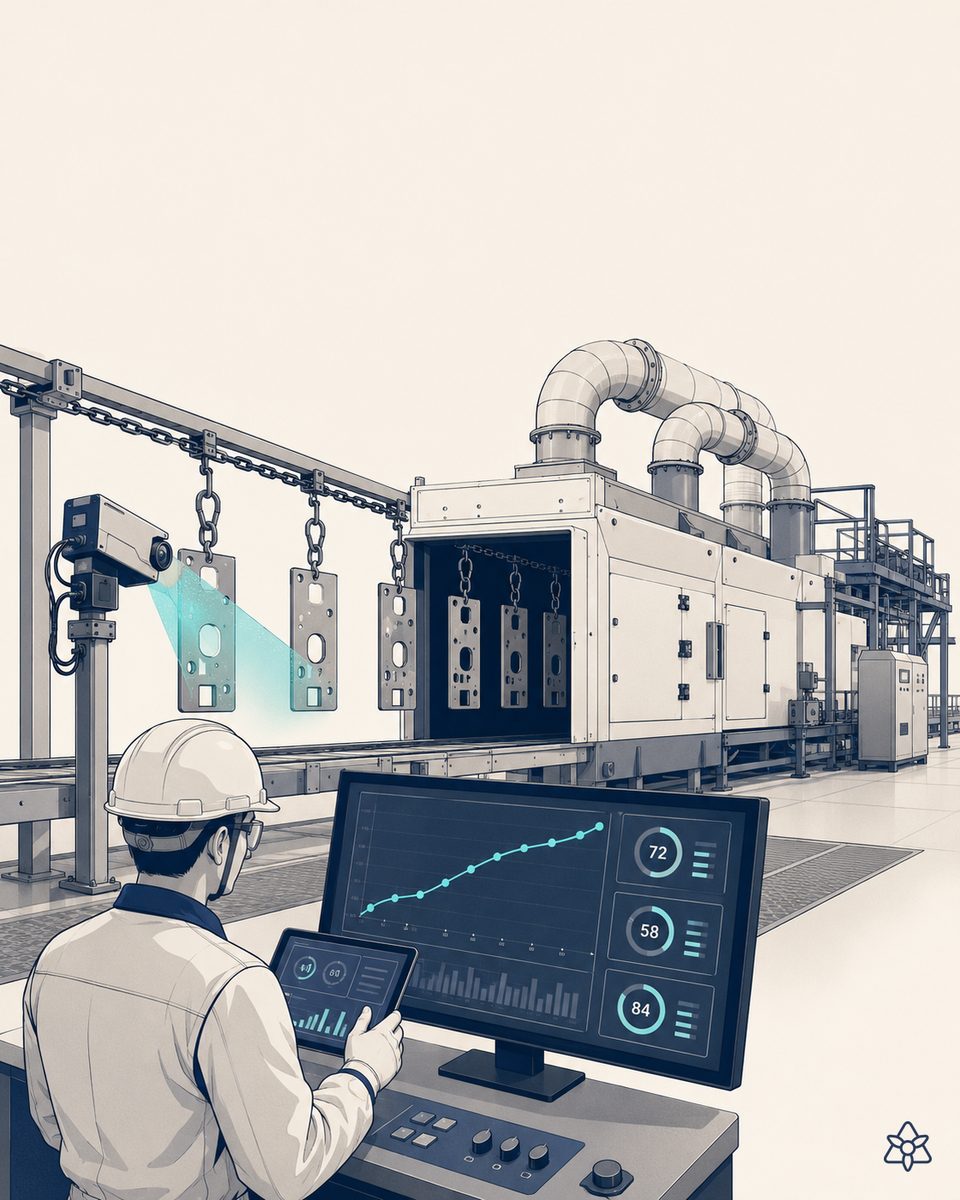
The recipe says one thing, the drum does another, and the customer can taste it.
On a snack line, seasoning is not applied as an exact weight on each chip: it is applied as a continuous flow of powder onto a rotating drum with a bed of product inside. And between the recipe and the consumer's mouth, half a dozen variables creep in that nobody ever wrote into any system:
- The day's humidity — on a dry day the seasoning flies; on a humid day it compacts and the dispenser discharges differently at the same setpoint.
- The drum fill level — if the upstream line slows down, the seasoning-to-product ratio shoots up.
- The upstream oil sprayer — if the oil cools or the filter clogs, the seasoning does not adhere and ends up on the floor instead of on the chip.
- The particle size of the seasoning batch — a change of supplier or batch and the flow changes without the recipe reflecting it.
The classic system is an hourly sample to the lab, a sensory test and the sales curve. It works 99% of the time. That 1% is the retailer complaint about bags as salty as the sea, or the entire batch sent to rework because the tasting panel downgraded it three hours after packing. The expensive part is not the salt: it is everything that gets labeled, packed, palletized and shipped before anyone finds out.
iLEAN does not replace the lab — it puts a continuous signal between two analyses.
The seasoning-control problem is not a lack of recipe: it is information living in islands that, at the moment things drift (SKU changeover, new seasoning batch, upstream stoppage), does not reach the decision-maker in time. iLEAN acts as the putty that fills the gaps between the recipe, the dispenser and the line, without asking you to change the drum or the packing.
Edge sees the coverage on the drum. Connect reads the dispenser, whether it comes from a modern PLC or an analog panel. The agent cross-checks against the SKU recipe and, if the deviation persists, holds product. The person signs — the line does not restart on its own.
The three iLEAN pieces applied to snack seasoning control:
- Edge — a machine-vision terminal (CNN) over the drum outlet. It reads the visible coverage of the product, measures distribution, detects pale zones and clumps. If coverage falls outside the SKU's window, it triggers an actuator (stack light, diversion to a rework bin) within milliseconds. It works without a network: if the plant loses WiFi, Edge keeps reading and holding, because what is critical cannot depend on connectivity.
- Connect — captures the seasoning dispenser reading in whatever format it comes: modern PLC, old isolated local computer, photographed analog panel. And it also captures what arrives from outside: the supplier's email with the new batch certificate, the shift lead's WhatsApp with the SKU changeover moved forward. Everything comes in at second zero, without anyone forwarding anything.
- Agent — cross-checks the visible coverage, the dispenser's actual flow rate, the SKU recipe, the recorded ambient humidity, the line's history and the upstream rate. If the deviation persists over several drum turns, it does not send an email at 10 p.m.: it holds the suspect bin and alerts the quality manager on whatever channel they use. The person validates and signs.
Manual seasoning control vs. cross-checked control with iLEAN
| Aspect | Hourly sampling + lab | With iLEAN Edge + Connect + Agent |
|---|---|---|
| Control frequency | Every 60-90 min, spot sample | Every turn of the drum, continuously |
| Dispenser reading | Written down by hand or ignored | Captured from the panel or the PLC at second zero |
| SKU changeover | New recipe, wait for the first analysis | Edge validates coverage from the first turn |
| Seasoning batch change | Assumed "equivalent" until something fails | Change captured by Connect, agent recalibrates the window |
| Deviation detection | 3 hours later, with product already packed | In line, before packing |
| File for the IFS/BRC auditor | Rebuilt by hand per batch | Per-batch dossier with coverage, flow rate and signature |
Impact estimate for your plant — to be validated with your numbers.
The block below is an estimate to be validated with the specific data of your plant. We put it forward so the committee has an order of magnitude; we refine it during the diagnostic.
- Fried or extruded snack plant, one drum seasoning line, 6-10 SKUs with different seasoning profiles (classic, spicy, BBQ, cheese).
- Edge pilot on one line (camera over the drum outlet + integration with the dispenser + cross-check against the MES recipe). First value expected within a few weeks.
- Indicative payback between 4 and 9 months, depending on the current average cost of a batch sent to rework and the frequency of retailer complaints about inconsistent flavor.
- Expected reduction in scrap from out-of-spec seasoning of ≥30%. The hard lever is what today goes into the rework sack or gets sold as lower-margin private label.
And the quality manager's reasonable doubt
"What if the AI decides to hold a good batch?" — hallucination is a problem of free generation, not of anchored tasks. When the AI merely reads an image of the drum and compares it against the recipe and the measured flow rate, the best models brought error below 1.5% [1]. And even so, what is critical is never decided alone: iLEAN holds and the person signs. The three safety rings exist precisely for this.
[1] OpenAI paper “Why Language Models Hallucinate”, 2025 — on the reliability of AI in anchored tasks.
What people ask about snack seasoning control
Why does snack seasoning drift out of control even when the recipe is fixed?
Because the recipe lives in one sheet, the dispenser lives in another, and the reality — how much salt lands on how many grams of product on each turn of the drum — lives in no system at all. Ambient humidity, seasoning particle size, drum fill level, belt speed and the state of the upstream oil sprayer all play a part. When those variables drift, the recipe still says the right thing but the actual dose is no longer what was planned. Without in-line capture there is no way to know until the lab confirms it hours later — and by then entire shifts are already headed for rework.
How does iLEAN measure seasoning coverage on the chip without a lab?
iLEAN Edge installs a camera with a neural network (CNN) over the seasoning drum outlet. It reads the visible coverage of the product in real time — color, distribution, presence of pale zones or clumps — and cross-checks it against the dispenser reading (actual grams per minute) and the batch recipe. It does not replace the lab: what it does is give you a continuous signal between analyses, so the deviation is caught at second zero and not three hours later.
What if the seasoning dispenser is old and has no digital output?
The usual case on snack lines. iLEAN Connect applies the capture gradient: if the dispenser has an analog panel, a camera photographs the reading and the system turns it into data; if it has a local computer, however old and isolated, Connect connects and extracts; if it has a modern interface, direct integration. It does not force you to replace the dispenser — it seals the crack between what exists and what the agent needs to know.
What if the AI gets it wrong and lets over-salted bags through?
Hallucination is a problem of free generation, not of anchored tasks. When the AI merely reads an image of the drum and compares it against the batch recipe, the error of the best models drops below 1.5% on source-anchored tasks (OpenAI paper, 2025). And even so, what is critical is never decided alone: iLEAN proposes, holds suspect product, and the person signs. The three safety rings exist precisely for this.
How long does a seasoning-control pilot take to go live?
First value — camera reading coverage and agent cross-checking against the dispenser — within a few weeks. The initial immersion takes 3-5 days: the mixed team works side by side (your plant's people + an embedded AI engineer), the SKU Pareto is identified (which flavors concentrate the bulk of the volume) and the baseline is measured. Without a baseline there is no way to prove the improvement — that is why we measure the "before" before touching anything.
More cases in food
- Sausage drying room control with AI — a piece that drifts is not recovered, it is anticipated.iLEAN cross-checks curing-chamber humidity, temperature and piece weight with the panel and the master…
- Shellfish cold chain control with AI — from boat to shelf, no jumps in the curve.How iLEAN cross-checks dock, transport and cold room with vision and agents to keep the shellfish cold…
- AI control of snack extrusion — the shape at the die rules, not the recipe in the spreadsheet.How iLEAN sees the snack's shape at the die exit and corrects the recipe before the oven — less scrap,…
- AI applied to spice, paprika and seasoning factoriesReal AI (IRIS) use cases for spice, paprika and seasoning factories: traceability, quality and less…
- Sugar refinery with AI — the commercial grade is not decided in the lab, it is decided in the vacuum pan.How iLEAN cross-checks ICUMSA color, polarization and pan-boiling parameters to stabilize refined sugar…
- Sunflower oil refining with AI — a container rejected for poorly precipitated wax is not an incident. It is a day's work lost.How iLEAN cross-checks acidity, color, peroxides and winterization to stabilize sunflower oil refining —…
Tell us your case and in 48h we'll send you the estimated ROI of this AI project for your snack line.
We work on your plant's real data, not ours. Diagnostic with no commitment.
Request estimated ROI in 48h See food industry