Sunflower oil refining with AI — a container rejected for poorly precipitated wax is not an incident. It is a day's work lost.
Sunflower oil refining cross-checks four lab results that each arrive at their own pace — crude acidity, tristimulus color, peroxide value and winterization for the US/UK market. That coordination is where the plant stumbles. iLEAN listens to the lab, the batches and the console, proposes the adjustment to the refinery lead, and the person signs.
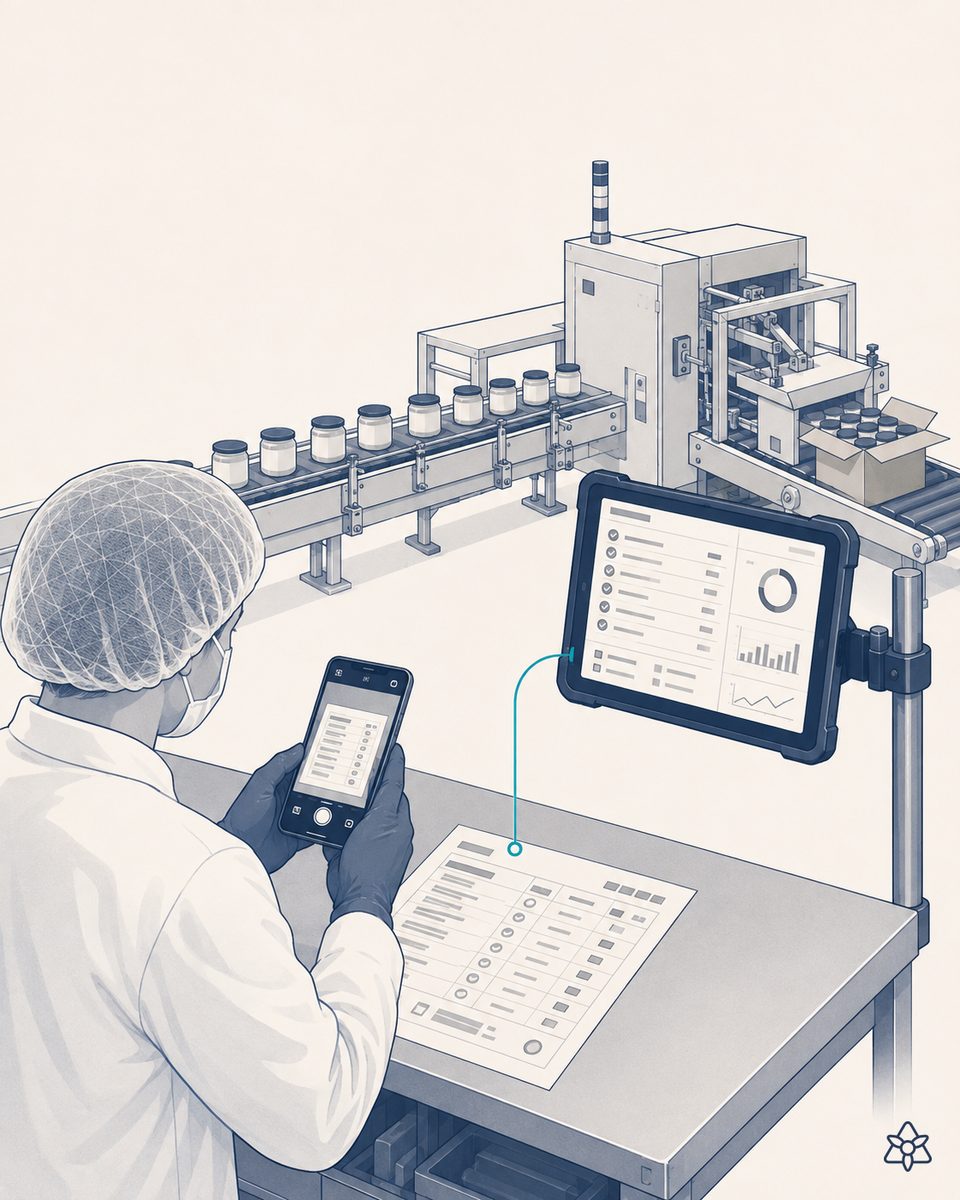
Four lab results, each at its own pace, and a retailer that rejects the container in the cold room.
Sunflower oil refining requires cross-checking four lab results — free acidity, color, peroxides, winterization — that do not arrive at the same time. Each one comes out of the lab in its own time window, and the refining operator receives them staggered. When they are cross-checked late, the batch is already packed and the container is on its way to the US or UK retailer, who measures winterization in the cold room before accepting it onto the shelf.
It happens because the data lives in different places and on different clocks:
- Incoming crude profile — sunflower variety (linoleic, high oleic, mid oleic), extraction conditions, age. In the receiving lab, and it arrives slowly.
- Neutralization and degumming parameters — caustic soda dose, temperature, time. On the console of the refining room, a screen the lead looks at every couple of hours.
- Color and peroxides — measured in the lab, several hours after the batch.
- Winterization — the slowest, the crystallization test takes hours.
When everything lines up, the plant runs. When a crude comes in with a different profile and nobody cross-checks it against the US retailer's winterization spec, the container leaves, arrives and is rejected. The plant does not fail on the technical side — it fails in the coordination between four streams of information that do not talk to each other.
iLEAN does not replace the LIMS or the refinery lead — it seals the cracks between what you already have.
The problem with refining control is not a lack of information: it is information living in islands that at the critical moment (the new crude coming in while the previous batch is being packed) does not reach the decision-maker in time. iLEAN acts as the putty that fills those gaps, without asking you to change the refining console, the LIMS or the packing line.
Edge watches color and turbidity in line. Connect reads the LIMS, the console and the retailer's spec at second zero. The agent correlates and proposes the adjustment to the refinery lead. The person signs — never the other way around.
The three iLEAN pieces applied to sunflower oil refining:
- Edge — a terminal with machine vision (CNN) and a multispectral sensor on a sight glass in the line, after bleaching or before packing. It reads tristimulus color, turbidity (correlated with residual wax) and suspended particles in real time. If the batch drifts from the declared retailer spec (color out of range, turbidity below the cloud point), it fires an alert and proposes redoing winterization. It works without a network: Edge keeps reading even if the plant loses its WiFi.
- Connect — captures the incoming crude profile whether it comes from the receiving lab or from the supplier's delivery note. It reads the refining-room console and the LIMS results as soon as they are issued. And it also captures what arrives from outside (a new US retailer spec by email, a complaint from the UK importer by WhatsApp) at second zero.
- Agent — cross-checks the crude profile, the neutralization / bleaching / deodorization / winterization parameters, the Edge in-line reading and the LIMS result. If it detects that the batch in progress is going to come out of the destination retailer's spec, it does not send an email at 10pm: it alerts the refinery lead with the specific adjustment (extend winterization time, adjust caustic soda dose, delay packing for reanalysis). The lead validates and signs; the refining does not adjust itself.
Classic control vs. cross-checked control with iLEAN
| Aspect | Classic control (LIMS + refinery lead) | With iLEAN Edge + Connect + Agent |
|---|---|---|
| Incoming crude profile | Delivery note to the lab, late result | Captured at second zero + cross-checked with the console |
| Color and turbidity | Spot sample, several hours | Continuous in-line reading |
| Winterization | Crystallization in the lab, hours | Anticipated by correlating crude + winterization history |
| Retailer spec | The sales rep's sheet, sometimes outdated | Captured from the retailer's email at second zero |
| Batch out of spec | Discovered at packing, already in the container | Redirected to a brand with a different tolerance beforehand |
| Batch file for the retailer | Rebuilt by hand, weeks | Per-batch dossier, automatic, with Edge photo + LIMS |
Impact estimate for your plant — to be validated with your numbers.
The block below is an estimate to be validated with the specific data of your refinery. We put it forward so the committee has an order of magnitude; we refine it during the diagnostic.
- Refinery with a standard sunflower oil line + high oleic for US/UK retailer export, a mix of crudes from variable suppliers.
- Edge pilot on the bleaching-outlet sight glass (multispectral camera + integration with the refining console and LIMS). First value expected within a few weeks.
- Indicative payback between 4 and 9 months, depending on the historical frequency of export rejections over winterization / color and the average cost per rejected container.
- Hard lever: ≥ 30% reduction in batches redirected to a wider-tolerance brand and winterization rework. A single avoided container rejection pays for the pilot.
And the quality manager's reasonable doubt
"What if the AI tells me winterization is fine and then the retailer rejects it?" — hallucination is a problem of free generation, not of anchored tasks. In tasks where the AI merely correlates what is already measured (color, turbidity, winterization parameters, crude profile), the best models brought error below 1.5% [1]. And even so, the batch release is not decided by the AI: the agent proposes, the quality manager signs. The three safety rings exist precisely for this.
[1] OpenAI paper "Why Language Models Hallucinate", 2025 — on the reliability of AI in source-anchored tasks.
What people ask about quality control in sunflower oil refining
Which parameters define quality in sunflower oil refining?
Four lab results dominate: free acidity (target < 0.1% in refined oil for consumption), peroxide value (oxidation, low target depending on the retailer), tristimulus color (Lovibond, sets the consumer's visual acceptance) and cold resistance / winterization (precipitated waxes, critical for the US/UK market and high-oleic oil). Add residual phosphorus (degumming) and soap traces. The challenge is not the analysis — the lab has it — it is that each parameter arrives at its own pace: degumming and neutralization in minutes, color and winterization in hours. When they are cross-checked late, the batch is already packed.
Why does quality drift between refining batches?
Because every crude oil comes in with a different profile (sunflower variety, crude extraction conditions, storage age) and the refinery has to adjust the caustic soda dose for neutralization, the winterization temperature and the deodorization vacuum against that profile. If the incoming crude data does not reach the refinery lead quickly, the adjustment is made late, and the batch comes out with residual acidity or poorly precipitated wax — which the US retailer detects and rejects in the cold room before it ever reaches the shelf.
Can iLEAN Edge read oil color and turbidity in line?
Yes. Edge is a terminal with machine vision (CNN) and a multispectral sensor mounted on a sight glass in the refining line, after bleaching or before packing. It reads tristimulus color, turbidity correlated with residual wax and the presence of suspended particles in real time. It cross-checks with the neutralization and winterization console via Connect, and if the batch is drifting from the retailer's spec (color too dark, turbidity below the declared cloud point), it alerts the refinery lead before packing — in time to redo winterization or redirect to another brand with a different tolerance.
How does this integrate with a lab that analyzes every batch?
iLEAN does not replace the LIMS — it listens to it. Connect captures the acidity, peroxide, phosphorus and winterization results as soon as the lab issues them, cross-checks them with the Edge in-line reading and with the console of the refining stages, and the agent correlates which deviation in the incoming crude or the process parameters is producing which quality deviation. The lab's hour turns into a predictive alert on the batch in progress. The quality manager decides; the agent saves them the cross-referencing Excel sheet.
How much does a quality-control pilot cost in an oil refinery?
The order of magnitude of an Edge pilot on a sight glass in the refining line falls in the usual range of any Edge pilot in an oils plant: an initial investment covering terminal + multispectral camera + integration with the refining console and the LIMS, plus an annual license. A reasonable payback sits between 4 and 9 months, conservatively — the hard lever is avoiding batches rejected by the US/UK retailer (one rejected container of high-oleic oil is tens of thousands of euros plus brand cost) and reducing rework from color or wax deviation. We ask for your refinery's data and send you the estimated ROI in 48h with your numbers.
Sugar refinery control with AI → · Flour mill control with AI →
More cases in food
- Snack seasoning control with AI — the right dose in every bag, not just in the recipe.How iLEAN cross-checks the SKU recipe, the seasoning dispenser and visible coverage so every bag of…
- AI applied to spice, paprika and seasoning factoriesReal AI (IRIS) use cases for spice, paprika and seasoning factories: traceability, quality and less…
- Sugar refinery with AI — the commercial grade is not decided in the lab, it is decided in the vacuum pan.How iLEAN cross-checks ICUMSA color, polarization and pan-boiling parameters to stabilize refined sugar…
- Industrial artificial intelligence in 100% agave tequila distilleries12 real industrial AI cases for 100% agave tequila distilleries: batch logs, autoclave, lab data,…
- Wild-catch fishing traceability with AI — the chain does not break in the plant, it breaks at the dock.iLEAN captures the vessel delivery note, the auction record and MSC certification and links them to the…
- Wine vintage traceability with AI — a vintage is worth twice as much when you can prove it.From harvest to bottle without losing the vintage. iLEAN binds parcel, tank, barrel and bottling into a…
Tell us your case and in 48h we'll send you the estimated ROI of this AI project for your refinery.
We work on your plant's real data, not ours. Diagnostic with no commitment.
Request estimated ROI in 48h See food industry