Sugar refinery with AI — the commercial grade is not decided in the lab, it is decided in the vacuum pan.
Quality control in a sugar refinery wrestles with three variables that are almost never aligned in real time — ICUMSA color, polarization and final moisture — because the data lives in the LIMS, on the pan operator's console and in the shift lead's Excel sheet. iLEAN cross-checks all three in line, anticipates the deviation before centrifuging, and leaves the decision with the person.
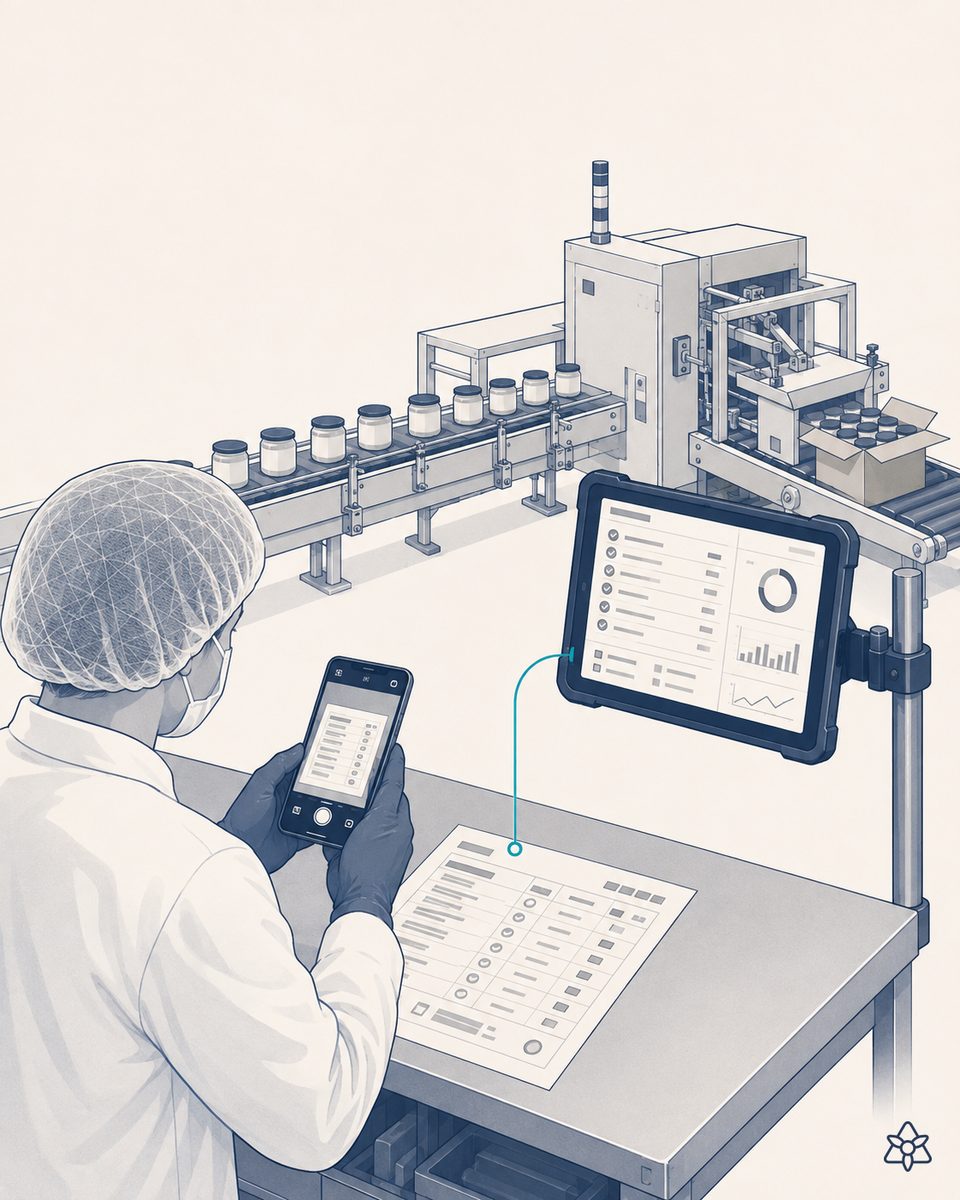
The pan has already boiled and nobody told the operator the syrup had changed.
Refined sugar quality is decided upstream — in the vacuum pan, when the operator feeds the syrup, introduces the seed and lets the grain grow. If that strike drifts, what comes out of the centrifuge cannot be recovered: it is either reworked or downgraded to a lower commercial grade. And most of the time, the operator does not know it is drifting until the LIMS, an hour later, returns the polarimeter result.
It happens because the information arrives late and through different channels:
- The color of the mother liquor charged — depends on how the earlier stages evaporated; the data lives on the evaporator console and nobody carries it to the pan panel.
- The veteran's adjustments — the pan's sight glass, the feel of the syrup flow, the moment of crystallization. That eye is not in any system.
- The lab result — polarization, ICUMSA color, ash. It arrives fine — but an hour later, when that pan has already discharged and is on its way to packing.
Everyone does their job. The system fails in the coordination, not in the measurements — and the loss is real: a season with 3-4% of batches downgraded to a lower commercial grade is hundreds of thousands of euros in refined sugar sold as standard white.
iLEAN does not replace the LIMS or the pan operator — it seals the cracks between what you already have.
The problem with refinery control is not a lack of information: it is information living in islands that at the critical moment (the next pan starting up before the lab returns the previous one) does not reach the decision-maker in time. iLEAN acts as the putty that fills those gaps, without asking you to change the pan console, the LIMS or the dryer.
Edge watches color and grain at the dryer outlet. Connect reads the pan console and the LIMS result at second zero. The agent correlates and proposes the adjustment to the operator. The person signs — never the other way around.
The three iLEAN pieces applied to refined sugar quality control:
- Edge — a terminal with machine vision (CNN) over the sugar belt coming out of the dryer or the holding silo. It reads color, mean grain size and grain-size dispersion without touching the line. If the reading drifts from the commercial grade declared for that batch, it fires an actuator (signal light, diverter to the standard-white silo) in milliseconds. It works without a network: if the plant loses its WiFi, Edge keeps sorting.
- Connect — captures the pan data whether it comes from a modern console or from an old PLC with only a local screen. It reads the LIMS as soon as the lab issues the result, without waiting for the shift report. And it also captures what arrives from outside (a retailer spec changed in an email, a complaint from an industrial customer over caking) and puts it in the system at second zero.
- Agent — cross-checks the Edge reading at the outlet, the console of the pan that produced that batch, the LIMS result and the season history. If it detects that the next strike is going to come out with a deviation, it does not send an email: it alerts the operator through whatever channel they use, with the specific proposed adjustment (raise the vacuum 3 mbar, lower the syrup flow, delay the seed). The operator validates and signs; the pan does not adjust itself.
Classic control vs. cross-checked control with iLEAN
| Aspect | Classic control (LIMS + veteran operator) | With iLEAN Edge + Connect + Agent |
|---|---|---|
| ICUMSA color | Lab result every hour, post-centrifuge | In-line reading + correlation with the pan that produced the batch |
| Polarization | Polarimeter reading, logged in an isolated LIMS | Cross-checked with the pan console as soon as it is issued |
| Final moisture | Sample at packing, too late to react | Anticipated from the dryer reading + proposed adjustment |
| Adjusting the next pan | Operator's memory + sight-glass intuition | Concrete proposal from the agent, validated by the operator |
| Commercial-grade downgrade | Confirmed at packing, no reaction possible | Diverted to the standard-white silo before packing |
| Season file | Rebuilt by hand at every season close | Per-pan dossier, automatic, with photos and traces |
Impact estimate for your plant — to be validated with your numbers.
The block below is an estimate to be validated with the specific data of your plant. We put it forward so the committee has an order of magnitude; we refine it during the diagnostic.
- Mid-sized refinery with 2-4 vacuum pans, a single dryer outlet, a mix of premium refined + standard white + industrial.
- Edge pilot at the dryer outlet (color + grain camera + integration with the pan console and LIMS). First value expected within a few weeks.
- Indicative payback between 4 and 9 months, depending on the historical percentage of batches downgraded in the previous season and the €/kg spread between your premium refined and standard white.
- Hard lever: ≥ 30% reduction in batches downgraded to a lower commercial grade. Over a season of several million kilos, a single well-captured correlation pays for the pilot.
And the refinery lead's reasonable doubt
"What if the agent proposes the wrong adjustment and I ruin the pan?" — hallucination is a problem of free generation, not of anchored tasks. In tasks where the AI merely correlates what is already measured (color, vacuum, polarization, feed profile), the best models brought error below 1.5% [1]. And even so, the pan adjustment is not decided by the AI: the agent proposes, the operator signs. The three safety rings exist precisely for this.
[1] OpenAI paper "Why Language Models Hallucinate", 2025 — on the reliability of AI in source-anchored tasks.
What people ask about quality control in a sugar refinery
Which parameters define refined sugar quality?
Three families: ICUMSA color (the lower, the whiter — premium refined < 45 IU), polarization (sucrose purity, ideally ≥ 99.8°Z) and final moisture (target < 0.04% to avoid caking in the silo). Add conductimetric ash and grain-size distribution by segment (consumer, industrial, baking). The problem is not measuring each one separately — the lab does that well — it is having all three aligned in the same batch, in the same shift, together with the boiling parameters of the vacuum pan that produced that massecuite.
Why does quality drift between pan strikes?
Because vacuum boiling of the massecuite depends on variables that are rarely cross-checked in real time: pan temperature and vacuum, the seed introduced, the syrup feed profile, the color of the mother liquor charged, and the fine adjustments the veteran operator makes "by eye" from how he sees the grain grow through the sight glass. By the time it is centrifuged and the lab returns the result, it is too late to correct that strike — and the rework or the commercial-grade downgrade begins.
Can iLEAN Edge measure color and grain on the line without touching the machine?
Yes. Edge is a terminal with machine vision (CNN) mounted over the sugar belt coming out of the dryer or the holding silo. It reads color, mean grain size and grain-size dispersion in real time, without stopping the line or changing the belt. It cross-checks with the centrifuge and pan consoles via Connect, and if the batch is drifting from its declared commercial grade, it flags it before packing — in time to reclassify to another grade without reprocessing.
How does this integrate with a lab that already runs hourly analyses?
iLEAN does not replace the LIMS — it listens to it. Connect captures the polarimeter and colorimeter results from the lab as soon as they are generated, cross-checks them with the Edge in-line reading and with the console of the pan that produced the massecuite, and the agent correlates which deviation in boiling parameters is producing which final-quality deviation. The lab's hour turns into a predictive alert on the strikes in progress. The quality manager decides; the agent saves them the cross-referencing Excel sheet.
How much does a quality-control pilot cost in a sugar refinery?
The order of magnitude of an Edge pilot on a dryer outlet or a centrifuging point falls in the usual range of any Edge pilot in an agri-food plant: an initial investment covering terminal + camera + integration with the pan console and the LIMS, plus an annual license. A reasonable payback sits between 4 and 9 months, conservatively — the hard lever is avoiding commercial-grade downgrades (premium refined to standard white is several cents per kilo across millions of kilos a year) and eliminating rework. We ask for your season's data and send you the estimated ROI in 48h with your numbers, not ours.
Flour mill control with AI → · Sunflower oil refining with AI →
More cases in food
- AI control of snack extrusion — the shape at the die rules, not the recipe in the spreadsheet.How iLEAN sees the snack's shape at the die exit and corrects the recipe before the oven — less scrap,…
- Snack seasoning control with AI — the right dose in every bag, not just in the recipe.How iLEAN cross-checks the SKU recipe, the seasoning dispenser and visible coverage so every bag of…
- AI applied to spice, paprika and seasoning factoriesReal AI (IRIS) use cases for spice, paprika and seasoning factories: traceability, quality and less…
- Sunflower oil refining with AI — a container rejected for poorly precipitated wax is not an incident. It is a day's work lost.How iLEAN cross-checks acidity, color, peroxides and winterization to stabilize sunflower oil refining —…
- Industrial artificial intelligence in 100% agave tequila distilleries12 real industrial AI cases for 100% agave tequila distilleries: batch logs, autoclave, lab data,…
- Wild-catch fishing traceability with AI — the chain does not break in the plant, it breaks at the dock.iLEAN captures the vessel delivery note, the auction record and MSC certification and links them to the…
Tell us your case and in 48h we'll send you the estimated ROI of this AI project for your refinery.
We work on your plant's real data, not ours. Diagnostic with no commitment.
Request estimated ROI in 48h See food industry