Flour milling with AI — a low falling number is not an incident, it is a complaint from the baker.
A stable mill depends on cross-referencing wheat moisture, product particle size, ash and falling number batch after batch. That data lives in four different places — and the quality manager cannot be in all four at once. iLEAN listens to all four inline, proposes the blend adjustment and the person signs.
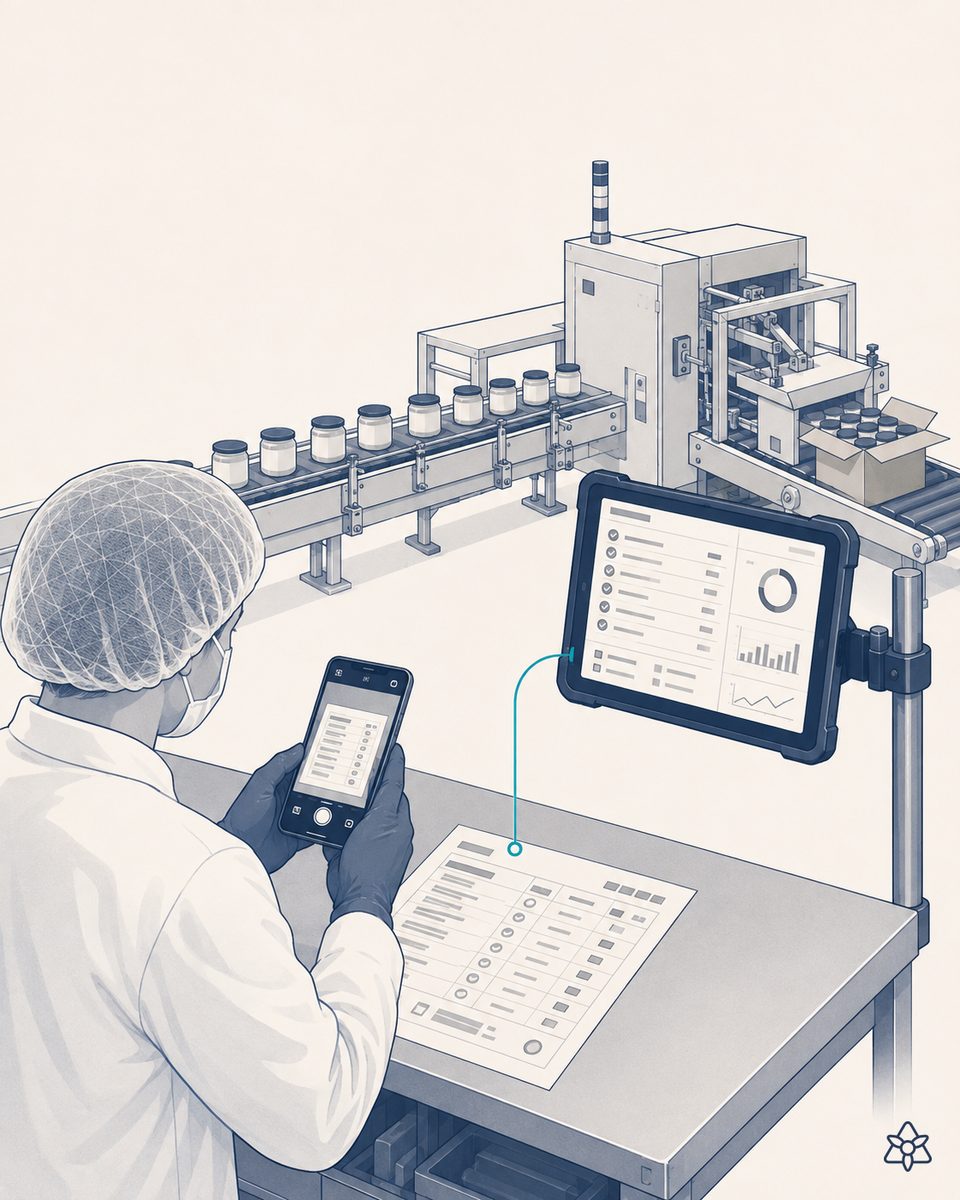
The wheat changes with every truck and the blend recipe changes in a spreadsheet.
The quality of an industrial flour depends on a balance that breaks every time a new wheat delivery arrives: different harvest moisture, different hardness, different protein profile. Conditioning (tempering) should compensate for it, but it only does so properly if the incoming data arrives in time and is cross-referenced with the destination of the blend. And that rarely happens.
It happens because the information lives in four different places:
- Moisture and hardness of the wheat on the truck — on the delivery note, in the intake lab, sometimes in the purchasing manager's head.
- Milling stand parameters — in the mill's SCADA, a screen the shift lead looks at every couple of hours.
- Particle size and color at the outlet — the plansifter does its job, but the fine analysis arrives later.
- Falling number, protein, ash — in the in-house lab, an hour later, once the flour is already in the silo.
When the industrial baker calls at 11 the next morning to say the dough is sticking, that batch is already spread across 30 points of sale. The mill works 95% of the time. That 5% is what comes back as a complaint — and every complaint is hard cost plus the cost to the account.
iLEAN does not add a fifth system — it seals the cracks between the four you already have.
The problem with blend control in a mill is not a lack of information: it is information living on islands that, at the critical moment (the new truck discharging while the day's blend keeps running to the silo), does not reach the decision-maker in time. iLEAN acts as the putty that fills those gaps, without asking you to change the mill's SCADA, the LIMS or the silo.
Edge sees the flour at the plansifter outlet. Connect reads the wheat delivery note, the SCADA and the LIMS at second zero. The agent correlates and proposes the adjustment to the shift lead. The person signs — never the other way round.
The three iLEAN pieces applied to quality control in a flour mill:
- Edge — a terminal with machine vision (CNN) over the plansifter outlet belt or the loading silo. It reads color (correlated with ash), mean particle size and dispersion without touching the line. If the reading drifts away from the declared type (T55 coming out darker than the range, coarser particle size), it triggers a diversion to another silo or requests a conditioning adjustment. It works without a network: Edge keeps classifying even if the plant loses WiFi.
- Connect — captures the incoming wheat delivery note whether it comes from the ERP, from the intake lab or from a spreadsheet kept by the purchasing manager. It reads the mill SCADA and the LIMS as soon as they issue a result, without waiting for the shift report. And it also captures what arrives from outside (a spec change from the industrial baker by email, a customer complaint over WhatsApp) at second zero.
- Agent — cross-references the incoming wheat, the conditioning parameters, the Edge reading at the outlet, the LIMS result and the blend recipe of the destination silo. If it detects that the batch in progress is going to come out off type, it does not send an email at 10 p.m.: it alerts the shift lead on whichever channel they use, with a concrete proposal (raise conditioning moisture, change the stand blend, redirect to a silo of a different type). The lead validates and signs; the blend is never adjusted on its own.
Classic control vs. cross-referenced control with iLEAN
| Aspect | Classic control (LIMS + shift lead) | With iLEAN Edge + Connect + Agent |
|---|---|---|
| New wheat intake | Delivery note to the lab, result hours later | Captured at second zero + cross-referenced with the SCADA |
| Particle size / color | Spot sampling + manual sieving | Continuous inline reading, on every batch |
| Conditioning adjustment | The miller's memory, based on the last analysis | Agent proposal cross-referencing wheat + SCADA + Edge |
| Type deviation (T55 → T80) | Confirmed by the lab, already in the silo | Diverted to the right silo before discharge |
| Baker complaint | Investigation after the fact, days to rebuild the batch | Per-batch dossier with every parameter, automatic |
| Shift close-out | The shift lead's manual spreadsheet | Automatic report with deviations and adjustments |
Impact estimate for your plant — to be validated with your numbers.
The block below is an estimate to be validated with the specific data of your mill. We put it forward so the committee has an order of magnitude; we refine it during the diagnostic.
- Mid-sized mill with 3-4 milling stands, a blend of soft and hard wheat, flours for industrial bakery + biscuits + pastry.
- Edge pilot at the main plansifter outlet (color + particle size camera + integration with SCADA and LIMS). First value expected within a few weeks.
- Indicative payback between 4 and 9 months, depending on the frequency of complaints for falling number / off-type ash recorded over the last few years and the average weight of the batch claimed.
- Hard lever: a reduction of ≥ 30% in off-type batches redirected to secondary uses. One single major complaint from an industrial baker pays for the pilot.
And the mill manager's reasonable doubt
“What if the agent proposes the wrong blend and I ruin a whole silo?” — hallucination is a problem of free generation, not of anchored tasks. In tasks where the AI merely correlates what is already measured (wheat moisture, stand parameters, the plansifter reading, falling number), the best models brought error below 1.5% [1]. And even so, the silo blend is not decided by the AI: the agent proposes, the miller signs. The three safety rings exist precisely for this.
[1] OpenAI paper “Why Language Models Hallucinate”, 2025 — on the reliability of AI in tasks anchored to the source.
What people ask about quality control in a flour mill
Which parameters define the quality of an industrial flour?
Four big ones: moisture (target depends on the product, typically 14-15%), particle size (sieve passage according to use — bread, pastry, biscuits), ash content (which sets the flour type: T45, T55, T80, T150) and falling number / amylase activity (critical for the baker: a flour with a low falling number gives a sticky crumb that the customer sends back). On top of that come protein, wet gluten, alveograph W/P and, in technical flours, full rheology. The problem is not the analysis — modern mills have it — it is that the analysis decides downstream, once the blend is already made.
Why does the flour blend drift from batch to batch?
Because every wheat delivery comes in with a different profile: harvest moisture, hardness, protein content, kernel size. If conditioning (tempering the wheat before milling) does not compensate for that variability, the flour comes out of specification — and the blend adjustment is made afterwards, charged against the silo of flour already produced. And if the silo blend recipe is updated in a spreadsheet that the quality manager passes to the shift lead over WhatsApp, one single new wheat delivery throws the day's batch out of calibration and the rework — or the industrial baker's complaint — starts the next morning.
Can iLEAN Edge measure flour particle size and color inline?
Yes. Edge is a terminal with machine vision (CNN) mounted over the plansifter outlet or over the belt to the silo. It reads color (correlated with ash), mean particle size and dispersion in real time, without stopping the line or touching the sieve. It cross-references with the milling stand console and with the lab result through Connect, and if the batch is drifting away from the declared type (T55 coming out darker, coarser particle size), it raises the alert before discharge into the silo — with time to adjust conditioning or redirect to the right silo.
How does this integrate with a lab that measures once an hour?
iLEAN does not replace the lab — it listens to it. Connect captures the ash, falling number and protein results as soon as the lab issues them, cross-references them with the inline Edge reading and with the milling stand console, and the agent correlates which conditioning or wheat-blend deviation is producing which quality deviation. The lab hour becomes a predictive alert on the blend currently running. The quality manager decides; the agent saves them the cross-referencing spreadsheet.
How much does a quality control pilot cost in a flour mill?
The order of magnitude of an Edge pilot over the plansifter outlet or the belt to the silo falls within the usual range for any Edge pilot in a grain plant: an initial investment covering terminal + camera + integration with the milling SCADA and the LIMS, plus an annual license. A reasonable payback is between 4 and 9 months, conservatively — the hard lever is avoiding industrial baker complaints (a single batch rejected for a low falling number is several thousand euros plus the cost to the brand) and cutting rework from off-type flour. We ask for your mill's data and send you the estimated ROI in 48h with your numbers.
Sugar refinery control with AI → · Rice whitening control with AI →
More cases in food
- Automatic FIFO/FEFO in a food warehouse — an expired unit on the retailer's shelf is not an incident, it is a phone call from your sales director.iLEAN drives picking by expiry date without relying on the operator. Expired product drops sharply, with…
- Fish cold room temperature control with AI — the range is not a chart, it is a dossier per batch.How iLEAN cross-checks temperature, door openings, load and the room's curve to keep fresh fish in range…
- Flash juice pasteurization with AI — the HTST window is seconds wide, and the decision cannot take longer.How iLEAN cross-references HTST curve, flow, pH and traceability on flash juice lines with Edge +…
- Blockchain traceability in food — the chain is only worth something if the data at source is true.iLEAN adds blockchain only where it pays off: verified plant data plus an external DLT to certify…
- 24/7 OEE in food manufacturing with AI — the micro-stops nobody writes down are your biggest loss pool.iLEAN measures OEE on your food lines 24/7: every micro-stop logged to the second, and the operator…
- Production waste and food waste with AI — waste should not surface only at month-end.iLEAN captures waste at the point where it happens, attributes every kilo to its root cause and ranks…
Tell us your case and in 48h we'll send you the estimated ROI of this AI project for your mill.
We work on your plant's real data, not ours. Diagnostic with no commitment.
Request estimated ROI in 48h See food industry