Blockchain traceability in food — the chain is only worth something if the data at source is true.
Blockchain in food makes sense if the data you record is real. iLEAN Tracer captures verified data on the plant floor and only then links it out to an external DLT — no blockchain marketing, no empty promises, and no lock-in to one particular network. The hard part is the capture; the blockchain is the last mile.
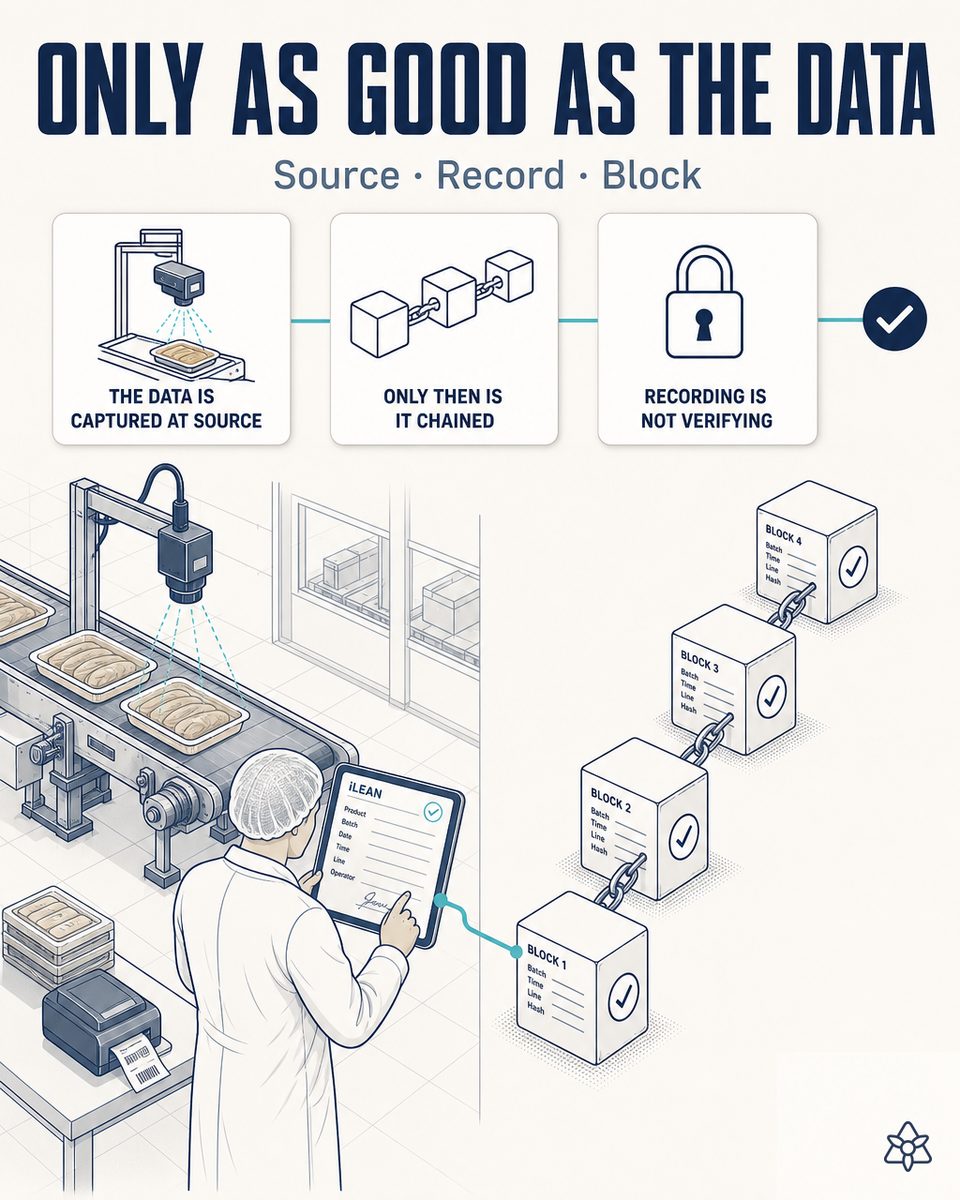
The blockchain promise, and the real problem almost nobody names.
The phrase “blockchain traceability” has been circulating in food for years, carrying the implicit promise that a record on a blockchain is, by itself, proof of origin. Technically, that is not true: blockchain guarantees that a recorded value is not altered afterwards, but it does not guarantee that the value was true at source. It is the classic computing problem: garbage in, immutable garbage out.
- The pilot project that never scales — a retailer pushes blockchain; the producer sets up a parallel process where somebody types the origin into a form, and that gets uploaded to the chain. Everything upstream of the typing is untouched: it still lives in delivery notes and spreadsheets.
- The consumer scanning the QR code — they see a pretty timeline, a photo of the farmer and a “blockchain verified” badge. They have no way of knowing whether what was verified is plant data or a keyboard in an office.
- The retailer's auditor — the only one who knows the difference. They keep asking for more evidence of the upstream capture: who weighed it? on which scale? with which camera? with whose signature? how long did it take to be uploaded?
The right question for a management committee is not “should we do blockchain?” — it is “is the data I am about to record verified on the plant floor, or is somebody typing it in?”. If the answer is the second one, the blockchain adds nothing a signed PDF was not already doing. If the answer is the first one, blockchain is a genuinely useful last mile. iLEAN focuses on turning the answer into the first one.
iLEAN charges for verified capture — the blockchain is the last 5%.
The problem with blockchain traceability is not the blockchain — it is the capture. iLEAN acts as the putty that seals the cracks between origin, plant and record: it makes sure the data that reaches the DLT arrives verified by sensors, vision and automatic cross-checking, not by a keyboard.
Tracer holds the batch identity. Edge sees the physical origin. Connect captures delivery notes, certificates and supplier communications. Only once the data is verified does the agent package it and link it to whatever DLT your customer or your sector demands.
The iLEAN pieces applied to blockchain traceability:
- Tracer — product batch identity from origin (farm, plot, fishing vessel, import) all the way to destination. Every change of custody, every operation, every milestone leaves a signed trace. The DLT receives those verified milestones, not a form.
- Connect — captures the supplier's delivery note (photo + automatic extraction), the weighbridge reading, the receiving manager's voice, the phytosanitary certificate in PDF, the WhatsApp message from the carrier about a problem. It all enters at second zero and gets cross-checked.
- Edge — wherever there is a critical physical operation (cutting, packing, labeling), a vision-equipped terminal verifies that what is being processed is what it claims to be. An Iberian cut marked with a PDO is the one that gets labeled with that PDO — not a similar-looking one.
- Agent — orchestrates the link to the external DLT (IBM Food Trust, Hyperledger, Ethereum, Polygon, a retailer's vertical network). It decides which data is public, which stays private to the consortium, which is published to a consumer QR code. And it prepares the file for the retailer's auditor, who keeps asking for more evidence of the capture. The person validates; the three rings guarantee that iLEAN proposes and the manager signs.
“Marketing” blockchain vs. blockchain with verified capture
| Aspect | Classic blockchain project | With iLEAN Tracer + verified capture + DLT |
|---|---|---|
| Source of the recorded data | A form typed in by a person | Sensors, vision, delivery notes and voice captured in the plant |
| Third-party verifiability | Only of the record itself | Of the record and of the upstream capture chain |
| Time between event and upload | Hours or days — a parallel process | Second zero, embedded in the plant flow |
| Recurring cost | Double: normal operation + parallel data entry | Capture built into normal operation |
| Resistance to a retailer audit | Fragile — the auditor asks about the capture | Solid — the capture is the system |
| Choice of DLT | Tied to the vendor who sold the project | Agnostic — chosen per customer and per sector |
Impact estimate for your plant — to be validated with your numbers.
The block below is an estimate to be validated with the specific data of your supply chain. We put it forward so the committee has an order of magnitude; we refine it during the diagnostic.
- Premium food producer facing a public-verification requirement: PDO/PGI, exports to Asia or North America, a retailer with a DLT initiative (Walmart Food Trust, Carrefour, etc.) or an in-house sustainability program.
- Tracer + Connect pilot over the key chain (from origin to labeling), linked to whatever DLT your end customer already uses or requires. First value expected within a few weeks: one batch traceable and verifiable by a third party.
- Reduction of the administrative effort of meeting the customer's blockchain requirement ≥ 30% against the baseline — the lever is eliminating the parallel data-entry process.
- Indicative payback between 4 and 9 months, depending on the price premium the customer pays for a verifiable certificate and on export volume.
- Additional hard lever: unlocking premium accounts that are out of reach today because you cannot demonstrate verifiable traceability. A single new export customer covers the pilot.
And the question every CAIO asks
“Isn't this just a fad?” — it depends what for. As a horizontal technology that was going to transform the whole food industry, yes, blockchain fell short of the initial expectations. As a tool for premium niches that need public verification (PDO/PGI, exports to demanding markets, products with an origin premium), it is established and growing. The difference between those two readings is exactly which factory is using it and for which customer. And as for the fear of trusting AI to prepare what goes onto the blockchain: hallucination is a problem of free generation, not of anchored tasks (extracting data from a delivery note to upload it to a chain), where the best models brought error below 1.5%[1]. And the batch is still signed by the person accountable for it.
[1] OpenAI paper “Why Language Models Hallucinate”, 2025 — on the reliability of AI in anchored tasks.
What people ask about blockchain traceability in food
What is blockchain actually good for in the food industry?
For guaranteeing that a record, once written, cannot be altered afterwards without the change being visible — and for letting a third party (retailer, importer, consumer) verify that record without having to take the manufacturer's word for it. The strongest real uses in food: protected designations of origin (PDO, PGI), premium products with an origin claim (Iberian ham, specialty coffee, single-origin cocoa), exports to markets that demand public proof (Asia and North America) and sustainability claims (food miles, certified carbon footprint). Where no third party is demanding public verification of the record, blockchain is marketing.
What if the data is false before it ever gets recorded? The GIGO problem.
That is the central problem — and it has a name: GIGO (garbage in, garbage out). Blockchain guarantees that a recorded value is not altered afterwards, but it does not guarantee that the value was true at source. If someone types “origin: Seville” into a form and the product actually came from Morocco, the blockchain certifies that falsehood forever. That is why iLEAN does not sell blockchain — it sells verified capture on the plant floor (Edge sees the weighing, Connect reads the supplier's delivery note, Tracer holds the identity) and only then links out to an external DLT. Blockchain without capture is blockchain marketing; with verified capture, it is real traceability.
Which DLT does iLEAN integrate with?
iLEAN is DLT-agnostic. We integrate with the networks your customers or your sector are already using — IBM Food Trust, Hyperledger Fabric, public networks (Ethereum, Polygon) when fully open verifiability is the goal, or a retailer's vertical network (Walmart, Carrefour, Mercadona in its internal variant). Choosing a DLT is not a technical decision — it is a strategic one: it depends on which external party is going to verify the record. iLEAN helps you choose, but never locks you into one.
Blockchain vs. classic ERP/MES traceability — what does it cost?
Classic internal traceability (ERP/MES + spreadsheets + email) works for internal audits and for food-safety authorities and rapid alert systems — not for public verification. If your need is to answer the regulator, you do not need blockchain. If your need is for an Asian importer or a consumer scanning a QR code to verify origin without trusting you, blockchain adds real value. The extra cost of the DLT (transactions + integration) is small next to the cost of real traceability on the plant floor — and that is exactly why iLEAN charges for the capture, not for the blockchain.
Is any customer or retailer demanding blockchain in food today?
Yes, in specific niches: Walmart has pushed IBM Food Trust onto leafy-green and other sensitive suppliers since the 2018 E. coli outbreak, Carrefour runs its own initiative on premium French products, and various Asian importers require blockchain verification for specialty coffee and single-origin cocoa. Where it really lands is premium products with an origin premium: the buyer pays extra only if they can verify it. Adoption is vertical and niche — not horizontal. iLEAN steps in when there is a concrete requirement, not to “modernize”.
More cases in food
- Fish cold room temperature control with AI — the range is not a chart, it is a dossier per batch.How iLEAN cross-checks temperature, door openings, load and the room's curve to keep fresh fish in range…
- Flash juice pasteurization with AI — the HTST window is seconds wide, and the decision cannot take longer.How iLEAN cross-references HTST curve, flow, pH and traceability on flash juice lines with Edge +…
- Flour milling with AI — a low falling number is not an incident, it is a complaint from the baker.How iLEAN cross-references wheat moisture, particle size, ash and falling number to stabilize the flour…
- 24/7 OEE in food manufacturing with AI — the micro-stops nobody writes down are your biggest loss pool.iLEAN measures OEE on your food lines 24/7: every micro-stop logged to the second, and the operator…
- Production waste and food waste with AI — waste should not surface only at month-end.iLEAN captures waste at the point where it happens, attributes every kilo to its root cause and ranks…
- Industrial artificial intelligence for fresh cheese factoriesTwelve real industrial AI cases in fresh cheese dairies: paperless capture, in-line vision and auditable…
Tell us your case and in 48h we'll send you the estimated ROI of this AI + blockchain project for your supply chain.
We work on your plant's real data, not ours. Diagnostic with no commitment.
Request estimated ROI in 48h See food industry