24/7 OEE in food manufacturing with AI — the micro-stops nobody writes down are your biggest loss pool.
An OEE figure rebuilt on Friday in a spreadsheet is no use for acting on Tuesday. iLEAN connects to the line counter, logs every stop to the second, and the operator classifies the cause by voice, without dropping what they are doing. The result: real 24/7 OEE by line, SKU and shift, plus the 3 stops that cost the most points — with human validation on every data point.
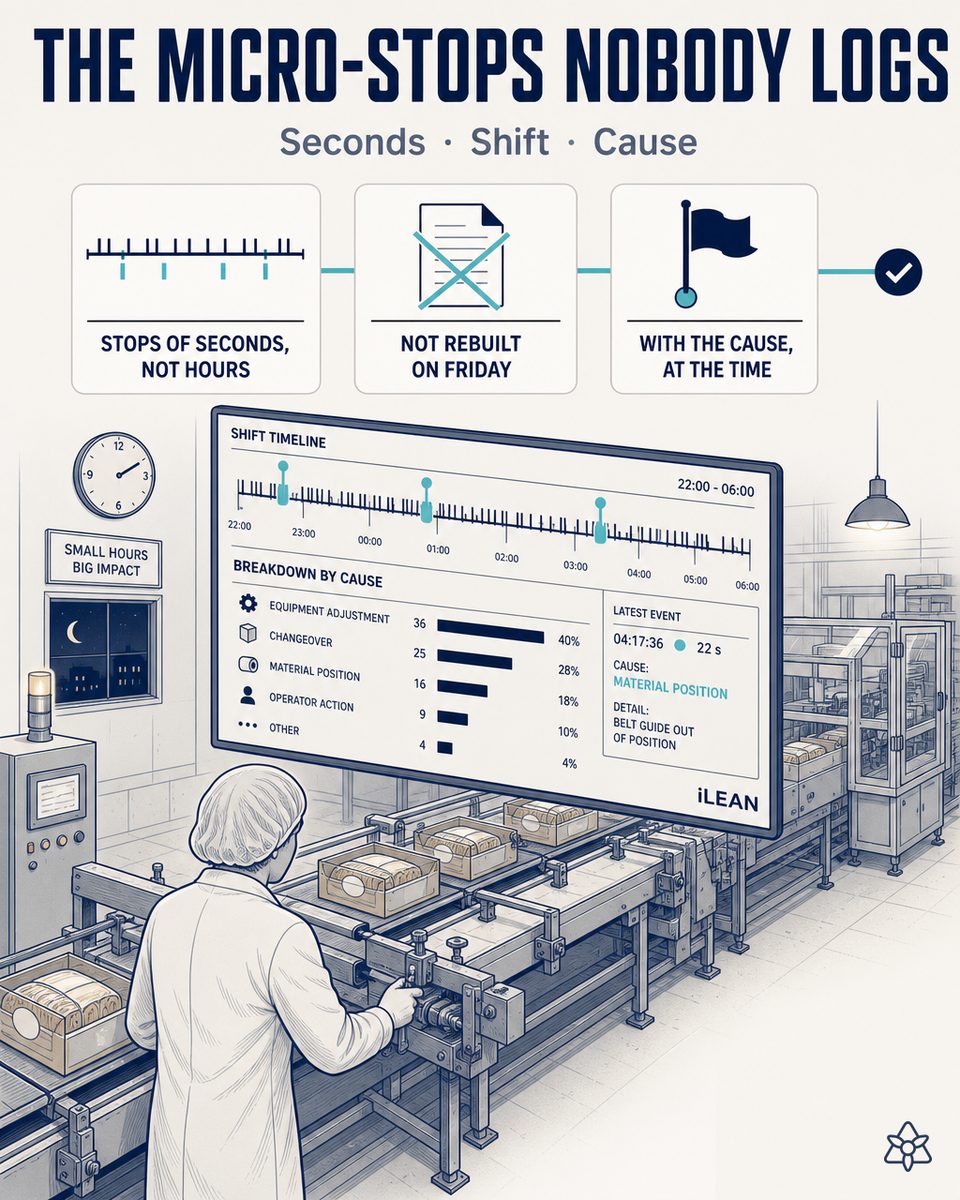
The weekly spreadsheet OEE is calculated on what the shift remembers — and the shift does not remember micro-stops.
The routine is the same in most food plants: at the end of the shift, the operator fills in the production report from memory — units, stops, causes — and on Friday someone in the engineering office keys those reports into a spreadsheet to rebuild the week's OEE. The number arrives late, and it arrives wrong, through four specific cracks:
- Micro-stops do not exist for the system — the film jam on the wrapper, cartons running out at the end of the line, the doser adjustment. Three minutes here, four there, fifteen times a shift. None of them makes it into the report, because nobody is going to drop what they have in their hands to write down three minutes. Added up, they are the line's biggest loss pool.
- The causes are generic — “breakdown”, “adjustment”, “cleaning”. At that level of detail nothing can be prioritized: a breakdown of what, on which machine, with which SKU running? The detail exists in the head of whoever was standing there, and it is lost at 10 p.m. when they clock out.
- Memory rounds off — a report filled in eight hours after the fact compresses three stops into one, forgets the one at start-up and estimates durations by eye. It is not bad faith; it is how memory works at the end of a packing shift.
- The data arrives when it is no longer useful — Monday's OEE is known on Friday. By then the problem SKU is off the line, the format has already changed, and the committee conversation is archaeology, not improvement.
The result: investment and continuous-improvement decisions are taken on an OEE that nobody has actually measured. And the biggest loss of all — micro-stops — does not even appear in the picture.
iLEAN does not ask the operator for more discipline — it takes the report out of their hands and measures the line instead.
The bottleneck is not calculating OEE (that is a division); it is that the underlying data does not exist: the line does not emit it, the report rebuilds it from memory and the spreadsheet consolidates it too late. iLEAN attacks the source: it captures the data where and when it happens — without changing your ERP or your MES, and without adding one more sheet of paper to the shift. And, importantly: iLEAN measures the line — counters, stops, speeds — not people. It does not hold the operator to account; it takes paperwork away.
Connect listens to the line counter and logs every stop to the second. The operator classifies the cause by voice, without dropping what they are doing. The agents consolidate real 24/7 OEE and flag the 3 stops that cost the most points. Nothing enters the system without human validation.
The iLEAN pieces applied to 24/7 OEE:
- Connect — connects to the line counter: if the machine is modern, by direct integration (OPC-UA, Modbus, encoder signal); if it is vintage and exposes nothing, with a camera pointed at the panel that reads the counter from the image. Every start-up, every stop and every unit is logged to the second, without touching the machine. And when the line stops, the operator simply says: “iLEAN, log this: film jam on the wrapper” — the cause is linked to the exact stop, by voice, without putting down what they are holding.
- Tracer agent — consolidates real OEE continuously, 24/7, cross-referenced by line, SKU and shift: availability, performance and quality calculated on stops that were measured, not remembered. Every morning it flags the 3 stops that cost the most OEE points, with machine, cause and SKU — the top 3 to act on today, not next month.
- Writer agent — drafts the shift report and the committee summary by itself from the captured data: stops, classified causes, open “no cause” items still to close. The shift lead validates before anything is consolidated — without a signature, the data does not go in. The twenty minutes of paperwork per shift disappear; validation takes two.
The Brain that orchestrates the agents lives in Central; production data stays in the plant's ring 1, not in some generic cloud (see the IRIS architecture and the three safety rings).
OEE rebuilt in a spreadsheet vs. OEE measured live with iLEAN
| Aspect | Report from memory + weekly spreadsheet | With iLEAN Connect + Tracer + Writer |
|---|---|---|
| Source of the data | Report filled in from memory at the end of the shift | Line counter to the second (integration or camera on the panel) |
| Micro-stops (2-5 min) | Invisible — never logged | All logged, with exact duration and cause |
| Stop causes | Generic: “breakdown”, “adjustment” | Classified by voice by whoever was there: machine + specific cause |
| OEE frequency | Weekly, rebuilt on Friday | Live 24/7, by line, SKU and shift |
| Prioritizing improvements | By intuition and by whichever breakdown is best remembered | Top 3 stops by OEE points lost, flagged every morning |
| Admin load on the operator | 15-20 minutes of paperwork per shift | Ten seconds of voice per stop — the report writes itself and is validated in two minutes |
Impact estimate for your plant — to be validated with your numbers.
The block below is an estimate to be validated with the specific data of your lines. It is there so the committee has an order of magnitude; we refine it during the diagnostic.
- Food packing plant with 2-8 lines and 2-3 shifts, OEE calculated today in a weekly spreadsheet from end-of-shift reports.
- Connect deployed on the counters (integration or camera on the panel) + Tracer/Writer agents. First value expected within a few weeks on one pilot line — the one that hurts most.
- OEE goes from a rebuilt weekly figure to live data. As micro-stops that were never logged come to the surface and the identified top 3 is attacked, the expected recovery is several OEE points — an estimate to be validated with your data.
- Indicative payback between 4 and 9 months depending on the number of lines, shifts and the value of an OEE point in your plant — an estimate to be validated in the diagnostic.
And production's reasonable doubt
“What if the AI classifies the cause of a stop wrongly?” — hallucination is a problem of free generation, not of anchored tasks. Linking the phrase “film jam on the wrapper” to the stop the counter has just registered and classifying it against the plant's catalog of causes is exactly an anchored task: the AI recontextualizes one piece of data (the operator's phrase) using another (the stop measured to the second) against a closed list. In this kind of task, the best models brought error below 1.5% [1]. And even so, the person validates the report — without a signature, the data is not consolidated. The three safety rings are there for exactly this.
[1] OpenAI paper “Why Language Models Hallucinate”, 2025 — on the reliability of AI in anchored tasks.
What people ask about 24/7 OEE in food manufacturing with AI
How does iLEAN connect to an old line with no accessible PLC?
You do not need to touch the machine. If the line is modern, Connect integrates with the counter or the PLC over standard industrial protocols (OPC-UA, Modbus, encoder signal). If the line is vintage and exposes nothing, we install a camera pointed at the panel or at the mechanical counter and read the data straight from the image. In both cases the result is the same: every unit produced and every stop is logged to the second, without modifying the equipment or voiding its warranty.
Is live OEE a way to control people?
No — and it is important to be clear about that from day one. iLEAN measures the line: units, stops, speed, causes. It does not measure people and it does not record what each operator does. In fact, it takes work away from the operator: the production report filled in from memory at the end of the shift disappears, because the data is already captured at source. Their only interaction is to say the cause of the stop out loud when it happens — ten seconds against the twenty minutes of paperwork it used to take.
How are stop causes logged?
By voice, without dropping what you are doing. When the line stops, the operator says: “iLEAN, log this: film jam on the wrapper”. The system links the phrase to the stop the counter has just registered, classifies it against the plant's catalog of causes and leaves it pending human validation — nothing enters the system until a person confirms it. If nobody classifies a stop, it is flagged as “no cause” and shows up in the shift summary to be closed out.
How is this different from the OEE I already calculate in a spreadsheet?
In resolution and in latency. Spreadsheet OEE is rebuilt once a week from reports filled in from memory: the 2-5 minute micro-stops never show up and the causes are generic (“breakdown”, “adjustment”). iLEAN's OEE is calculated continuously, to the second, by line, SKU and shift, and it includes every micro-stop — usually the biggest loss pool of all. It stops being a retrospective report and becomes operational data you can act on the same day.
How many OEE points can be recovered, and how quickly?
It depends on your starting point, so any figure is an estimate to be validated with your data. The usual pattern: measuring to the second surfaces micro-stops that had never been logged, the agents flag the 3 causes that cost the most points and, by attacking that top 3, the expected recovery is several OEE points in the first few months. Indicative project payback is between 4 and 9 months depending on lines, shifts and the value of an OEE point in your plant — we refine it in the diagnostic, on your numbers.
More cases in food
- Flash juice pasteurization with AI — the HTST window is seconds wide, and the decision cannot take longer.How iLEAN cross-references HTST curve, flow, pH and traceability on flash juice lines with Edge +…
- Flour milling with AI — a low falling number is not an incident, it is a complaint from the baker.How iLEAN cross-references wheat moisture, particle size, ash and falling number to stabilize the flour…
- Blockchain traceability in food — the chain is only worth something if the data at source is true.iLEAN adds blockchain only where it pays off: verified plant data plus an external DLT to certify…
- Production waste and food waste with AI — waste should not surface only at month-end.iLEAN captures waste at the point where it happens, attributes every kilo to its root cause and ranks…
- Industrial artificial intelligence for fresh cheese factoriesTwelve real industrial AI cases in fresh cheese dairies: paperless capture, in-line vision and auditable…
- Fresh pasta quality control with AI — fewer returns, held before the dock.iLEAN cross-references shape and surface-moisture vision, unit weight and cold chain to protect the…
Tell us your case and in 48h we'll send you the estimated ROI of measuring the real OEE of your lines 24/7.
We work on the real data of your plant and your lines, not ours. Diagnostic with no commitment.
Request estimated ROI in 48h See food industry