Fresh pasta quality control with AI — fewer returns, held before the dock.
Fresh pasta loses on several fronts at once — shape out of tolerance, surface moisture that kills shelf life, a cold chain broken between packing and the dock. iLEAN cross-references vision over the forming line with the tunnel's and the truck's dataloggers to hold the batch before the dock, not after the retailer's return. The person signs.
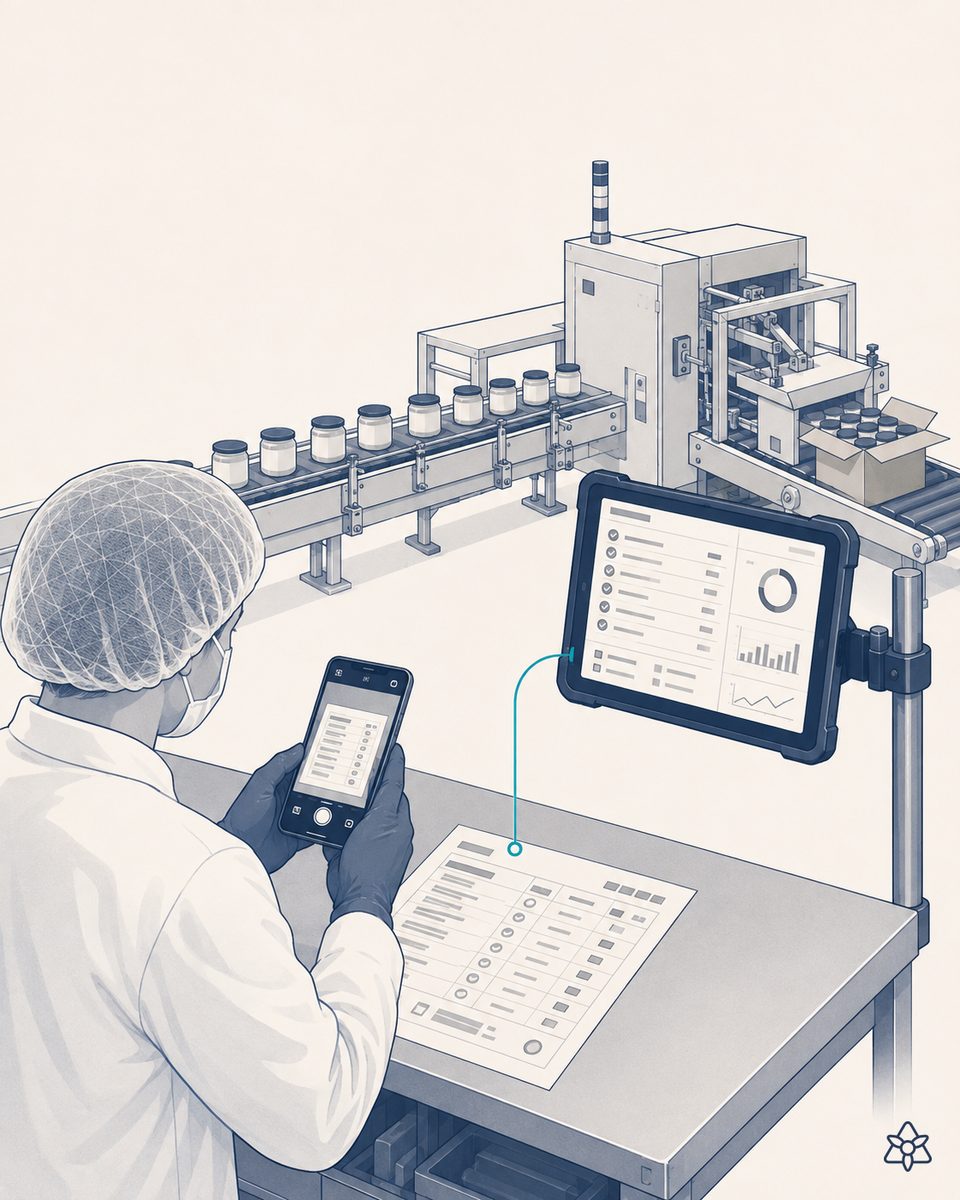
Three pain points in the same product — and the retailer returns them all.
Fresh pasta is a delicate product on three fronts at once, and it only takes one to fail for the batch to come back:
- The shape — the ravioli with a badly closed fold, the tortellini without its ring, the lasagna with uneven thickness. The retailer looks at the tray and rejects the unit. A tray with two ugly units sinks the whole batch.
- Surface moisture — if the dough leaves the tunnel with moisture out of range, the pasta comes out sticky or dries out. The shelf life declared on the label loses real days without anyone seeing it in the moment, and the customer notices it on the shelf.
- The cold chain — between the packer, the cooling tunnel and the dock there are points where the temperature can climb a degree without anyone noticing. The declared expiry date stops being real, and the return arrives when the truck has already been unloaded.
The classic system — an operator with a tape measure, a technician checking the tunnel panel, a hauler downloading the datalogger "when there is a complaint" — works 99% of the time. The 1% is the returned pallet and the retailer contract up for review.
iLEAN does not add a system — it seals the three cracks in a single cross-check.
Fresh pasta's problem is not one of point technology: it is three realities living in three different systems — the line, the tunnel, the truck — that never get cross-referenced at the critical moment (loading the pallet). iLEAN acts as the putty that fills those gaps without asking you to change the extruder, the tunnel or the truck.
Edge sees the shape on the line. Connect reads the tunnel and the truck. The agent cross-references and, if something does not add up, holds the batch before the dock. The person signs — never the other way around.
The three iLEAN pieces applied to fresh pasta control:
- Edge — a machine-vision (CNN) terminal over the forming line. It learns the silhouette of your product (ravioli, tortellini, gnocchi, lasagna) and fires the actuator in milliseconds when a unit falls out of tolerance, before packing. It works without a network. If the plant loses WiFi, Edge keeps ejecting.
- Connect — reads the tempering tunnel's datalogger whether it is modern with an output or old with a photo of the panel. It reads the truck's datalogger when there is one. It also captures what arrives from outside (a temperature incident over WhatsApp from the hauler, a retailer complaint by email) at second zero.
- Agent — cross-references the image from the line, the tunnel data, the unit weight from the packer and the truck's cold chain. If the combination is going to compromise the declared shelf life or the expected quality, it holds the batch before it is loaded onto the truck and alerts the quality manager through their channel. The person validates and signs; the batch does not go out the door on its own.
Tape-measure control vs. cross-referenced control with iLEAN
| Aspect | Classic pasta factory | With iLEAN Edge + Connect + Agent |
|---|---|---|
| Unit shape | Sampling + the packer's eye | 100% inspection, ejection in milliseconds |
| Surface moisture | Post-mortem tunnel reading | Image + tunnel data cross-checked in real time |
| Unit weight | Isolated checkweigher | Cross-referenced with recipe and shape |
| Cold chain | Datalogger downloaded "if there is a complaint" | Continuous reading of tunnel and truck |
| Holding the batch | After the retailer's return | Before loading the truck |
| Real declared shelf life | Label assumption | Traceable per batch, defensible to the customer |
Impact estimate for your plant — to be validated with your numbers.
The block below is an estimate to be validated with your plant's data. We put it forward so the committee has an order of magnitude; we refine it during the diagnostic.
- Pasta factory with 2-4 forming lines (ravioli, tortellini, gnocchi, lasagna), tempering tunnel, MAP or vacuum packing, national refrigerated distribution + some export lines.
- Edge + Connect + Agents pilot on the line with the highest current returns. First value expected within a few weeks: automatic ejection of out-of-tolerance units and cold-chain traceability from the first shift.
- Indicative payback between 4 and 9 months, with the hard lever in (1) fewer returns for shape, (2) real shelf-life extension by closing off surface moisture, (3) auditable cold-chain traceability.
- A reduction in returns on the order of 30% or more is defensible as a conservative floor on lines with a history of shape problems.
And the quality director's reasonable doubt
"What if the AI ejects good units and drags our yield down?" — hallucination is a problem of free generation, not of anchored tasks. In tasks where the AI merely compares an image against a learned pattern (ravioli silhouette vs. tolerance), the best models brought error below 1.5% [1]. The ejection threshold is calibrated with you during the immersion, not imposed. The line is still yours; iLEAN assists you, it does not replace you.
[1] OpenAI paper "Why Language Models Hallucinate", 2025 — on the reliability of AI in anchored tasks.
What people ask about fresh pasta quality control
What makes fresh pasta so vulnerable to returns?
Three things at once. One, the shape: ravioli, tortellini, lasagna — the retailer rejects the unit that falls out of tolerance, and a single batch with irregular shapes empties the shelf. Two, surface moisture: if the dough leaves the tunnel too damp, shelf life drops by days and stickiness shows up in the tray. Three, the cold chain: a one-degree break between packing and the dock is invisible to the eye but seals the fate of the expiry date. Any of the three sends the batch back — and the return arrives when there is nothing left to be done.
How does iLEAN Edge detect irregular shapes on the line?
Edge is a machine-vision (CNN) terminal over the forming line. It learns the silhouette of your product — the ravioli with its characteristic fold, the tortellini with its ring, the lasagna with its uniform thickness — and fires the actuator (ejector, warning light) in milliseconds when a unit falls out of tolerance, before packing. It works without a network: if the plant loses WiFi, Edge keeps inspecting and ejecting, because what is critical cannot depend on connectivity.
And surface moisture? Can vision see that too?
It is a combined read. Edge can detect surface sheen/stickiness from the image, but the most reliable reading comes from cross-referencing the image with the drying and tempering tunnel's data: temperature, relative humidity, belt speed. Connect reads the tunnel's datalogger — whether it is modern with an output or old with a photo of the panel — and the agent cross-references it with the image from the line. If surface moisture leaves the range, it holds the batch before packing, not after the retailer's return.
How is the cold chain controlled between packing and the dock?
Connect reads the cooling tunnel's datalogger, the truck's datalogger when there is one, and the dock thermometer. If the temperature strayed from the range between packing and loading, the agent flags it before the truck leaves, not when the retailer receives the pallet with the chain broken. What is critical is never decided alone: the quality manager signs. If the batch is accepted with an incident, it is recorded for the dossier.
What return can a mid-sized pasta factory expect?
As an order of magnitude — and always an estimate to be validated with your data — an Edge + Connect + Agents pilot on one forming line and its cold chain delivers first value within a few weeks (first shift with automatic ejection of out-of-tolerance units) and a reasonable payback between 4 and 9 months. The hard lever is threefold: (1) fewer returns for irregular shapes, (2) real shelf-life extension by closing off surface moisture, (3) cold-chain traceability auditable per batch. We send you the estimated ROI in 48h with your numbers.
More cases in food
- 24/7 OEE in food manufacturing with AI — the micro-stops nobody writes down are your biggest loss pool.iLEAN measures OEE on your food lines 24/7: every micro-stop logged to the second, and the operator…
- Production waste and food waste with AI — waste should not surface only at month-end.iLEAN captures waste at the point where it happens, attributes every kilo to its root cause and ranks…
- Industrial artificial intelligence for fresh cheese factoriesTwelve real industrial AI cases in fresh cheese dairies: paperless capture, in-line vision and auditable…
- Real AI cases in frozen foodsReal AI cases in frozen foods: pallet-level cold chain, plus the cross-cutting food industry cases —…
- AI control of fruit dehydration — the drying end point should not arrive hours late.iLEAN connects the tunnel's probes and adds vision at the outfeed: the drying end point is decided by…
- FSMA for food exports to the US — seven rules, one single file, 24 hours to hand it over.iLEAN covers all seven FSMA pillars: traceability, preventive controls, food defense, importer rule. One…
Tell us your case and in 48h we'll send you the estimated ROI of this AI project for your pasta factory.
We work on your plant's real data, not ours. Diagnostic with no commitment.
Request estimated ROI in 48h See food industry