Production waste and food waste with AI — waste should not surface only at month-end.
Real waste is generated at dozens of points across the plant and only shows up as an aggregate at the monthly close. iLEAN captures it where it happens — scale, photo or voice —, attributes every kilo to its cause and ranks the 3 that hurt most. The person validates; the data enters clean.
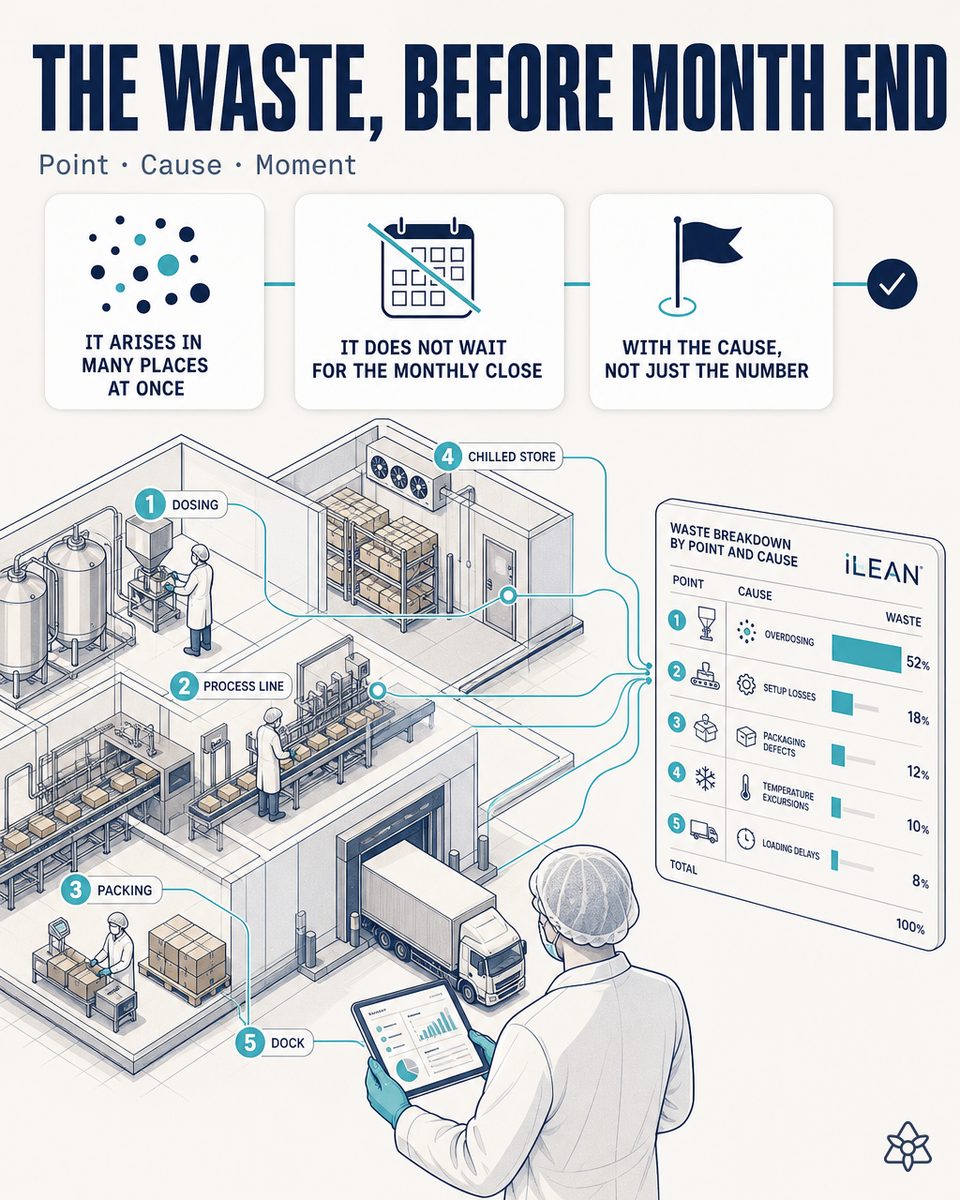
Waste is produced in twenty places and discovered in one: the P&L.
Ask any plant manager how much waste they have and they will give you a percentage. Ask them where it is generated and the answer turns into a list of suspicions. Because real waste is spread across dozens of points that nobody records at the moment they happen:
- Format trim — the edges of the dough, the cuts that fall outside the size grade, the fillet that comes up short of weight. It goes into the bin with nobody logging how many kilos or from which batch.
- Line startups and stoppages — the first minutes after a startup produce out-of-spec output; what gets discarded before the line stabilizes is almost never weighed.
- Quality rejects — the detector ejects, the checkweigher rejects, the inspector pulls a unit aside. Every reject is a data point; almost none of them is logged with its cause.
- Expiry in the cold store — raw material and work in progress that expire waiting for their work order. It is discovered at stocktaking, weeks after the decision that caused it is beyond fixing.
- SKU changeover leftovers — whatever is left in the mixer, in the hopper or in the pipework when you switch reference. Kilos purged at every changeover, multiplied by every changeover in the month.
At month-end, accounting subtracts actual consumption from theoretical consumption and one single aggregate number appears. No batch, no line, no cause. With that number nothing can be attacked: the waste meeting turns into an exchange of hypotheses. And the waste reduction targets — plus the sustainability reporting the retailers already ask for and the CSRD demands — stay as estimates that nobody can defend in an audit.
iLEAN does not add another waste log nobody fills in — it captures the data in the gesture that already exists.
The bottleneck is not analyzing waste (that is arithmetic); it is that the data never comes into existence. The operator who has just finished a format changeover is not going to walk over to a terminal, open a screen and fill in a form for 12 kilos of trim. Any system that depends on that form is dead before it starts. iLEAN inverts the problem: it brings capture to the point where waste happens, at a logging cost close to zero — and without asking you to change ERP, MES or scales.
Connect captures every kilo where it is generated — scale, photo or voice. Edge counts line rejects automatically. The agents attribute every record to its cause and rank the 3 that hurt most. The person validates — without a signature, the data does not enter.
The iLEAN pieces applied to production waste and food waste management:
- Connect — the connected scale sends the weight on its own; the trim bin is logged with a photo; and the operator with an earpiece dictates it without putting down what is in their hands: “iLEAN, log this: 12 kilos of trim from a format changeover”. Every record is born with line, shift, batch and time. Waste stops being an accounting number and becomes a stream of events with context.
- Edge — at the points where there is already a camera, a detector or a checkweigher, Edge counts the rejects automatically: units ejected, kilos set aside, minutes of out-of-spec startup. With no operator involvement and without taking critical data out of the plant: processing happens in ring 1.
- Tracer and Writer agents — Tracer cross-references every record with the line context (was there a startup? an SKU changeover? a quality reject? a cold store release past its date?) and attributes every kilo to its cause; when in doubt, it asks instead of inventing. Writer aggregates, computes the Pareto of causes, ranks the 3 that weigh most and prepares both the weekly action plan and the food waste report built on primary data. The person in charge validates the attribution — without a signature it does not enter the system.
The Brain that orchestrates the agents lives in Central; critical data stays in ring 1 of the plant, not in some random cloud (see the IRIS architecture and the three safety rings).
Waste aggregated at month-end vs. waste captured at the point with iLEAN
| Aspect | Accounting close + spreadsheets | With iLEAN Connect + Edge + Agents |
|---|---|---|
| When waste surfaces | At month-end, aggregated in the P&L | The moment it is generated, point by point |
| Attribution by cause | Hypotheses in the monthly meeting | Every kilo with its cause: startup, SKU changeover, defect, expiry |
| Detail by batch and line | Does not exist — one single global number | Record with line, shift, batch and time |
| Cost of logging a discard | A form or paper report nobody fills in | Scale, photo or voice — seconds, without putting the tool down |
| Food waste reporting (CSRD, retailers) | An estimate built on the close, hard to defend | Auditable primary data, broken down by cause and batch |
| Prioritizing actions | Every cause at once, none of them properly | A living Pareto — the 3 heaviest causes, tracked weekly |
Impact estimate for your plant — to be validated with your numbers.
The block below is an estimate to be validated with the specific data of your plant. It is there so the committee has an order of magnitude; we refine it during the diagnostic.
- Plant with 2-8 lines and aggregate waste of between 2% and 6% of consumption, with no reliable breakdown by cause. Frequent SKU changeovers and growing pressure from retailers and the CSRD for defensible waste figures.
- Deployment of Connect + Edge + Tracer/Writer agents on one pilot line, integrated with the existing ERP/MES and the scales already in place. Visibility of waste by cause from the very first week — before touching anything, you already know where every kilo goes.
- Expected reduction of ≥30% on the first causes attacked (estimate to be validated: every plant's Pareto is different, but the top 3 causes usually concentrate most of the kilos). Food waste reporting goes from estimated to real data with no extra work.
- Indicative payback between 4 and 9 months (estimate to be validated), depending on current waste volume, raw material cost and the number of lines brought in after the pilot.
And production's reasonable doubt
“What if the AI attributes waste to the wrong cause?” — hallucination is a problem of free generation, not of anchored tasks. Attributing a waste record to its cause is precisely an anchored task: the AI recontextualizes one data point (kilos, line, time) using another (the line event happening at that moment) and applies verifiable rules. In this kind of task, the best models brought error below 1.5% [1]. And even so, the person validates the attribution — without a signature, the data does not enter the system. The three safety rings are there for exactly this.
[1] OpenAI paper “Why Language Models Hallucinate”, 2025 — on the reliability of AI in anchored tasks.
What people ask about production waste and food waste management with AI
How is waste captured without changing the operator's habits?
iLEAN Connect adapts to the gesture that already exists, not the other way round. If the trim gets weighed, the connected scale sends the data on its own; if it goes into the bin, a photo is enough to estimate the volume; if the operator wears an earpiece, they dictate it: “iLEAN, log this: 12 kilos of trim from a format changeover”. Every record is born with line, shift, batch and time attached, with no extra forms or screens. The goal is for logging waste to take less than five seconds — below that threshold the data gets captured; above it, the data is lost.
How does the system know the cause of each kilo of waste?
From context. The agents cross-reference every record with what was happening on the line at that moment: if it coincides with a startup, it is attributed to startup; if it coincides with an SKU changeover, to the format change; if it comes from quality control, to a defect; if it leaves the cold store past its date, to expiry. When the context is ambiguous, the agent asks instead of inventing, and a person confirms the cause before the data enters the system. Attribution improves with every confirmation.
Does it work for sustainability reporting (CSRD) and for waste reduction targets?
Yes, and it is one of the fastest levers. The CSRD and the specification manuals of the large retailers ask for food waste figures that are broken down and defensible, not an estimate calculated from the accounting close. With iLEAN every kilo is recorded with date, line, batch and cause, so the report comes straight from the primary data — the same data production uses to attack the causes — and it holds up in an audit with no last-minute reconciliations.
What happens if the photo or the voice dictation records the wrong data?
Nothing enters the system without validation. Every capture lands in a confirmation queue where the shift or quality lead reviews the doubtful records — the weight that does not match the scale, the ambiguous photo, the dictation that line noise cut off halfway. The agent flags the confidence level of every data point and only asks for human intervention in borderline cases; the rest are confirmed in bulk. It is the same principle as the three safety rings in IRIS: the AI proposes, the person signs.
Do I need to buy new scales or change my ERP/MES?
No. Connect integrates with what is already there: scales with a serial or IP output, existing cameras, and the ERP or MES where theoretical consumption and production reports live. Where there is no sensor, voice or a photo acts as the sensor. The comparison between theoretical and actual consumption comes from cross-referencing your own data, not from replacing it. Deployment starts with one pilot line and the rest of the plant is brought in by phases — the exact schedule is an estimate to be validated during the diagnostic, but with no construction work and no line stoppage.
More cases in food
- Flour milling with AI — a low falling number is not an incident, it is a complaint from the baker.How iLEAN cross-references wheat moisture, particle size, ash and falling number to stabilize the flour…
- Blockchain traceability in food — the chain is only worth something if the data at source is true.iLEAN adds blockchain only where it pays off: verified plant data plus an external DLT to certify…
- 24/7 OEE in food manufacturing with AI — the micro-stops nobody writes down are your biggest loss pool.iLEAN measures OEE on your food lines 24/7: every micro-stop logged to the second, and the operator…
- Industrial artificial intelligence for fresh cheese factoriesTwelve real industrial AI cases in fresh cheese dairies: paperless capture, in-line vision and auditable…
- Fresh pasta quality control with AI — fewer returns, held before the dock.iLEAN cross-references shape and surface-moisture vision, unit weight and cold chain to protect the…
- Real AI cases in frozen foodsReal AI cases in frozen foods: pallet-level cold chain, plus the cross-cutting food industry cases —…
Tell us your case and in 48h we'll send you the estimated ROI of capturing your plant's waste by cause.
We work on the real data of your plant and your lines, not ours. Diagnostic with no commitment.
Request estimated ROI in 48h See food industry