Fish cold room temperature control with AI — the range is not a chart, it is a dossier per batch.
A fresh fish cold room does not fail because of the setpoint on the panel: it fails because of the fifteen door openings, the warm pallet and the evaporator frosting up. iLEAN cross-checks real probes, door openings and load, anticipates the deviation before the thermometer draws it, and leaves the per-batch HACCP file signed. The person decides — the room warns, it does not shut itself.
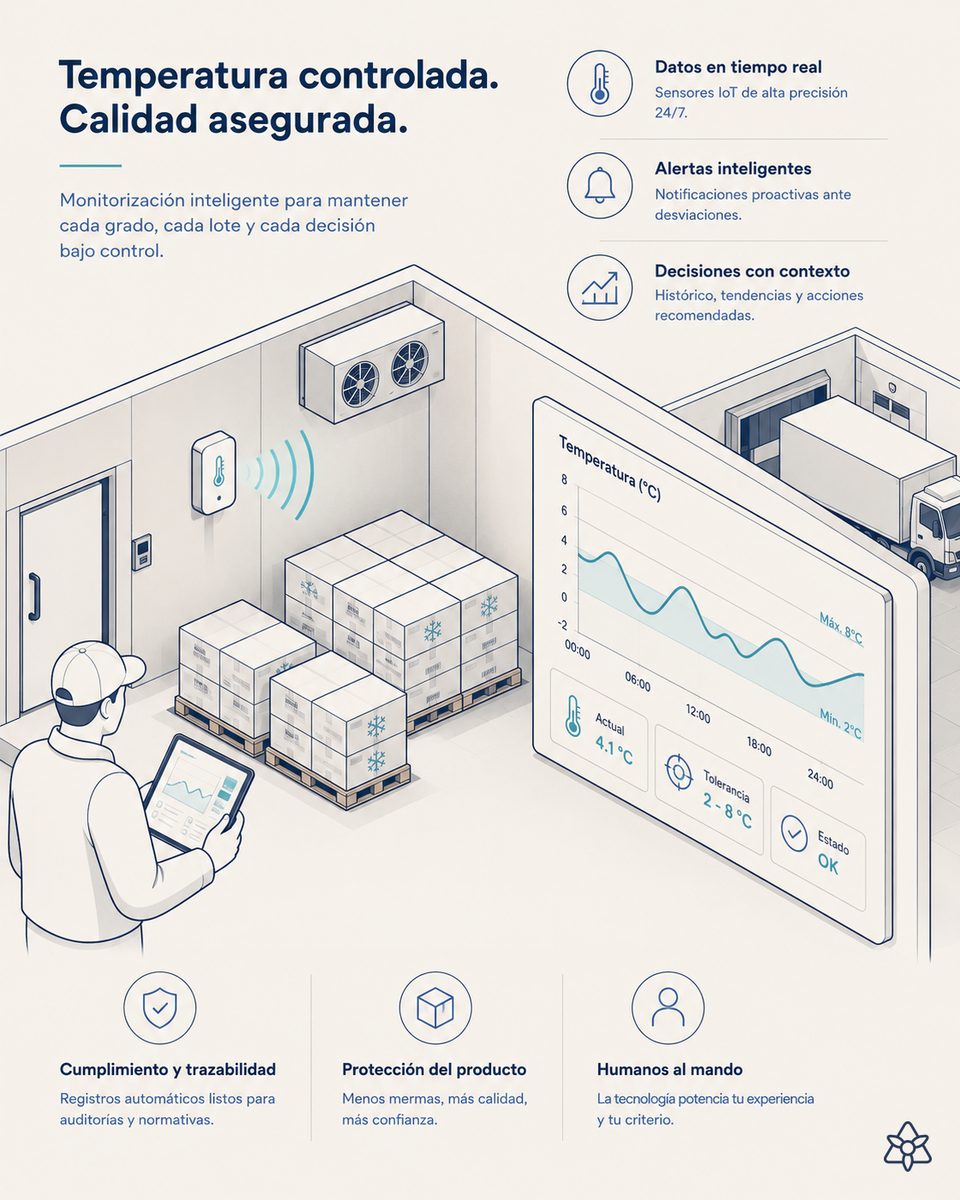
The recorder draws a pretty line. The fish does not.
The room's panel reads 1°C and the recorder draws a horizontal line with no jumps. The shift lead sleeps soundly. And yet four things happen on the floor that the chart never captures:
- The door opens all day long. Fifteen, twenty times per shift: dock unloading, order picking, a warehouse hand going in for a crate. Each opening lets in warm air that the wall probe takes a while to notice.
- Warm load arrives. A pallet from the dock that did not spend the time it should have in the refrigerated truck. The load pushes up the real curve of its surroundings even if the average ambient does not move.
- The evaporator frosts up. Before the room warms, the evaporator loses performance. The ambient temperature holds for a few minutes on inertia, and by the time it rises, product is already out the door.
- The probe sits in the convenient spot. Next to the office door, not at the back where the oldest stock accumulates. The probe measures what it sees, not what happens.
The health inspector knows it, and when auditing asks for more than the curve: opening frequency, average duration, defrost cycles, the correlation with the batches that were in the room at every moment. Rebuilding that by hand takes a week — and by then the fish is already sold.
iLEAN does not buy you a new room — it puts eyes where there were none and joins what lives in islands.
The room works. The probe works. The panel works. What is missing is for the four realities (probe, door, load, batch) to be seen together, at second zero, on the shift lead's phone. iLEAN is the putty that fills the joints between the refrigeration PLC, the wall recorder, the warehouse hand's notebook and the warehouse ERP.
Edge sees the door and the load. Connect captures probes, recorder and batch. The agent anticipates the deviation, gets the right technician on it first, and closes the per-batch HACCP dossier. The person validates — the room warns, it does not go silent.
The three iLEAN pieces applied to fish cold room temperature control:
- Edge — a machine-vision terminal (CNN) over the room's door. It counts actual openings, measures opening time, identifies the pallet coming in and which batch it belongs to. It works without a network: if the warehouse loses WiFi, it keeps recording on the panel's power.
- Connect — captures the distributed probes (existing or supplementary), reads the analog recorder's curve from a photo if there is no integration, and pulls the batch record from the ERP or from the dock delivery note. Capture gradient: if the room has a modern PLC, direct integration; if it only has a ticket recorder, Edge digitizes it.
- Agent — cross-checks distributed temperature + openings + load + the room's history, anticipates a frosting evaporator or a short defrost, and alerts the refrigeration technician before the ambient curve reflects it. It closes the per-batch HACCP file without anyone gathering spreadsheets on audit day. The person decides — the AI does not open the room, does not stop the compressor unit, does not sign alone.
A room with a recorder vs. a room with an iLEAN nervous system
| Aspect | Classic recorder | With iLEAN Edge + Connect + Agent |
|---|---|---|
| Temperature reading | One wall probe, one curve | Distributed probes + correlation with openings and load |
| Evaporator frost detection | Once the ambient temperature has already risen | Anticipated from the performance drop |
| Record of door openings | "Whoever was there remembers" | Count and duration by vision, automatic |
| Per-batch traceability | Rebuilt by hand for the inspector | Per-batch dossier with the curve actually lived |
| Alert to the refrigeration technician | When someone notices | Before the thermometer reflects it |
| HACCP file | Paper folder, weeks of preparation | Ready at any time, signed by the person |
Impact estimate for your plant — to be validated with your numbers.
The block below is an estimate to be validated with the specific data of your plant. We put it forward so the committee has an order of magnitude; we refine it during the on-site diagnostic.
- Fresh fish wholesaler or processor, 2-5 fresh-fish rooms, analog recorder or a mixed PLC setup.
- Pilot in one critical room: Edge over the door + 2-3 distributed probes + integration with the batch record in the ERP. First value expected within a few weeks — the first early warning for frost or excess openings.
- Indicative payback between 4 and 9 months, depending on the historical frequency of incidents and the documented cost of cold chain breaks (destroyed product, complaints, health alerts).
- Measurable hard lever: ≥30% reduction in quality hours spent on HACCP reconstruction, plus early warnings on refrigeration performance before the incident.
And the warehouse manager's reasonable doubt
"What if the AI raises a false alarm and makes us start the backup generator for nothing?" — the AI here does not start the generator. It alerts the person, proposes a probable cause, and lets the manager decide. The reliability of AI on anchored tasks (reading a probe and comparing it against a history) brought error below 1.5% in the best models[1]. Even so, no critical decision is executed without your signature. The three safety rings exist precisely for this.
[1] OpenAI paper “Why Language Models Hallucinate”, 2025 — on the reliability of AI in anchored tasks.
What people ask about fish cold room temperature control
What temperature should a fresh fish cold room maintain?
Whole or gutted fresh fish must be kept at a temperature close to that of melting ice — around 0 to 2°C (32-36°F) under EU regulation 853/2004 and the AESAN guidance. Refrigerated processed products go up to 4°C. What fails is rarely the setpoint on the control panel; what fails is reality: the room opens fifteen times in an hour, a warm pallet arrives, the evaporator frosts up. The recorder draws a pretty line and the product is not where the chart says it is.
How does iLEAN detect a real deviation, not the wall thermometer's?
By cross-checking three realities that today live in islands: the distributed probes in the room (existing ones, or supplemented if there is only one), the actual door openings and load movement (recorded by Edge with machine vision or captured by Connect from the warehouse hand's notebook), and the history of how that specific room behaves. An evaporator with early frost does not raise the temperature — it loses performance. The agent detects it before the thermometer reflects it, and alerts maintenance.
What about HACCP and the records for the health inspector?
Temperature control is one of the most closely watched CCPs (critical control points) in fish: the inspector asks for the continuous record, the records of opening frequency and duration, and per-batch traceability with the actual curve that batch lived through in the room. iLEAN closes that file on its own: for every batch it knows when it came in, what curve it had, how many openings there were, when the evaporator was defrosted. On audit day, it is done.
Do I need to replace the refrigeration installation?
No. iLEAN sits on top of what you already have. If the room has a modern PLC, we integrate through the interface. If it has a recorder with paper tickets, Edge photographs and digitizes them. If all there is is a thermometer on the office wall, we place two wireless probes at the critical points (entrance, back, near the evaporator) and get started. The capture gradient adapts to each room — not the other way around.
What if the room loses WiFi or Internet?
Edge keeps working. The non-negotiable rule is that as long as it has power, the basic detection and recording cycle continues — because in a fish plant, what is critical cannot depend on connectivity. When the network comes back, the system syncs. If the room loses power, the agent detects the signal loss and alerts the shift lead by SMS/WhatsApp: the person decides whether it is time to start the backup generator or move the stock out.
Related: dairy cold chain · frozen, pallet by pallet · cold room inventory
More cases in food
- Tetilla PDO — shape cannot be fixed in the ripening room: you either catch it at demolding, or it is PDO scrap.iLEAN Vision verifies the characteristic conical shape of Galician Tetilla PDO cheese after demolding…
- Torta del Casar PDO — thistle rennet does not perform the same every day, and the creaminess tells you weeks too late.iLEAN Edge controls the Cynara cardunculus thistle rennet in Torta del Casar PDO: pH curve, creaminess…
- Automatic FIFO/FEFO in a food warehouse — an expired unit on the retailer's shelf is not an incident, it is a phone call from your sales director.iLEAN drives picking by expiry date without relying on the operator. Expired product drops sharply, with…
- Flash juice pasteurization with AI — the HTST window is seconds wide, and the decision cannot take longer.How iLEAN cross-references HTST curve, flow, pH and traceability on flash juice lines with Edge +…
- Flour milling with AI — a low falling number is not an incident, it is a complaint from the baker.How iLEAN cross-references wheat moisture, particle size, ash and falling number to stabilize the flour…
- Blockchain traceability in food — the chain is only worth something if the data at source is true.iLEAN adds blockchain only where it pays off: verified plant data plus an external DLT to certify…
Tell us your case and in 48h we'll send you the estimated ROI of this AI project for your fish cold rooms.
We work on your plant's real data, not ours. Diagnostic with no commitment.
Request estimated ROI in 48h See food industry