Pallet-by-pallet cold chain in frozen food — a pallet with a broken history cannot go out on the truck.
A frozen pallet can spend weeks in the cold store before it ships, and in the meantime it can live through an evaporator failure, a door left open too long or a localized hot spot. iLEAN keeps its thermal history pallet by pallet and, if at any point it broke -18 °C, it blocks shipping before the truck is loaded. The WMS stays the WMS — iLEAN closes the crack between sensor and decision.
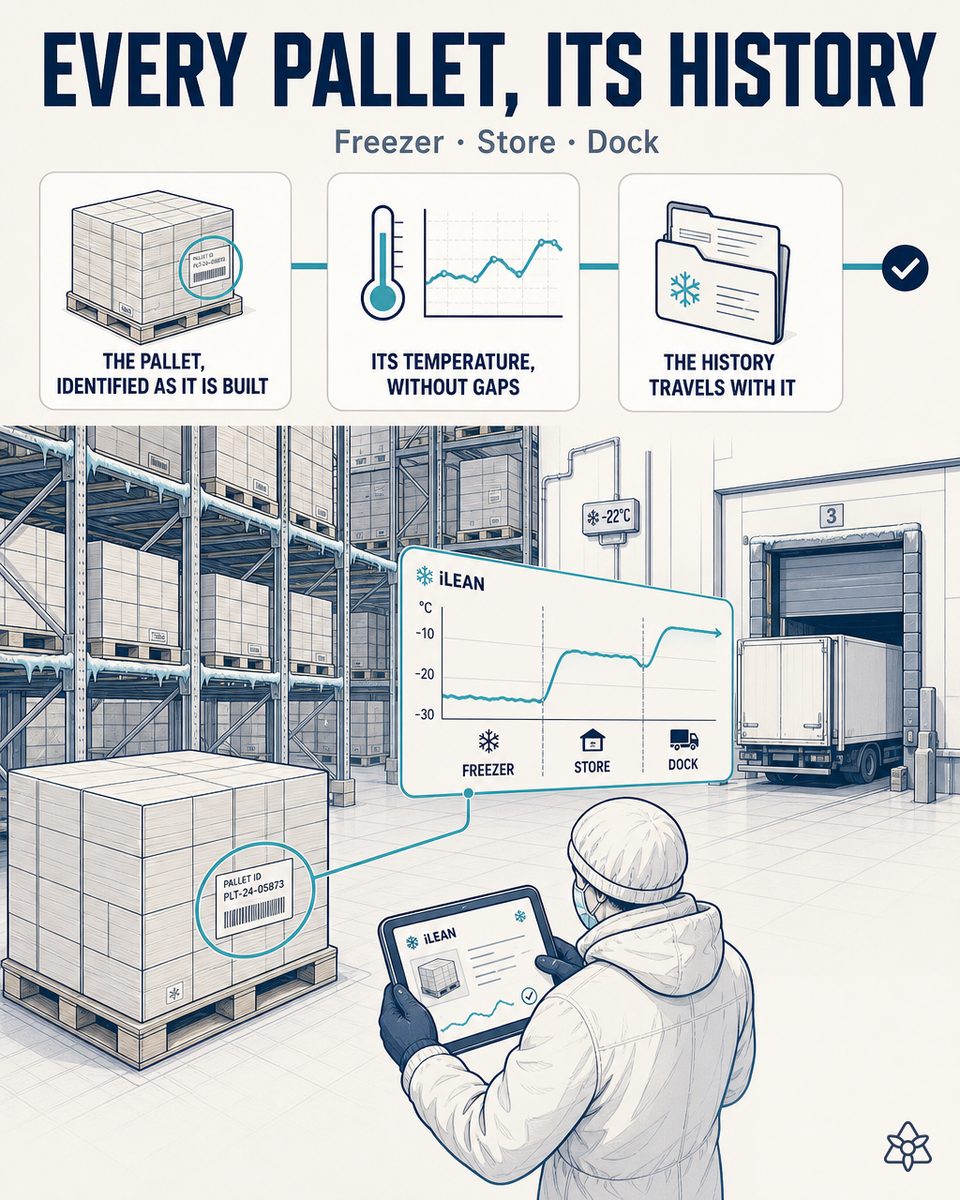
The average temperature of the cold store is not the temperature of your pallet.
The cold store's SCADA shows an average cold-store temperature that is almost always fine. And even so, cold chain breaks happen — because a large -25 °C cold store is not uniform: there are hot spots at traffic points, near doors, in areas where an evaporator performs below par. A pallet can spend weeks in exactly the worst place, and the daily average of the cold store never notices.
Then, when a retailer asks for the thermal history of the batch, or an inspector asks for FSMA evidence for an export, the plant hands over the cold store's curve — not the pallet's curve. And where the customer is strict, that is no longer enough. Current practice assumes that "if the cold store is fine, the product is fine"; that assumption breaks the moment there is an event (a door left open, a one-off evaporator failure, a badly mapped thermal gap) that affects a zone and not the average.
And the WMS, which is excellent at moving pallets and managing locations, was not designed to govern fine-grained thermal history. The thermal trace lives in the SCADA. The location lives in the WMS. The decision to ship or not is signed by somebody looking at two screens and cross-referencing by hand.
iLEAN does not replace the WMS — it gives every pallet its own thermal history.
The problem is neither the cold store nor the WMS: each does its own job well. The problem is the dead zone between the two — and between both of them and the external data (FSMA, US retailer, health alert). iLEAN acts as the putty that seals that crack, without asking you to change the cold store, the evaporators or the WMS.
Edge aggregates the sensors at second zero. Tracer glues the thermal history to the pallet. The agent blocks shipping if there was a break. The person signs when a dossier goes out to a strict retailer.
The iLEAN pieces applied to pallet-by-pallet cold chain:
- Edge — terminals inside the cold store connected to the grid of IoT sensors (ceiling, critical aisles, points near doors, evaporators). Readings aggregated at second zero, immediate detection of a hot zone. It works without a network: if the plant loses WiFi, Edge keeps aggregating locally and syncs afterwards, because what is critical cannot depend on connectivity.
- Tracer + Connect — Tracer keeps the pallet ↔ location ↔ cold store association alive, cross-referencing what the WMS records on every movement. Connect captures what arrives from outside: a health alert by email, a new FSMA requirement from the US retailer, a change of procedure from the quality director. It all enters the system at second zero.
- Agent (Brain) — cross-references each pallet's thermal history with the customer's thresholds and the standard's, and flags pallets as candidates for a hold before shipping. It keeps the per-pallet thermal dossier alive and available: when the US retailer or the inspector asks for it, it is already done. The agent proposes the hold and the reassignment; the person signs — iLEAN's three rings guarantee that the decision to ship or segregate is never executed without human validation on critical batches.
SCADA + WMS + two screens vs. per-pallet history with iLEAN
| Aspect | Cold store SCADA + WMS + manual cross-referencing | With iLEAN Edge + Tracer + Brain |
|---|---|---|
| Granularity of the trace | Average curve of the cold store | Curve per pallet, with its location and movements |
| Hot zone detection | Only if it shows in the average | Earlier, at second zero |
| Holding a pallet with a break | Human decision across two screens | Flagged automatically, human signature to release |
| Dossier for a US retailer / FSMA | Rebuilt, days | Already done — it comes from the live history |
| Incoming health alert | Email at 10 p.m., meeting tomorrow | Affected pallets located in seconds |
| Operation without network | n/a | Edge keeps aggregating locally, syncs afterwards |
Impact estimate for your plant — to be validated with your numbers.
The block below is an estimate to be validated with the specific data of your warehouse. We put it forward so the committee has an order of magnitude; we refine it during the diagnostic.
- Mid-sized frozen warehouse, one or several cold stores at -25 °C, in-house WMS, a mix of domestic market + exports with FSMA / strict-retailer requirements.
- Edge + Tracer pilot in one cold store (sensor grid + WMS integration + per-pallet dossier). First value expected within a few weeks: a real thermal map of the cold store and a thermal dossier for the new pallets entering the pilot.
- Reduction of waste and rework caused by undetected breaks of ≥ 30% in the first months. A conservative estimate; the ceiling depends on how much of your current waste was avoidable versus structural to the process.
- Indicative payback between 4 and 9 months, depending on the volume of the warehouse and the average cost of a batch rejected by a strict retailer. The hard lever is the combination of fewer rejections at shipping + the ability to serve markets that demand a fine-grained thermal dossier without a day's delay + office hours saved rebuilding history.
And the industry figure worth having in front of you
The most digitalized sectors have raised productivity by as much as 40% between 2000 and 2021; the least digitalized barely improved[1]. A frozen warehouse, asset-intensive and running on thin margins, is exactly one of those sectors where the difference between having fine-grained history and not having it will show up in the P&L in the medium term.
And the operations director's reasonable doubt: “What if the system holds pallets that are perfectly fine?” — hallucination is a problem of free generation, not of anchored tasks such as comparing a thermal history against a threshold. In anchored tasks the best models brought the error below 1.5%[2]. And even so, a critical hold is never decided alone: the system flags, the person signs. iLEAN's three safety rings are designed precisely for this.
[1] Productivity +40% in the most digitalized sectors (2000-2021) — source Fundación BBVA / Ivie.
[2] OpenAI paper “Why Language Models Hallucinate”, 2025 — on the reliability of AI in anchored tasks.
What people ask about pallet-by-pallet cold chain in frozen food
What threshold defines a cold chain break?
The classic reference is -18 °C at the core of the product (the general commercial standard for quick-frozen foods). iLEAN is configured per plant and per customer: threshold, minimum time above it and peak tolerance, so a genuine deviation can be told apart from an air change caused by a door opening. The break is always assessed at the product core, inferred from the cold store's air sensors and the loading history, not from a single spot reading.
How do you instrument a large -25 °C cold store?
With a grid of IoT sensors placed according to a prior thermal map (the temperature of a large cold store is not uniform; there are hot spots in traffic areas and near doors). iLEAN combines fixed sensors (ceiling, critical zones), sensors on key pallets and, optionally, sensors on the evaporators. Edge aggregates the readings at second zero and keeps the thermal grid alive; when a zone starts drifting, it warns before product is affected.
How do you locate one exact pallet in a large cold store?
By its identity (tag/label) cross-referenced with the location the WMS records when it is put away. iLEAN Tracer keeps the pallet ↔ location ↔ cold store association alive and updates it on every movement. When a batch has to be segregated, the operator receives the exact list of slots to touch — no hunting by eye among thousands of identical pallets.
Does it integrate with the existing WMS?
Yes, that is the usual pattern. iLEAN Connect reads the location and movements of every pallet from the WMS, and writes the hold flag back into the WMS when a pallet must not be shipped because of a break. The WMS remains the management system; iLEAN acts as the intelligence layer that fills the dead zone between the sensor reading and the decision to ship.
Does it comply with FSMA (exporting to the USA)?
FSMA requires traceability and a record of storage conditions along the chain, especially for foods in higher-risk categories. iLEAN keeps the thermal dossier per pallet (sensors, location, times) audit-ready; when a US retailer or an inspector asks for the history of a specific batch, the dossier is already there — it is not rebuilt. Final conformity is signed by whoever is responsible at the plant; iLEAN delivers the evidence.
Tell us about your case and within 48h we'll send you the estimated ROI of this AI project for your frozen warehouse.
We work on your plant's real data, not on ours. Diagnostic with no commitment.
Request estimated ROI in 48h ‹ All frozen food cases See food industry