Planning the frozen food plant around the center that eats the most energy: the freezing tunnel.
In a frozen food plant, the freezing tunnel (or the spiral / IQF freezer) is one of the biggest energy consumers in the whole factory: bringing it down to temperature costs money, keeping it there costs money, and running it at half load is throwing money away. The iLEAN Planning Agent builds the monthly plan so the tunnel runs at full load with its hours concentrated in the cheap energy bands — starting from the spreadsheets you already have.
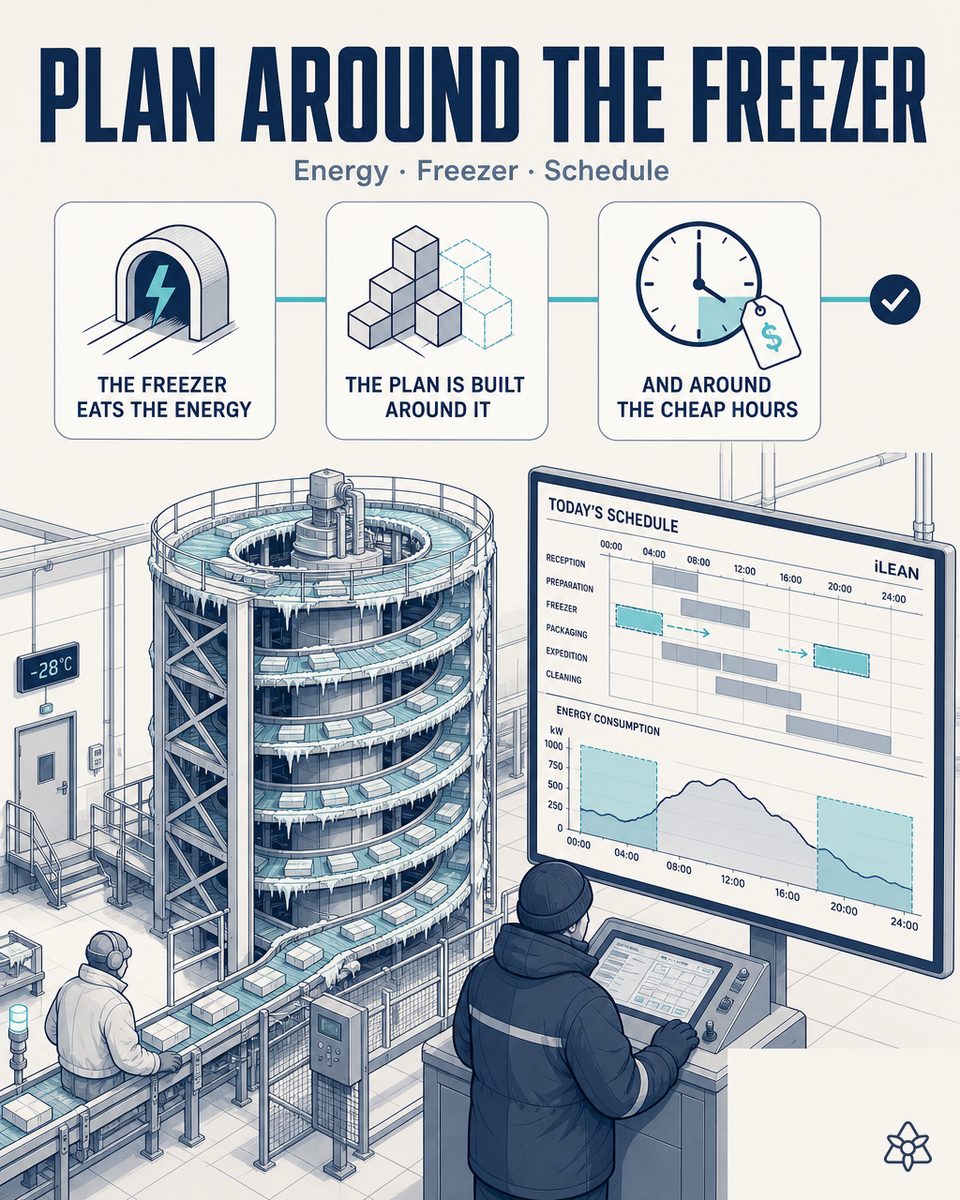
The tunnel freezes at half load during expensive hours — because the plan never looks at energy.
The freezing tunnel is the energy heart of a frozen food plant, and a plan built in a spreadsheet mistreats it without meaning to:
- Freezing at half load. A tunnel running at 50% of its capacity for twice as long consumes far more — in energy, in auxiliary services, in wear — than the same tunnel at full load for half the time. The fragmented demand in the spreadsheet condemns it to run half empty.
- Freezing during peak hours. The cost of a kWh between the peak band and the off-peak band can vary several times over; the production plan, blind to the tariff, sets the tunnel running whenever it happens to fall — including the most expensive hours.
- Start-ups and thermal cycles. Every time the tunnel comes down to temperature again because of a badly grouped plan, that is extra energy and extra stress on the refrigeration equipment.
And who decides at what load and in which band the tunnel freezes? The production plan. With a spreadsheet, looking only at demand, nobody recalculates the energy fit — even though it costs money every month. Redoing it by hand when the tariff or the demand changes is simply out of reach.
Connect absorbs your spreadsheets; the Agent plans the tunnel at full load and in cheap hours.
The iLEAN Planning Agent was born planning centers that really cannot stop — continuous centers in heavy industry where continuity is a hard constraint. That same machinery scales down to what your plant needs: strict continuity if you decide so, or a heavy penalty on every start-up so the engine minimizes them without banning them.
The user drops in their spreadsheets and their electricity bands. The agent builds the model of the frozen food plant and hands back an editable receipt. The engine concentrates the tunnel at full load in off-peak windows. The human compares three scenarios and approves with a stamp.
The specific iLEAN piece for your frozen food plant:
- Connect — absorbs the chaotic documents the plant already has: the production spreadsheet with its thousand tabs, the commercial demand that arrives by email, the rates per SKU and line. No mandatory template and no prior integration project.
- Planning Agent — builds the planner's database on its own (centers, lines, items, constraints, demand), asks only when something blocking cannot be derived from the documents, and solves with a constraint optimization engine. The freezing tunnel is the case where the planner's two axes come together: it should run full and stable (like a continuous center) and its running hours should fall in the cheap energy bands (the time bands enter the model as a penalty). The engine groups production to fill the tunnel and places it away from the peak, planning the full cascade — preparation → freezing → packing — with the intermediate buffers that give it room.
- Three scenarios, not one plan — maximum output, tight inventory and stability (long campaigns, minimum changeovers). Side by side, with KPIs and the differences explained one by one.
Packing and product forming are planned as discrete centers: the same output in fewer hours and, if it pays off, in cheap bands, taking advantage of the fact that much of it already shifts off-peak alongside the tunnel.
The approved plan is exported to the spreadsheet in the format of the production schedule the plant already uses. The team's routine does not change on day one — what changes is how long it takes to reach a good plan.
Plan in a spreadsheet vs. plan with the Planning Agent
| Aspect | The planner's spreadsheet | With the Planning Agent |
|---|---|---|
| Load of the freezing tunnel | Half load, many hours | Full load, fewer hours |
| Time band for freezing | Whichever comes up — peak included | Concentrated off-peak where the buffer allows |
| Electricity cost in the plan | Invisible | Penalty per band, compared across scenarios |
| Tunnel start-ups and thermal cycles | Whatever the manual fit throws up | Minimized through grouping |
| Packing | Inherited shifts at partial load | Compressed and, if it pays off, in off-peak hours |
| Strategy alternatives | A single feasible plan | 3 scenarios compared with KPIs + what-ifs |
| Replanning after a surprise | Another few days | Minutes: recalculate and compare |
| Format of the approved plan | The usual spreadsheet | The very same spreadsheet — just exported |
Impact estimate for your plant — to be validated with your numbers.
The block below is an estimate to be validated with the specific data of your plant. We put it forward so the committee has an order of magnitude; we refine it during the diagnostic.
- Frozen food plant with a freezing tunnel or a spiral/IQF freezer and packing centers, monthly plan built today in a spreadsheet without looking at the electricity tariff.
- First planning session with the agent on the existing documents — with no prior data project. First comparable plan in one morning.
- Expected reduction of tunnel hours in expensive bands and of partial-load running of ≥30%, by concentrating full load off-peak. (Conservative range — estimate to be validated; the ceiling depends on the product buffer your process allows.) In a center this energy-intensive, every point counts.
- Indicative payback between 4 and 9 months, depending on the consumption of your continuous centers, the cost of transitional product and the planning hours freed up.
The defensible technical anchor comes from the planner's best-documented real case: a high-demand industrial plant in heavy industry — with a strictly continuous center — whose agent built the complete model on its own (one furnace with 3 lines, 128 items with their production rates, 5 operating constraints and ~4,600 tonnes of demand) from a 114 MB zip containing an 18-sheet spreadsheet, and delivered 3 optimized scenarios in under an hour. The same class of constraint engine, scaled to what a freezing tunnel needs.[1]
And the operations director's reasonable doubt
“What if the plan the AI proposes cannot actually be run in my plant?” — that is exactly why there is human verification at every gate. The intake receipt shows everything the agent has understood from your documents and is corrected inline before anything is solved; the scenarios are compared with the differences explained; and the plan only goes into production when the manager approves it with a stamp. If the demand does not fit in full, the system does not say “infeasible”: it delivers a partial plan with its coverage and points out exactly what is left out, so a person can decide. The AI proposes; the plant signs.
[1] Real iLEAN case, high-demand plant in heavy industry — verified pilot figures: 114 MB of documents, 18 sheets, 128 items, ~4,600 t, 3 scenarios in <1 h, 99.5% coverage.
What people ask about planning production with an agent
Is the freezing tunnel a “continuous” center like a tile plant's kiln?
It is similar on the energy side, not on the breakage side. A tile kiln cracks if you stop it; a freezing tunnel does not break, but it is one of the biggest energy consumers in the plant — bringing it down to temperature costs money, keeping it there costs money, and running it at half load is throwing money away. That is why the tunnel is best run full and stable, like a continuous center, and with its running hours in the cheap bands. The planner brings both axes together in a single plan.
Where do the savings come from if I freeze the same amount?
From two places. By load: the tunnel at full load for fewer hours consumes less than at half load for twice as long (auxiliary services, start-ups, base consumption). By band: if those hours fall in the off-peak windows of the tariff, every kWh costs a fraction of a peak one. In a process this cold-intensive, the two levers together carry a lot of weight.
How does the planner know which are my cheap hours?
You tell it with data: the time bands of your electricity contract are loaded as penalties per band, just like every other constraint. The engine places the tunnel's running hours away from the expensive bands, and the scenarios show the effect — you can compare a plan “concentrated off-peak” against a “spread out” plan with the numbers in front of you and decide how much it is worth to you.
Is there a risk of the tunnel running out of product to freeze?
That is exactly why it is planned as a network, not center by center. Preparation runs upstream and packing downstream, with buffers (product ready to freeze, bulk frozen product) that give room to shift the tunnel's hours toward the cheap bands without leaving it empty. If the buffer does not stretch that far, the plan says so — it does not hide it.
Who approves the plan: the AI or the plant?
The plant, always. The AI proposes: the intake receipt is editable, the scenarios are compared, and the plan only goes into production when the manager approves it with a stamp. The approved plan is exported to the spreadsheet in the format the plant already uses.
Tell us about your case and within 48h we'll send you the estimated ROI of this AI project for your plant.
We work on your plant's real data, not on ours. Diagnostic with no commitment.
Request estimated ROI in 48h ‹ All frozen food cases See food industry