Tetilla PDO — shape cannot be fixed in the ripening room: you either catch it at demolding, or it is PDO scrap.
Galician Tetilla PDO cheese is defined by its conical shape with a tip — the specification measures height, base and projection. When a piece comes out of the mold out of spec, there is a narrow window to reshape it before salting; past that point, it goes to sale without the PDO seal. iLEAN Vision reads the silhouette of every piece as it leaves demolding and separates, in line, the ones that can still be recovered from the ones that cannot. The cheesemaker signs.
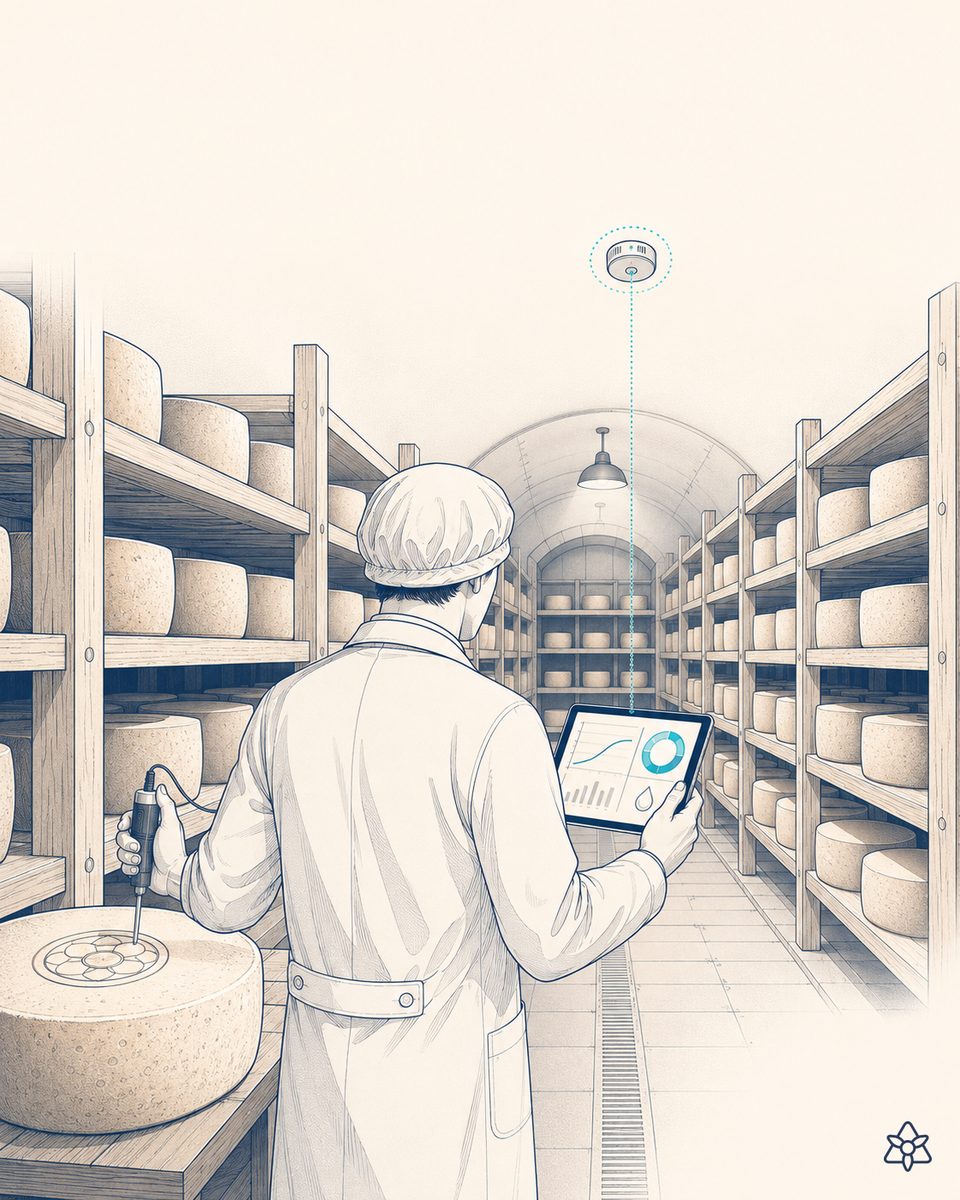
A tenth of a degree in the room moves the shape — and the window to correct it is very narrow.
A correct piece of Tetilla PDO is conical, with a wide base and a well-defined tip on top. The specification measures three things:
- Total height and base diameter — the characteristic proportion of the cone.
- Cone angle — neither too open, nor too slender.
- Curvature and projection of the tip — the most closely watched feature, because it is what distinguishes a Tetilla from a Galician cheese with a similar paste but a different shape.
Molding depends on three variables that change every single day: pressing temperature, airing in the mold and the moment of demolding. And a curd slightly fattier than usual, or a mold with a micro-deformation, gives you pieces with a short tip, an asymmetric cone or a flattened base. The cheesemaker sees it after demolding, but by then the piece has a very narrow window for reshaping. If it goes to salting out of shape, the rind sets and the Regulatory Council declassifies the piece. The gap between Tetilla PDO and generic Galician soft cheese is real in price per kilo — and demolding is what decides it.
iLEAN Vision separates the recoverable piece from the lost one — before salting.
The problem with conical molding is not a lack of judgment: the cheesemaker knows perfectly well which piece is right and which is not. The problem is holding that judgment piece by piece through a long working day and, above all, deciding in time which one can be recovered by reshaping it by hand. iLEAN acts as the putty that fills that gap between the cheesemaker's eye and the outfeed belt, without asking you to change anything in the traditional process.
Edge sees the piece as it leaves demolding and sorts it into three: within spec, recoverable with manual reshaping, lost. Connect captures the day's temperature and recipe. The agent cross-references against the PDO specification and the person signs every decision.
The iLEAN pieces applied to conical molding of Tetilla PDO:
- iLEAN Vision (Edge) — a terminal with a camera and a CNN trained on real pieces from the dairy. It reads the side silhouette, measures height, base and curvature of the tip, and sorts into three categories: within spec (continues to salting), recoverable (diverted for manual reshaping), lost (diverted to sale without the PDO seal). It triggers a gentle actuator (a light stack, a diverter arm on the belt) in milliseconds. It works with no network.
- iLEAN Connect — captures the recipe and the day's temperature (molding room, airing in the mold) from the ERP, from an Excel sheet or from the cheesemaker's notebook. It closes the loop between the outcome of each piece and the process conditions, so the agent can learn which combination produces which shape.
- Agent — cross-references the piece as seen, the day's conditions and the PDO specification. When it spots a pattern (for example, pieces with a short tip at the end of the third shift), it warns the cheesemaker before it happens again. The cheesemaker decides and signs; the agent never touches the recipe on its own.
Demolding by eye vs. demolding with iLEAN Vision
| Aspect | Classic control | With iLEAN Vision + Connect |
|---|---|---|
| Shape verification | The cheesemaker's eye, piece by piece | CNN on every piece, no fatigue, against the PDO spec |
| Sorting of an out-of-spec piece | “Goes to salting” or “set it aside” — nothing in between | Recoverable / lost, decided in line |
| Window for manual reshaping | Few pieces reach reshaping in time | The diversion happens before the rind sets |
| Piece sold without the PDO seal | Detected in the ripening room, value already gone | Detected at demolding, segregated to the right channel |
| Operation with no network | n/a | Edge keeps running on its own panel power |
| File for the Regulatory Council | Rebuilt by hand | Automatic per-batch dossier, with a photo of every piece |
Impact estimate for your plant — to be validated with your numbers.
The block below is an estimate to be validated with the specific data of your dairy. We put it forward so the committee has an order of magnitude; we refine it during the diagnostic.
- Tetilla PDO dairy with a batch molding room, two or three long working days per week.
- Vision pilot on the demolding outfeed belt (overhead camera + lighting + gentle diverter + integration with the cheesemaker's notebook). First value expected within a few weeks: pieces sorted into within spec / recoverable / lost with ≥ 90% agreement with the cheesemaker's own judgment.
- Expected reduction of declassified pieces of ≥ 30%, conservatively, thanks to timely manual reshaping. Indicative payback between 4 and 9 months depending on volume, PDO price per kg and the historical rate of declassification.
- The hard lever is the piece recovered in time (sold as Tetilla PDO instead of going out as bulk) and the out-of-spec piece segregated before it takes the seal.
And the cheesemaker's reasonable doubt
“What if the AI rejects a good piece?” — the AI does not reject. It diverts for human review. Hallucination is a problem of free generation, not of anchored tasks. In tasks where the AI merely compares an image with a learned pattern (the silhouette against the specification), the best models brought error below 1.5% [1]. And even so: the agent diverts, the cheesemaker signs. The system never sends a piece to the unsealed channel on its own.
[1] OpenAI paper “Why Language Models Hallucinate”, 2025 — on the reliability of AI in anchored tasks.
What people ask about conical molding of Tetilla PDO with AI
What does the PDO specification require of the shape of Tetilla cheese?
The specification for Queixo Tetilla PDO requires a conical or pear shape with a characteristic tip on top — height, base diameter and projection of the tip are all regulated. It is one of the PDOs where shape is an essential part of the product: a Galician cheese with a similar paste but a different shape is not Tetilla PDO. The Regulatory Council inspects and declassifies pieces outside the specification, and the curvature of the tip is one of the most closely watched points because of its tradition.
Why does conical molding go wrong in batch production?
Because Galician curd has a high plasticity that depends on pressing temperature, on airing in the mold and on the exact moment of demolding. A tenth of a degree of variation in the room temperature, a curd slightly fattier than usual, or a mold with a micro-deformation give you a piece with a short tip, an asymmetric cone or a flattened base. The cheesemaker sees it after demolding, but by then the piece has little margin left — if it goes to salting out of shape, it has to be declassified.
How does iLEAN Vision read the conical silhouette of Tetilla PDO?
iLEAN Vision (Edge) is a terminal with a camera and a convolutional neural network (CNN) trained on real pieces from your own dairy. It reads the side silhouette of every cheese after demolding, measures total height, base diameter, cone angle and curvature of the tip, and compares them against the PDO specification. If a piece is out of spec and still has recoverable plasticity, the system diverts it for manual reshaping before it goes to salting. If the piece can no longer be recovered, it is set aside for sale without the PDO seal. The person signs every decision.
Does this work if the molding and demolding room is small and manual?
Yes. iLEAN Edge is a local terminal you install wherever it is needed — on the demolding outfeed belt, over a table with controlled lighting, wherever the flow allows. It does not require an automatic belt, or SCADA, or MES. And it works with no network: if the dairy loses its internet connection, Edge keeps reading and diverting pieces, because what is critical cannot depend on connectivity. Connect captures the recipe and the day's temperature from the ERP or from the cheesemaker's notebook.
How much does AI vision cost in a Tetilla PDO dairy?
The order of magnitude of an Edge pilot in the demolding room of a Galician PDO dairy is close to that of any Edge pilot in a small food plant: an initial investment covering terminal + camera + lighting + light integration, plus an annual license. A reasonable payback is in the order of several months — the hard lever is the piece recovered in time before salting (recoverable while it still has plasticity) and the out-of-spec piece held back before it leaves carrying the seal. We send you the estimated ROI in 48h with the real data of your dairy.
More cases in food
- Rind scraping in ripening — the veteran's eye inside the system, with no over-scraping.iLEAN Vision guides the scrape rind: it sees the cheese rind during ripening, flags unwanted molds and…
- Controlling Penicillium roqueforti inoculation in Roquefort AOP — the mold is the signature, and a signature is not improvised.iLEAN Edge controls the inoculation and dosing of Penicillium roqueforti in every Roquefort AOP curd,…
- Blue veining in Stilton PDO — verifying the piercing before the cheese goes into the cave.How iLEAN Vision verifies the manual piercing of Stilton PDO before the final cave, counting holes and…
- Torta del Casar PDO — thistle rennet does not perform the same every day, and the creaminess tells you weeks too late.iLEAN Edge controls the Cynara cardunculus thistle rennet in Torta del Casar PDO: pH curve, creaminess…
- Automatic FIFO/FEFO in a food warehouse — an expired unit on the retailer's shelf is not an incident, it is a phone call from your sales director.iLEAN drives picking by expiry date without relying on the operator. Expired product drops sharply, with…
- Fish cold room temperature control with AI — the range is not a chart, it is a dossier per batch.How iLEAN cross-checks temperature, door openings, load and the room's curve to keep fresh fish in range…
Tell us your case and in 48h we'll send you the estimated ROI of this AI project for your Galician PDO dairy.
We work on your dairy's real data, not ours. Diagnostic with no commitment.
Request estimated ROI in 48h See European cheeses