Rind scraping in ripening — the veteran's eye inside the system, with no over-scraping.
In European ripening cellars, unwanted molds grow without warning and the scrape rind is done by the master affineur's eye. iLEAN Vision sees the rind the way they see it, marks wheel by wheel where to scrape and where not to — and the person decides and signs. The veteran's eye stays inside the system as a permanent capability.
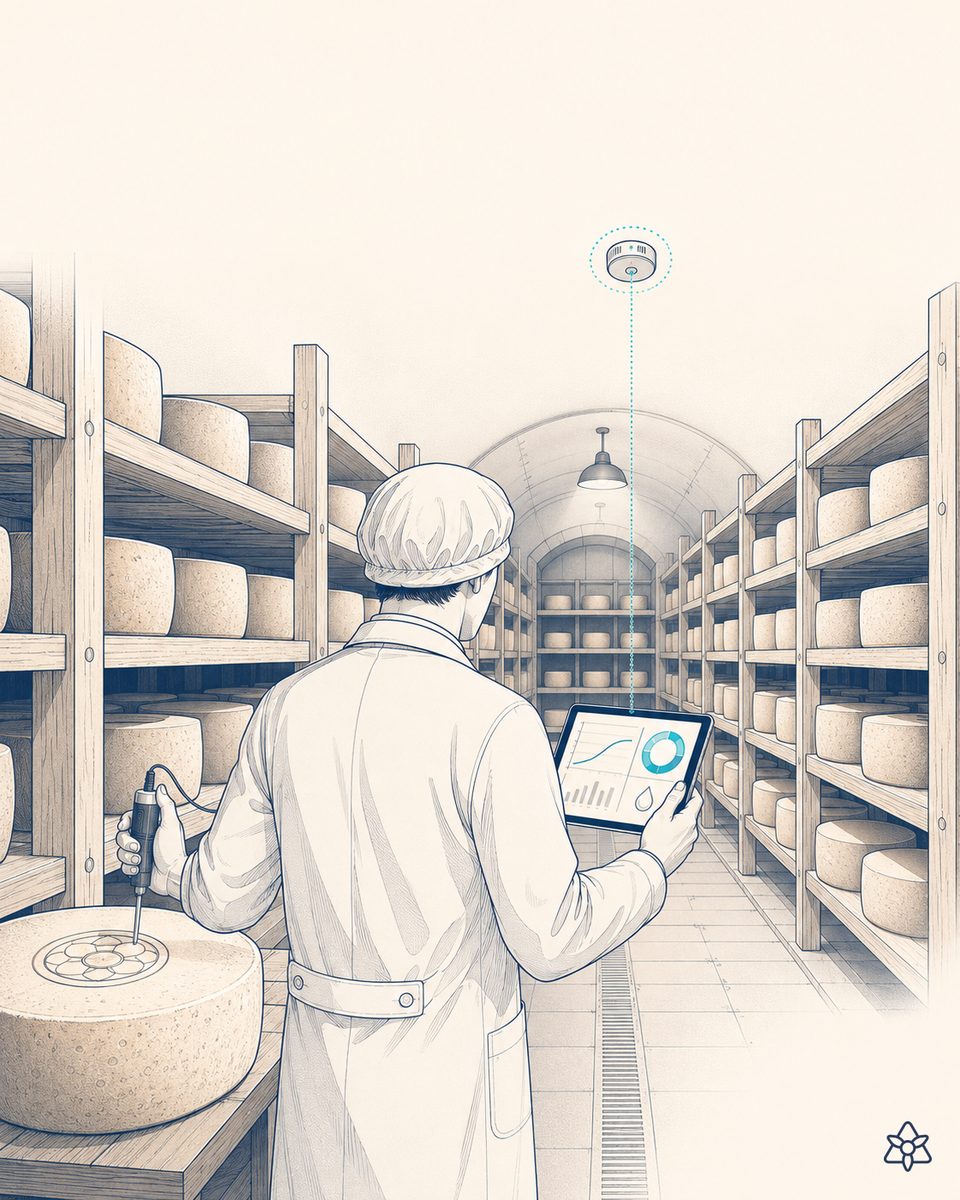
Scrape rind is done by eye — and the eye retires.
In the ripening of live-rind cheeses (soft paste, washed rind, natural rind), the balance between useful flora and unwanted molds is decided wheel by wheel, in corridors and cellars at half light, with a spatula and many years of craft. There are three problems and they stack up:
- The veteran's eye is not transferable — the master affineur can tell a useful Penicillium from cat's-hair Mucor at ten feet, and a trainee takes years to learn it. The day they retire, half the cellar goes with them.
- Over-scraping is hard cost — trimming extra to "play it safe" translates into AOP/PDO grade downgrades and wheels that end up grated. Almost nobody measures that cost on its own line, but it is there.
- Wheel-by-wheel traceability is hard — the AOP/PDO auditor wants to see the history of each wheel (what was done to it, when, why) and rebuilding it by hand takes weeks.
The classic system (craft + spatula + notebook) works — until the veteran leaves or the production rate goes up. That is the moment to capture their eye as a permanent capability.
iLEAN Vision does not replace the affineur — it gives them a hundred extra eyes in the cellar.
The problem with rind scraping is not a lack of judgment: the judgment belongs to the master affineur. The problem is that the judgment does not replicate, is not documented and gets lost. iLEAN acts as the putty that fills that gap between the craft and the system, without asking you to change the way you ripen.
Edge sees the rind under controlled light. The agent cross-references the image with the wheel's history and proposes the trim. The master affineur signs — the spatula is still theirs.
The iLEAN pieces applied to scrape rind during ripening:
- Edge (iLEAN Vision) — a terminal with machine vision (CNN) and cellar optics (controlled-spectrum LED). It runs along the shelving or mounts on the cart, reads the rind wheel by wheel and marks the zones with unwanted flora. It detects cat's-hair Mucor, anomalous green patches, runaway Geotrichum. It works without a network.
- Connect — captures the wheel's history wherever it lives: ERP, ripening sheet, a photo of the master's notebook. The ripening recipe (washing frequency, salinity, days in the cellar) enters at second zero, without anyone having to re-send anything.
- Agent — cross-references the image of the rind with the wheel's history and the ripening recipe. It proposes the exact trim (zone, depth, frequency) and records the decision. If the proposal departs from the usual, it does not execute on its own — it waits for the master affineur's signature.
Scrape rind by eye vs. scrape rind guided by iLEAN Vision
| Aspect | Classic ripening by eye | With iLEAN Vision + Agent |
|---|---|---|
| Who sees the rind | The master affineur, when they walk the cellar | A hundred extra eyes, on every round, under controlled light |
| Telling useful flora from unwanted mold | Craft accumulated in one person | A CNN trained on your own flora + the master's signature |
| Over-scraping to "play it safe" | Frequent — AOP/PDO grade downgrades | An exact trim proposed, validated by the person |
| Wheel-by-wheel traceability | Notebook + memory + manual reconstruction | Automatic history with a photo per wheel |
| Capturing the craft | It leaves with whoever retires | It stays in the system as a permanent capability |
| AOP/PDO audit | Rebuilding a dossier per wheel, weeks | A per-wheel dossier generated on its own, with images |
Impact estimate for your plant — to be validated with your numbers.
The block below is an estimate to be validated with the specific data of your ripening operation. We put it forward so the committee has an order of magnitude; we refine it during the diagnostic.
- Cellar with several thousand wheels ripening at the same time, multi-format (soft paste + washed rind), a recurring problem with unwanted molds in the warm season.
- iLEAN Vision pilot in one ripening room (Edge terminal with cellar optics + integration with the ripening sheet). First value expected within a few weeks.
- Indicative payback between 4 and 9 months, depending on the share of wheels that drop an AOP/PDO grade because of over-scraping and on the price differential per grade in your sales network.
- Reduction in over-scraping and in wheels sent to grating of ≥ 30% as a conservative floor. The hard lever is the grade improvement wheel by wheel.
And the master affineur's reasonable doubt
“What if the AI gets it wrong and calls for a trim where there shouldn't be one?” — hallucination is a problem of free generation, not of anchored tasks. In tasks where the AI merely reads an image and compares it against a pattern trained on your own flora, the best models brought error below 1.5% [1]. And even so, the trim does not execute on its own: iLEAN proposes and the person signs. The three safety rings exist precisely for this.
[1] OpenAI paper “Why Language Models Hallucinate”, 2025 — on the reliability of AI in anchored tasks.
What people ask about AI-guided scrape rind in ripening
What is scrape rind in cheesemaking and when is it done?
Scrape rind is the selective trimming of the rind during ripening to remove unwanted molds (cat's-hair Mucor, runaway Geotrichum, greenish patches) without touching the useful flora. It is done wheel by wheel with a spatula or a brush, at specific points in the ripening depending on the type of cheese. It is an operation with a narrow margin: scraping too little leaves the mold living inside the rind; scraping too much ruins the wheel and downgrades its classification.
How does an AI tell an unwanted mold from the useful rind flora?
With machine vision (CNN) trained on images of real rinds from the affineur's own cellar: the model learns their Penicillium candidum, their Brevibacterium linens, their normal Geotrichum — and learns to flag anything that departs from that pattern (color, texture, distribution). iLEAN Vision does not decide for the master affineur: it shows them the map of the wheel with the zones to review highlighted, proposes the trim, and the person validates and signs. The veteran's eye stays inside the system as a permanent capability, not tied to a retirement date.
Does over-scraping show up in the AOP/PDO grade of the cheese?
Yes, and it is one of the invisible costs of ripening. A wheel with an over-scraped rind loses thickness, loses visual symmetry and often drops a grade in the AOP/PDO classification (from extra to class 1, or from first to second), with a direct hit to the selling price. Add the wheels that end up as grated cheese because of excessive trimming, and over-scraping is a hard cost that almost nobody measures because nobody sees it on its own line.
Does iLEAN Vision work in real ripening cellars, with high humidity and low light?
Yes. iLEAN Edge is built for the plant environment — high humidity, dust, salt, vibration — and the Edge optics for cellars use their own controlled-spectrum LED lighting so that the true color of the rind reaches the model, without depending on ambient light. It works without a network: if the cellar loses WiFi, the Edge keeps reading and recording, because what is critical cannot depend on connectivity.
How much does it cost to put AI vision into a ripening cellar?
The order of magnitude of an Edge pilot in a ripening cellar is close to that of any Edge pilot in a food plant: an initial investment covering a terminal with cellar optics + integration with your ripening system, plus an annual license. A reasonable payback to put before the committee is several months — the hard lever is the improvement in AOP/PDO grade wheel by wheel and the reduction of over-scraping. We ask for your ripening data and send you the estimated ROI in 48h, with your numbers.
More cases in food
- Casein mark traceability per wheel in PDO Parmigiano Reggiano — a dossier per wheel, not an Excel per shift.iLEAN Tracer links the casein mark of every PDO Parmigiano Reggiano wheel to the Consorzio file: milk…
- Payoyo cheese — "which goat is this cheese from?" should not be a question without a concrete answer.iLEAN Tracer ties every batch of Payoyo cheese from the Sierra de Cádiz to its payoya goat and…
- EU Reg 853/2004 on raw milk for export cheese — a live temperature log, not the tanker's notebook.iLEAN Connect captures the tanker temperature log and cross-references EU Reg 853/2004 — raw milk for…
- Controlling Penicillium roqueforti inoculation in Roquefort AOP — the mold is the signature, and a signature is not improvised.iLEAN Edge controls the inoculation and dosing of Penicillium roqueforti in every Roquefort AOP curd,…
- Blue veining in Stilton PDO — verifying the piercing before the cheese goes into the cave.How iLEAN Vision verifies the manual piercing of Stilton PDO before the final cave, counting holes and…
- Tetilla PDO — shape cannot be fixed in the ripening room: you either catch it at demolding, or it is PDO scrap.iLEAN Vision verifies the characteristic conical shape of Galician Tetilla PDO cheese after demolding…
Tell us your case and in 48h we'll send you the estimated ROI of this AI project for your ripening operation.
We work on your cellar's real data, not ours. Diagnostic with no commitment.
Request estimated ROI in 48h See food industry