Payoyo cheese — "which goat is this cheese from?" should not be a question without a concrete answer.
Payoyo cheese from the Sierra de Cádiz is made with payoya goat milk and, depending on the variety, with grazalemeña merino sheep milk — native breeds that justify the premium price. But the information linking the animal to the cheese lives on five islands (farmer's notebook, tanker delivery note, ERP, vat sheet, label). iLEAN Tracer closes that chain at second zero, without asking the farmer or the master cheesemaker to change anything of theirs. The person signs.
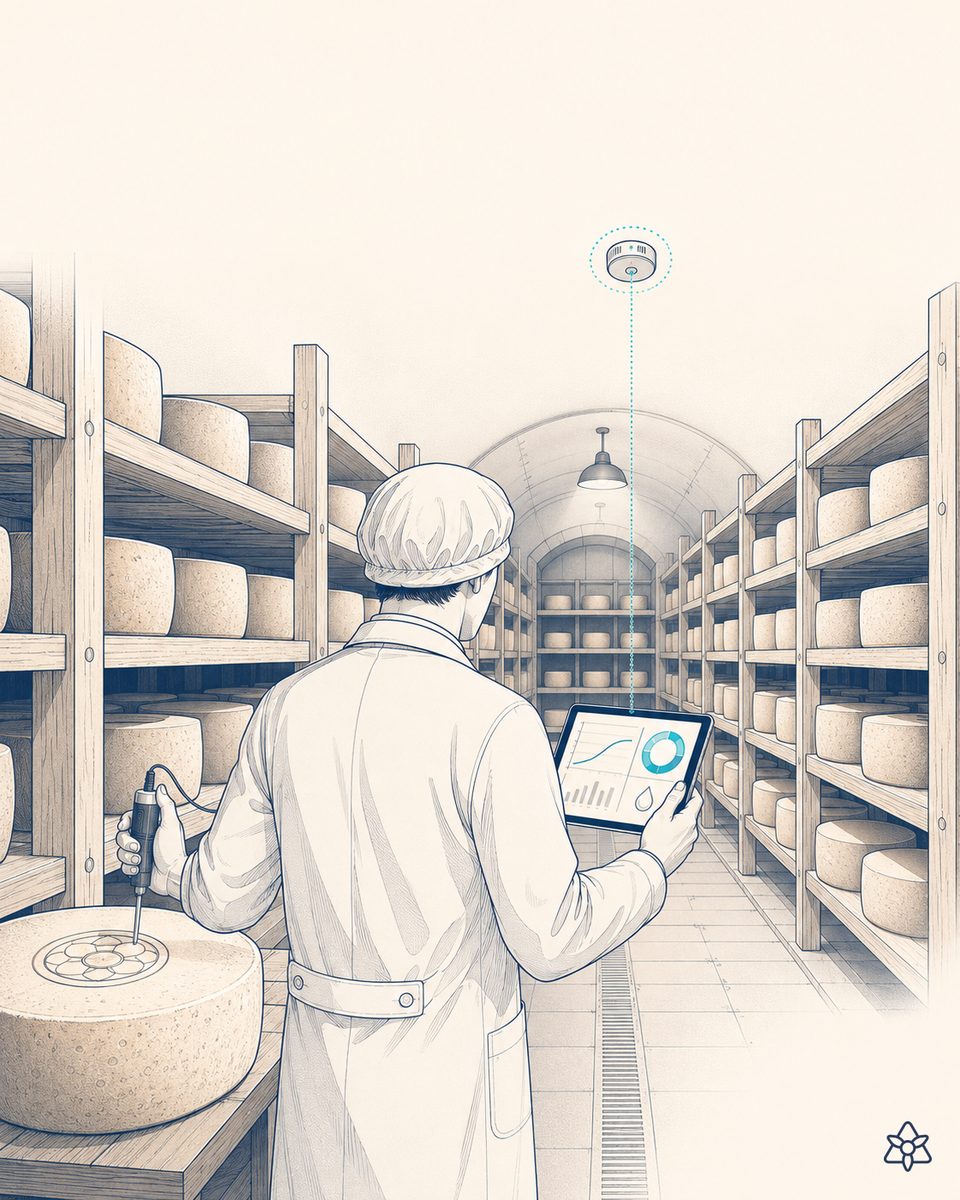
Five links, five systems, and a cheese that does not know which goat it came from.
The value of Payoyo cheese lies in the goat and in the pasture, not only in the aging. But between the animal and the cheese there are five links where information breaks:
- The farm — REGA number, breed register, head count. In the farmer's notebook.
- The milking — how much, what quality, which day. Sometimes on paper, sometimes in a notebook in the milking parlor.
- The tanker collection — which farms the driver visited today, and in what order. A paper delivery note signed at every stop.
- The dairy tank — which milk goes into which tank, blended with yesterday's. In the ERP, if there is one, or in a notebook.
- The vat — which vat is made from which tank, at what time, in what quantity. On the master cheesemaker's sheet.
When a gourmet buyer, a journalist or a visitor asks "which goat is this cheese from?", the honest answer is "from the mountains". And the mountains are not a goat. Today, breed traceability per cheese is weeks of work after the fact, and almost nobody does it outside an audit. The cheese loses premium value because it cannot tell its origin with a scan.
iLEAN Tracer joins the five links — without asking anyone to change what they already do.
The problem with breed traceability is not missing data. The data is there — in five different places. It is information that lives in islands and that, by the time it comes together, can no longer be tied to a specific cheese. iLEAN acts as the putty that fills the gaps between the farmer's notebook, the tanker, the ERP, the vat sheet and the cheese label — without forcing artisan farmers to digitalize overnight.
Tracer is an agent that lives on top of Connect. It captures the data where it already is (voice, photo, app or ERP), joins it by batch and leaves every cheese with a verifiable origin all the way back to the goat. The person signs — the chain builds itself from what is already there.
The iLEAN piece applied to Payoyo and breed traceability:
- iLEAN Connect at the farm — captures the day's milking through whichever channel each farm uses: a photo of the notebook, voice dictation into the earpiece, a WhatsApp to the driver, a simple app. Graded farm by farm: direct integration for those who have a system, assisted capture from a phone for those who do not. Nothing has to change.
- iLEAN Connect on the tanker — the driver logs every collection stop (which farm, how much, what time) with a couple of taps on the phone or by voice. The paper delivery note is still signed if it has to be — Connect reads it and cross-references it.
- iLEAN Connect at the dairy — captures which tank each tanker load goes into, which vat is made from each tank and which pieces come out of each vat. A modern ERP, a MES, Excel, the master cheesemaker's sheet: it all goes in.
- iLEAN Tracer (agent) — lives on top of Connect and joins the five links by batch. Every labeled cheese carries an identifier that returns, with a single scan, the list of farms of origin, the goat/sheep breeds and the collection day. Breed traceability per cheese, not per plant.
Fragmented documentary traceability vs. breed traceability per cheese
| Aspect | Classic control | With iLEAN Tracer + Connect |
|---|---|---|
| Origin of the milking | Farmer's notebook, never cross-referenced | Batch per farm, captured on the day |
| Tanker traceability | A delivery note signed at every stop | Full route with quantities, at second zero |
| Blending in the tank | Implicit, with no breakdown by origin | Tank composition by farm and by breed |
| Cheese ↔ breed | "From the mountains" | "From these three farms, 80% payoya / 20% grazalemeña" |
| Time to reconstruct | Weeks, during an audit | Available as the cheese leaves the vat |
| Burden on the farmer | Extra paperwork, resistance | Capture through his own channel (voice/photo/WhatsApp) |
Impact estimate for your plant — to be validated with your numbers.
The block below is an estimate to be validated with the specific data of your creamery. We put it forward so the committee has an order of magnitude; we refine it during the diagnostic.
- Artisan dairy collecting from 5-10 payoya goat farms and 2-3 grazalemeña merino farms, one tanker of its own or shared, one vat room.
- Connect + Tracer pilot: rollout of voice/photo/WhatsApp capture for the driver and the master cheesemaker, light integration with the ERP or the master's sheet. First value expected within a few weeks: breed traceability per cheese available as the pilot batches leave the vat.
- Expected margin improvement on the gourmet/export channel of ≥ 30%, conservatively (the additional premium for cheese with a certifiable breed). Indicative payback between 4 and 9 months depending on volume, channel and average price per kg.
- The hard lever is the cheese sold with its origin told on the label: a premium price in gourmet and export, and the Regulatory Council's bonus for a creamery with accredited breed traceability.
And the master cheesemaker's reasonable doubt
"What if the AI mixes up a batch and puts down the wrong breed?" — hallucination is a problem of free generation, not of anchored tasks. In tasks where the AI simply recontextualizes a piece of data from one system into another (the notebook entry, the tanker delivery note, the vat sheet), the best models brought error below 1.5% [1]. And even so, what is critical is never decided alone: Tracer proposes the traceability and the master cheesemaker signs the batch. The chain is always signed by a person.
[1] OpenAI paper "Why Language Models Hallucinate", 2025 — on the reliability of AI in anchored tasks.
What people ask about payoya goat traceability and Payoyo cheese with AI
Which native breeds go into Payoyo cheese from the Sierra de Cádiz?
Payoyo cheese from the Sierra de Cádiz is traditionally made with milk from the payoya goat (a native Andalusian breed at risk of extinction) and, in some varieties, milk from the grazalemeña merino sheep. The payoya is the breed that gives the cheese its name and defines its sensory profile — together with the mountain pasture. Blending in generic standard goat milk is legal, but it loses the point of the product: the premium buyer pays for the breed, not just for the cheese.
Why is it so hard to trace the breed from the goat to the cheese?
Because the chain has five links where information breaks: farm → milking → tanker collection → dairy tank → vat. Documentary traceability does exist (the REGA register, the farm logbook, the milk delivery note), but it lives in five different systems — the farmer's notebook, the tanker's paper log, the dairy's ERP, the master cheesemaker's vat sheet. If milk from three farms and two breeds gets blended in a single day, reconstructing which cheese carries which milk is weeks of work after the fact. The visitor at the dairy who asks "which goat is this cheese from?" is left without a concrete answer.
How does iLEAN Tracer close breed traceability per cheese?
iLEAN Tracer is an agent that lives on top of Connect: it captures the data where it already is (farmer's notebook, tanker delivery note, ERP, vat sheet) and joins it by batch at second zero. Every cheese is tied to its vat, the vat to the tank, the tank to that day's tanker run, the tanker to the list of farms collected from, and every farm to its REGA number and its breed register. The result: every piece has a verifiable origin all the way back to the goat, without the master cheesemaker or the farmer having to write down anything new on paper.
Does this work if the mountain farms barely have any systems?
Yes — that is exactly why Connect exists. It captures the data wherever it comes from: a WhatsApp from the farmer to the tanker driver, a photo of the farm logbook, voice dictation into the earpiece, a photographed paper delivery note, a simple app if the farmer wants one. The level is graded farm by farm: direct integration for those who have a system, assisted capture from a phone for those who do not. We do not force the farmer to change anything for the dairy to be able to trace breed per cheese.
How much does it cost to implement breed traceability per cheese in an artisan dairy?
The order of magnitude of a Tracer pilot in an artisan dairy in the Sierra de Cádiz is close to that of any Connect pilot in a small food operation: an initial investment covering the capture rollout (phones/earpieces for the driver and the master cheesemaker, light integration with the ERP), plus an annual license. A reasonable payback is several months — the hard lever is the premium price for cheese with a verifiable breed in the gourmet/export channel, and the Regulatory Council's bonus for dairies with accredited breed traceability. We send you the estimated ROI in 48h with the real data from your creamery.
More cases in food
- OEE in a multi-PDO cheese plant — the changeover between European formats stops eating hours.iLEAN Brain orchestrates recipe changes between PDO formats in a multi-PDO cheese plant, validates the…
- Morge in Munster AOP — the master affineur's craft, replicable wheel by wheel.iLEAN Edge sees the Munster AOP rind in the cave and proposes the optimal morge washing frequency wheel…
- Casein mark traceability per wheel in PDO Parmigiano Reggiano — a dossier per wheel, not an Excel per shift.iLEAN Tracer links the casein mark of every PDO Parmigiano Reggiano wheel to the Consorzio file: milk…
- EU Reg 853/2004 on raw milk for export cheese — a live temperature log, not the tanker's notebook.iLEAN Connect captures the tanker temperature log and cross-references EU Reg 853/2004 — raw milk for…
- Rind scraping in ripening — the veteran's eye inside the system, with no over-scraping.iLEAN Vision guides the scrape rind: it sees the cheese rind during ripening, flags unwanted molds and…
- Controlling Penicillium roqueforti inoculation in Roquefort AOP — the mold is the signature, and a signature is not improvised.iLEAN Edge controls the inoculation and dosing of Penicillium roqueforti in every Roquefort AOP curd,…
Tell us your case and in 48h we'll send you the estimated ROI of this AI project for your native-breed dairy.
We work on the real data from your creamery and your farms, not ours. Diagnostic with no commitment.
Request estimated ROI in 48h See European cheeses