Morge in Munster AOP — the master affineur's craft, replicable wheel by wheel.
The morge and the rind washing of Munster AOP are decided by the master affineur in dim light, with his hands and his nose. iLEAN Edge sees the orange rind the way he sees it, proposes a washing frequency wheel by wheel and leaves a record. The decision and the signature stay his — the eye stays inside the system.
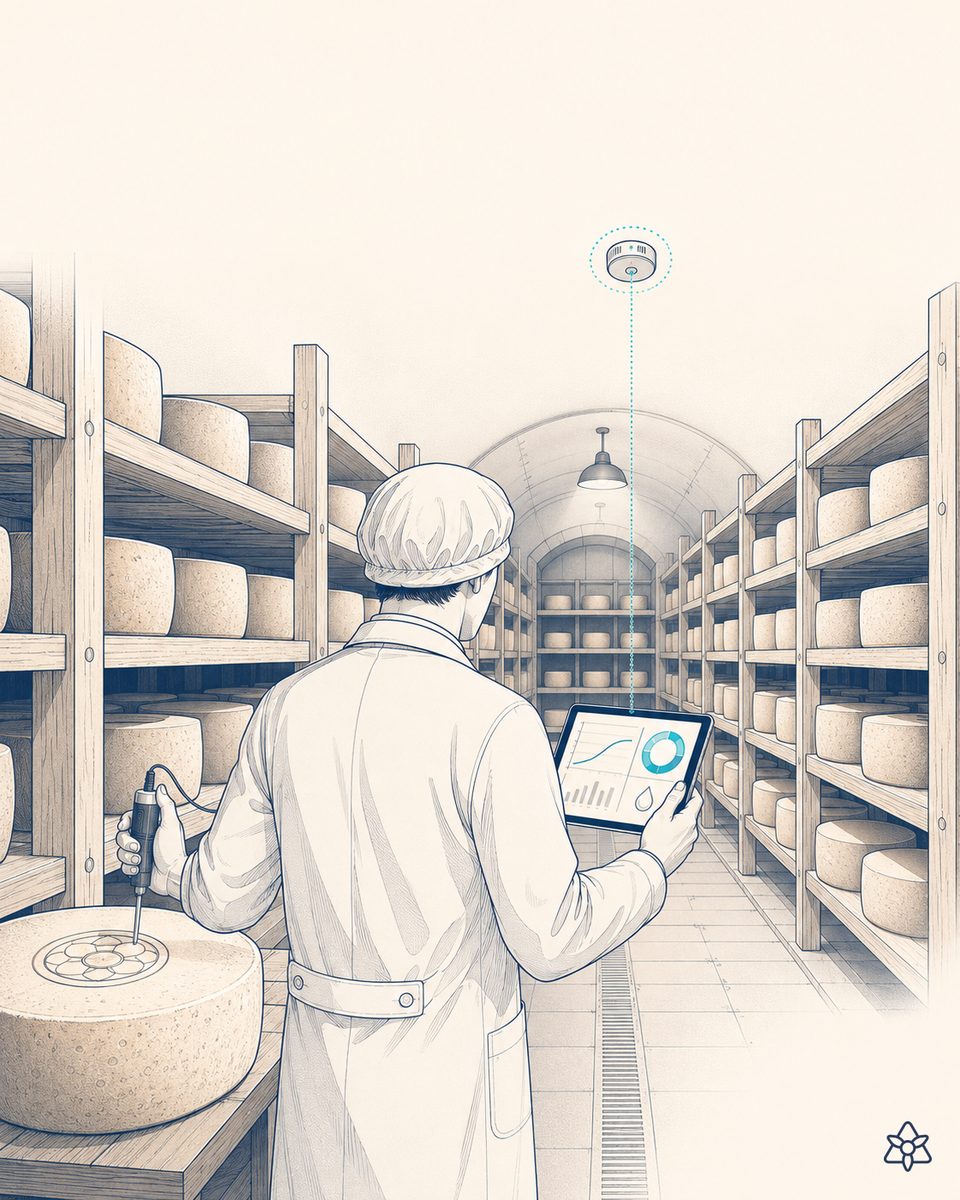
The craft of the morge is not written down — it is learned by watching the master.
The consistency of a Munster AOP rests on the look of the orange rind during ripening. And that look depends on three decisions the master affineur makes throughout the day, wheel by wheel:
- When to wash — the rind asks for morge when it starts to go pale or dries out. Washing at the wrong time throws the flora out of balance.
- How hard to wash — it depends on the ripening day and on how the wheel is responding. Washing too much makes it bitter; washing too little loses the color and the aroma.
- What to do with the wheels that drift — the ones that grow too fast, the ones that never get going. Each one needs a different routine.
The classic setup (craft + ripening sheet + a visual round) works — until volume goes up, new people come in or the master retires. That is the moment to capture his judgment as a permanent capability without touching what makes it unique.
iLEAN Edge does not decide the morge — it puts a hundred extra eyes in the Munster cave.
The problem with the morge is not a lack of judgment — the judgment sits with the master affineur. The problem is that the judgment does not replicate: when volume goes up, when the team rotates, when the next generation arrives, the craft stays inside one person. iLEAN acts as the putty that fills that gap between the craft and the system, without touching the AOP recipe or the role of the master affineur.
Edge sees the rind under controlled light. The agent cross-references the image with the ripening day and proposes a washing frequency. The master affineur validates and signs — the morge is still his.
The iLEAN pieces applied to morge control in Munster AOP:
- Edge — a terminal with machine vision (CNN) and cave-grade optics (controlled-spectrum LED). It travels through the ripening room on a cart or on a rail, reads the rind wheel by wheel and assesses the development of the orange flora. It detects pale patches, abnormal dryness, spotting. It works with no network.
- Connect — captures the ripening sheet (day in the cave, temperature, humidity, morge brine used) whether it comes from the MES, the master's notebook or a shared Excel file. It also captures the tasting notes of each batch at second zero.
- Agent — cross-references the rind image with the ripening day, the historical response of similar wheels and the AOP recipe. It proposes the washing frequency for each tray (tomorrow, in two days, not needed) and records the decision. The master affineur signs; the routine never runs itself.
Washing by rounds vs. washing guided by iLEAN Edge
| Aspect | Classic Munster AOP ripening | With iLEAN Edge + Agent |
|---|---|---|
| Who sees the rind | The master affineur, on his rounds | A hundred extra eyes, on every tray, under controlled light |
| When the morge washing is decided | By ripening sheet + eye | Proposal per wheel + the master's signature |
| Replicability of the judgment | Tied to one or two people | Stays in the system as a permanent capability |
| Wheel-by-wheel traceability | Ripening sheet + memory | Automatic history with a photo per wheel |
| Variation between batches | Accepted as "just how ripening goes" | Bounded with data — you see what failed and why |
| Generational handover | Years of learning for the newcomer | The veteran's judgment stays inside the system |
Impact estimate for your plant — to be validated with your numbers.
The block below is an estimate to be validated with the specific data of your ripening operation. We put it forward so the committee has an order of magnitude; we refine it during the diagnostic.
- Munster AOP cave with several ripening rooms, thousands of trays in active washing, generational handover of the master affineur on the horizon.
- iLEAN Edge pilot in one room (terminal with cave-grade optics + integration with the ripening sheet). First value expected within a few weeks.
- Indicative payback between 4 and 9 months, depending on the share of wheels downgraded or sold as second quality because of rind defects and on the opportunity cost of the master affineur training his successor.
- Reduction of downgraded wheels of ≥ 30% as a conservative floor. The hard lever is the consistency of the rind wheel by wheel and the capture of the veteran's judgment before he leaves.
And the master affineur's reasonable doubt
"What if the AI proposes the wrong thing and I ruin a whole batch of AOP wheels?" — hallucination is a problem of free generation, not of anchored tasks. In tasks where the AI simply reads a rind and compares it against a pattern trained in your own cave, the best models brought error below 1.5% [1]. And even so, the washing never runs itself: iLEAN proposes and the master affineur signs. The three safety rings exist precisely for this.
[1] OpenAI paper "Why Language Models Hallucinate", 2025 — on the reliability of AI in anchored tasks.
What people ask about Munster AOP morge with AI
What is the morge in a Munster AOP?
The morge (also called ferments d'orange) is the brine enriched with Brevibacterium linens and other rind bacteria used to wash the rind of Munster AOP during ripening. It is what gives the cheese its characteristic orange color, its strong aroma and, to a large extent, its flavor. The frequency and composition of the washing are decided by the master affineur according to the look and smell of the rind, the temperature and humidity of the cave, and the ripening day the wheel is on. It is pure craft.
Why is the morge washing frequency in Munster AOP so hard to standardize?
Because the optimal washing depends on how each wheel is responding at that precise moment. Washing too much brings bitterness; washing too little dries the rind and the color is lost; washing at the wrong time throws the flora out of balance. The master affineur reads it in dim light, with his hands and his nose. The challenge is not to replace that judgment: it is to replicate it when volumes go up or when new people join the team. Without replicability, the craft stays inside one person and the AOP depends on his retirement date.
How can iLEAN Edge help the master affineur without replacing him?
iLEAN Edge travels through the Munster ripening room with cave-grade optics (controlled-spectrum LED) and sees the rind wheel by wheel the way the master affineur would see it. It assesses the development of the orange flora (Brevibacterium linens), detects pale or dried-out areas, flags anomalies and proposes the morge washing frequency for each tray. The master affineur validates and signs — the decision is still his, but the eye is there a hundred times a day. The craft stays inside the system as a permanent capability, not tied to one retirement.
Does the Munster AOP allow the use of AI in ripening?
The AOP cahier des charges regulates milk origin, breed, zone, rennet, minimum ripening times and organoleptic characteristics — it does not forbid the master affineur from using technical aids to decide when to wash the rind. iLEAN Edge does not touch the recipe or the process protected by the AOP: it sees the rind and proposes. The decision and the signature remain the master affineur's. The wheel-by-wheel traceability the system brings is, on top of that, an argument in your favor in any AOP inspection.
How much does it cost to bring AI into a Munster AOP cave?
The order of magnitude of an Edge pilot in an AOP ripening cave is close to that of any Edge pilot in a food plant: an initial investment covering a terminal with cave-grade optics + integration with the ripening sheet, plus an annual license. A reasonable payback to put in front of the committee is several months — the hard lever is the improved regularity of the rind (color, aroma) and the reduction in downgraded wheels. We ask for your ripening data and send you the estimated ROI in 48h, with your numbers.
More cases in food
- Mahón-Menorca PDO — the fogasser fold does not show up on the scale, it shows up on the cloth.iLEAN Vision verifies the fogasser cloth folding and the characteristic shape of Mahón-Menorca PDO at…
- Manchego PDO cheese — Manchega breed, farm of origin and Regulatory Council, signed from second zero.iLEAN Tracer records the Manchega breed and farm of origin of every raw milk tanker for Manchego PDO…
- OEE in a multi-PDO cheese plant — the changeover between European formats stops eating hours.iLEAN Brain orchestrates recipe changes between PDO formats in a multi-PDO cheese plant, validates the…
- Casein mark traceability per wheel in PDO Parmigiano Reggiano — a dossier per wheel, not an Excel per shift.iLEAN Tracer links the casein mark of every PDO Parmigiano Reggiano wheel to the Consorzio file: milk…
- Payoyo cheese — "which goat is this cheese from?" should not be a question without a concrete answer.iLEAN Tracer ties every batch of Payoyo cheese from the Sierra de Cádiz to its payoya goat and…
- EU Reg 853/2004 on raw milk for export cheese — a live temperature log, not the tanker's notebook.iLEAN Connect captures the tanker temperature log and cross-references EU Reg 853/2004 — raw milk for…
Tell us your case and in 48h we'll send you the estimated ROI of this AI project for your Munster AOP.
We work on your cave's real data, not ours. Diagnostic with no commitment.
Request estimated ROI in 48h See food industry