Mahón-Menorca PDO — the fogasser fold does not show up on the scale, it shows up on the cloth.
Mahón-Menorca PDO requires pressing in a cotton cloth (fogasser) and a characteristic fold that leaves its mark on the four top edges — a detail the supermarket never sees, but one that is decisive for the Regulatory Council. iLEAN Vision reads every piece after pressing and before airing, compares it against the PDO specification and holds any out-of-spec unit. The person signs.
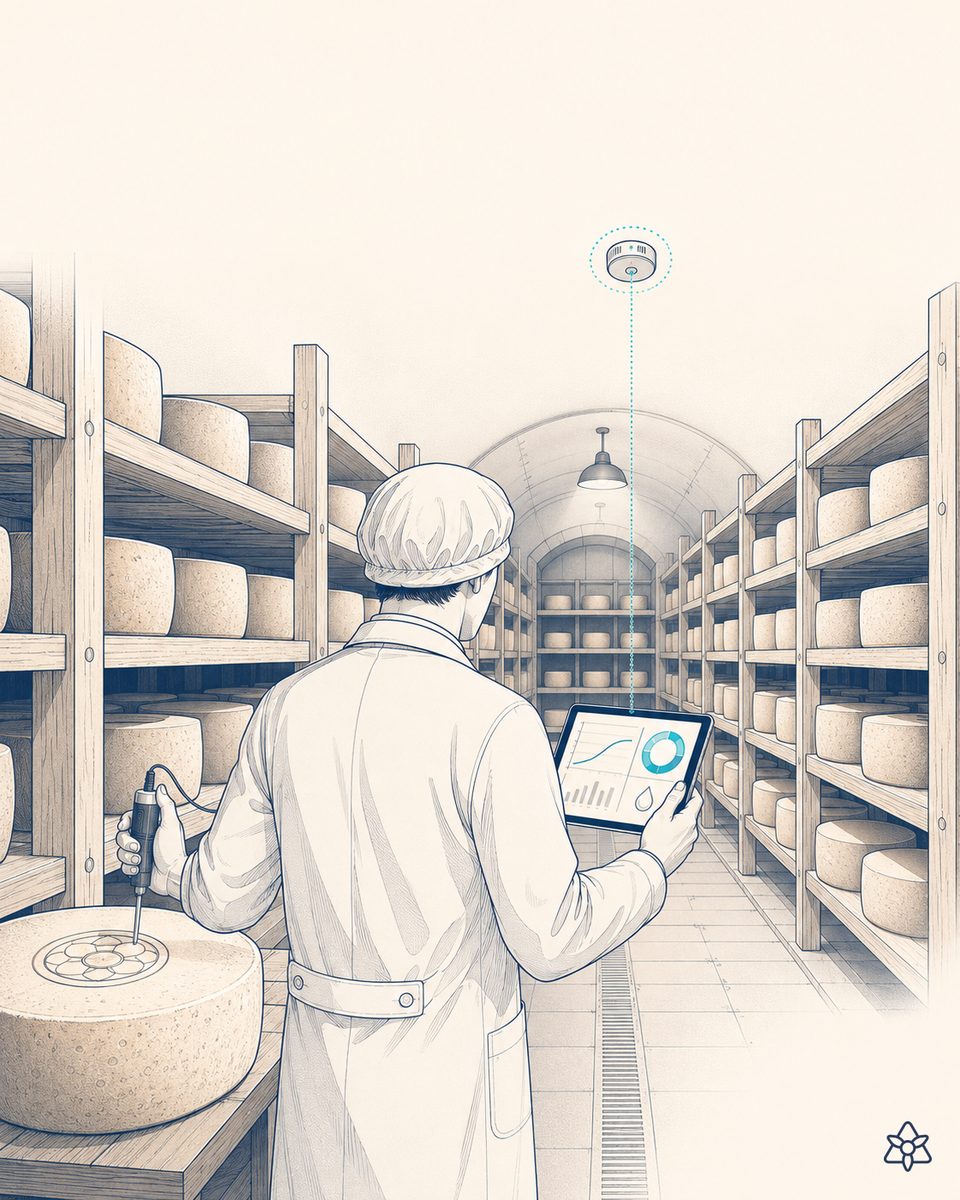
The detail the supermarket never looks at and the Regulatory Council always does.
A correct Mahón-Menorca PDO is not only raw material from the island and ripening in an authorized facility. It is also a shape and a set of marks that only appear if the cloth pressing is done right:
- The shape — square with rounded corners and the characteristic domed top face.
- The four folding marks left by the fogasser cloth on the top edges, which only well-executed traditional folding produces.
- The cloth finish — the texture of the cotton printed on the surface of the piece before airing.
The master cheesemaker sees it. But on a long day, with a tired hand and a curd that is a little softer than usual, the fold drifts from piece to piece and the edge mark ends up weak or incomplete. The piece passes the internal check on the scale and on appearance, and is then declassified by the Council — or worse, it goes to market with the PDO mark and loses it afterwards. The classic system (master + eye + habit) works 99% of the time. That 1% is hard cost and brand damage.
iLEAN Vision does not replace the master cheesemaker — it takes half the dumb work off their hands.
The problem with traditional pressing is not a lack of judgment: the master knows perfectly well which piece is right and which is not. The problem is sustaining that judgment for eight hours, on every piece, without a break. iLEAN acts as the putty that fills that gap between the master's eye and the line — it does not ask them to change anything about how they press, the cloth or the curd.
Edge sees the piece after pressing, before airing. Connect captures the day's recipe and batch. The agent cross-references against the PDO specification and, if a piece does not add up, holds the unit. The master signs — the system never declassifies on its own.
The iLEAN piece applied to Mahón-Menorca PDO:
- iLEAN Vision (Edge) — a terminal with a camera and a convolutional neural network (CNN) trained on real pieces from the creamery itself. It identifies the four fogasser marks on the top edges, measures the curvature of the top face and compares the silhouette against the PDO specification. If a piece does not show the marks or drifts, it triggers a soft actuator (a light signal, a diverter on the belt) and sends an alert to the master. It works without a network: if the dairy loses WiFi, Edge keeps reading and holding.
- iLEAN Connect — captures the day's recipe (which curd, which milk, what pressing time) whether it comes from the ERP, the master's logbook, or a spreadsheet updated every morning. It puts the data within the agent's reach at second zero.
- Agent — cross-references the piece seen by Vision, the day's recipe and the PDO specification. If the piece does not add up, it does not send an email at 10 pm: it holds it on the line and alerts the master through their channel. The master validates and signs; the line does not restart on its own.
Pressing supervised by eye vs. pressing verified with iLEAN Vision
| Aspect | Classic control | With iLEAN Vision + Connect |
|---|---|---|
| Verifying the fogasser fold | The master's eye, piece by piece, all day long | CNN on every piece, no fatigue, against the PDO specification |
| Detecting an out-of-specification piece | A later audit or a notice from the Regulatory Council | Before airing, on the line, in seconds |
| Variation in the day's curd | The master's memory, adjusted after the fact | The day's data cross-referenced with the pressing result |
| Operation without a network | n/a | Edge keeps running on the panel's power |
| File for the Regulatory Council | Rebuilt by hand, over weeks | Automatic dossier per batch, with a photo of every piece |
| The master's knowledge | Lives only in them — it leaves the day they retire | Captured as a reusable visual pattern |
Impact estimate for your plant — to be validated with your numbers.
The block below is an estimate to be validated with the specific data of your creamery. We put it forward so the committee has an order of magnitude; we refine it during the diagnostic.
- A creamery with one pressing room producing large pieces (≈ 1 kg and 3 kg), three long production days a week.
- Vision pilot on the pressing table (overhead camera + controlled lighting + light integration with the master's logbook). First value expected within a few weeks: identification of pieces with a weak fold at ≥ 90% agreement with the master's criterion.
- Expected reduction in pieces declassified by the Regulatory Council of ≥ 30%, conservatively. Indicative payback between 4 and 9 months depending on volume, price per kg of PDO cheese and the historical frequency of declassification.
- The hard lever is the piece held in time: a piece declassified by the Council is a bulk sale, not a PDO sale — and the prices are very different.
And the master's reasonable doubt
“What if the AI holds a good piece?” — hallucination is a problem of free generation, not of anchored tasks. In tasks where AI merely compares an image against a learned pattern (the piece against the specification), the best models brought error below 1.5% [1]. And even so, what is critical is never decided alone: iLEAN holds and alerts, and the master signs. The system never throws a piece away on its own.
[1] OpenAI paper “Why Language Models Hallucinate”, 2025 — on the reliability of AI in anchored tasks.
What people ask about PDO pressing of Mahón-Menorca with AI
What does the Mahón-Menorca PDO specification require about cloth pressing?
The Mahón-Menorca PDO specification requires the curd to be pressed wrapped in a cotton cloth called a fogasser, folded in a way that leaves a characteristic mark on the four top edges of the piece. The resulting shape (square with rounded corners, a domed top face) and those marks are among the visual traits that tell a genuine Mahón-Menorca apart from any other square cheese. The Regulatory Council inspects and declassifies pieces that do not meet the folding requirement.
How can AI verify the traditional folding of the fogasser?
With machine vision (CNN) trained on pieces from the creamery itself, not with a generic model. iLEAN Vision reads the piece after pressing and before airing, identifies the four folding marks left by the cloth, measures the recess on each edge and compares the overall shape against the specification. If a piece does not show all four marks, or the folding drifts, the system holds the unit and alerts the master cheesemaker. The master signs — the system never declassifies on its own.
Why does cloth folding fail on long production runs?
The fogasser is folded by hand on every piece, and over a long day a tired hand repeats micro-deviations the supervisor's eye does not always catch in time. If the curd is softer than usual (because of a variation in the fat content of that day's milk), the folding comes undone before airing and the mark ends up weak. And if the cloth has been washed many times, it loses stiffness and the recess blurs. Three different causes with the same visible consequence — and exactly the kind of pattern AI vision detects on the line.
Does iLEAN Vision work in a small dairy with no SCADA?
Yes. iLEAN Edge is a local terminal with vision that is installed wherever it is needed — above the pressing table, over the belt coming out of the mold, wherever the flow allows. It needs no SCADA, no MES and no stable network. If the dairy loses its internet connection, Edge keeps reading and holding pieces, because what is critical cannot depend on connectivity. Connect closes the loop by capturing the day's recipe from the ERP, a spreadsheet or a digitized logbook.
How much does deploying AI vision cost in a small PDO dairy?
The order of magnitude of an Edge pilot in the pressing room of a PDO dairy is close to that of any Edge pilot in a food plant: an initial investment covering terminal + camera + actuator + light integration, plus an annual license. A reasonable payback to present to the committee is several months — the hard lever is the out-of-specification piece held in time (one that is not sold as PDO and, above all, never reaches the Regulatory Council). We send you the estimated ROI in 48h with the real data from your creamery.
More cases in food
- Halloumi PDO — hot whey cooking and the sheep-goat blend, watched batch by batch.iLEAN Edge watches Halloumi PDO cooking in hot whey with AI vision and traces the sheep-goat milk blend…
- Idiazabal PDO — the craft of beechwood smoking, assisted by a camera that never blinks.iLEAN Edge watches the beechwood smoking of Idiazabal PDO cheese with an AI profile of time, temperature…
- Listeria environmental program in soft cheese — the swab where the risk is, not where the grid says.iLEAN Edge guides Listeria monocytogenes environmental sampling in soft cheese under EU Reg. 2073/2005 —…
- Manchego PDO cheese — Manchega breed, farm of origin and Regulatory Council, signed from second zero.iLEAN Tracer records the Manchega breed and farm of origin of every raw milk tanker for Manchego PDO…
- OEE in a multi-PDO cheese plant — the changeover between European formats stops eating hours.iLEAN Brain orchestrates recipe changes between PDO formats in a multi-PDO cheese plant, validates the…
- Morge in Munster AOP — the master affineur's craft, replicable wheel by wheel.iLEAN Edge sees the Munster AOP rind in the cave and proposes the optimal morge washing frequency wheel…
Tell us your case and in 48h we'll send you the estimated ROI of this AI project for your PDO dairy.
We work on the real data from your creamery, not ours. Diagnostic with no commitment.
Request estimated ROI in 48h See European cheeses