Halloumi PDO — hot whey cooking and the sheep-goat blend, watched batch by batch.
The Halloumi PDO demands two things — a sheep-goat blend that meets the product specification and cooking in hot whey — and today both are controlled by the master cheesemaker's eye. iLEAN Edge watches the cooking with AI vision and captures the profile of every batch; Connect traces the blend from the tanker. The master cheesemaker signs. The vat does not run itself.
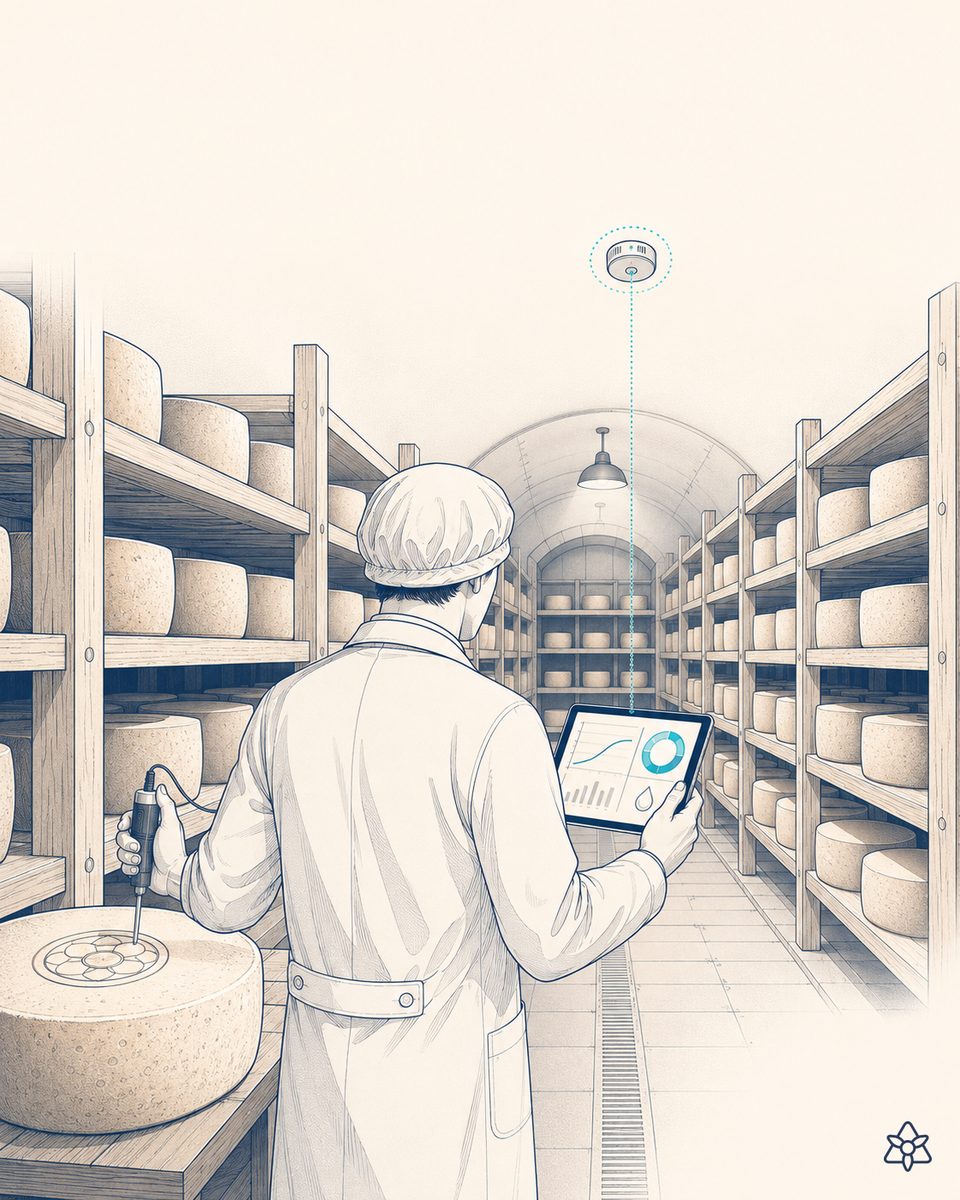
Two PDO requirements, both judged by eye, both without an automatic record.
Halloumi PDO is decided in two delicate steps that the Cypriot PDO specification requires you to document. One, the sheep-goat milk blend (with minimum percentages over cow milk, depending on the version of the specification in force). Two, cooking the pieces in hot whey, which is what gives Halloumi its “squeaky” texture and its ability to take the grill without melting. In most plants, both steps are controlled by the master cheesemaker — and both end up documented by hand, afterwards.
- The blend is calculated on whatever arrives. Each tanker brings its breed and its liters on a delivery note; the quality manager cross-checks against the batch recipe and decides. If a tanker turns up different from what was planned, the numbers are redone on the fly; the record ends up on a sheet at the end of the day.
- Cooking is measured by the master cheesemaker. The whey enters the vat hot, the pieces float, the master watches time and appearance and decides when to lift the batch out. If the vat drops a few degrees, the effective time changes; the logbook only reflects nominal time.
- The PDO dossier is built afterwards. When the inspection arrives, someone cross-references delivery notes, spreadsheets and the master's logbook to reconstruct each batch. It is office work with a risk of gaps.
The classic system works — but the master cheesemaker's craft lives in their head and the specification dossier lives across separate pieces of paper. PDO traceability depends on memory the day a batch is questioned.
iLEAN does not replace the master cheesemaker — it captures the craft and leaves the specification signed.
The Halloumi vat and the milk tanker are exactly the kind of process where IRIS fits as putty: it does not ask you to change the vat, the formula or the farmers, it only fills the gap between what the master cheesemaker decides in each batch and what the specification requires you to have documented. iLEAN sits on top, without touching the critical OT network of the vat.
Edge watches the cooking batch by batch. Connect traces the blend tanker by tanker. The agent cross-checks against the specification and leaves the file signed at second zero. The master cheesemaker signs — the vat does not run itself.
The iLEAN pieces applied to Halloumi PDO cooking:
- Edge — a terminal with machine vision (CNN) over the cooking vat. It measures the real whey temperature, the cooking time of every batch and the appearance of the pieces in the vat. It captures the complete profile (time + temperature + visual observation) and tags it by batch. It works without a network. If the plant loses WiFi, Edge keeps capturing and the profile is not lost.
- Connect — captures the sheep and goat delivery notes (and cow, where applicable) through whichever channel each farmer uses (email, WhatsApp, a photo of the paper, a co-op app). The agent calculates the percentages and cross-checks them against the specification minimum before the batch starts. If the blend does not comply, the agent alerts the manager — the batch is not labeled as Halloumi PDO unless it complies.
- Agent — cross-references the blend, the cooking profile, the load logbook and the PDO specification in force. If a vat drifts from the good profile, it proposes a correction to the master through their channel (tablet, full-duplex earpiece). If the day's blend falls below the mandatory percentage, it proposes diverting the batch to semi-hard table cheese with no designation. The master signs every decision.
Cooking by craft vs. craft-led cooking assisted by iLEAN
| Aspect | Classic Halloumi, the master's craft | With iLEAN Edge + Connect + Agent |
|---|---|---|
| Calculating the sheep-goat blend | Spreadsheet over delivery notes | Calculated at second zero, cross-checked against the specification |
| Cooking in hot whey | Nominal time, the master's eye | Real profile (T + time + visual) per batch |
| Temperature drop in the vat | Noticed when the piece comes out odd | Noticed as it starts to drop; correction proposed |
| Batch with an insufficient blend | Risk of labeling it PDO when it is not | Flagged, diverted to non-PDO with the master's signature |
| Operation without a network | n/a | Edge keeps running on the panel's power |
| PDO dossier for inspection | Rebuilt by cross-referencing paperwork | Per batch, indexed, signed by the master |
Impact estimate for your plant — to be validated with your numbers.
The block below is an estimate to be validated with the specific data of your plant. We put it forward so the committee has an order of magnitude; we refine it during the diagnostic.
- Halloumi PDO plant with one or two cooking vats, daily sheep and goat milk collection from several farms, cooking time decided by the master cheesemaker.
- Edge pilot over one vat (camera + thermocouples + integration with the batch recipe) and Connect over tanker reception. First value expected within a few weeks: cooking profile captured per batch, blend cross-checked against the specification at the start of the batch.
- Indicative payback between 4 and 9 months, depending on how often batches come out off profile and the cost of every batch diverted away from the PDO price.
- Hard lever: a reduction in off-profile batches on the order of ≥30%, based on cross-sector experience in thermal transformations with room to act, plus the side lever of fewer mislabeled batches (every batch correctly labeled as PDO is recovered margin).
And the master cheesemaker's reasonable doubt
“What if the camera says the vat is fine and the piece then comes out wrong?” — hallucination is a problem of free generation, not of anchored tasks. Measuring whey temperature and looking at the appearance of the piece in the vat is an anchored task — the camera does not invent a cooking curve, it measures the one that is there. In tasks like these, the best models brought error below 1.5% [1]. And even so, what is critical is never decided alone: the agent proposes; the master cheesemaker signs. The three safety rings exist precisely for this.
[1] OpenAI paper “Why Language Models Hallucinate”, 2025 — on the reliability of AI in anchored tasks.
What people ask about cooking Halloumi PDO with AI
What does the Halloumi PDO require regarding cooking and the milk blend?
The Halloumi PDO Regulation reserves the name for cheese made in Cyprus with a blend of sheep and goat milk (with a legal minimum of sheep+goat over cow milk, according to the product specification in force), cooked in hot whey as the characteristic step that gives it its “squeaky”, non-melting texture. Without that blend and without that cooking step, it is not Halloumi PDO — it is a semi-hard table cheese. Cooking in hot whey and the milk blend are the two steps the specification requires you to document.
Why is Halloumi cooking so hard to standardize?
Because the whey enters the vat hot and its temperature keeps shifting while the pieces float. The piece has to spend exactly the right time at exactly the right temperature to set without losing its “squeaky” texture. If the vat drops a few degrees, or if the batch is larger than usual, the effective time changes and two nominally identical batches come out different. The master cheesemaker corrects from experience; iLEAN Edge captures the real profile batch by batch and gives them the data to correct sooner.
How does iLEAN cross-check the sheep-goat blend against the specification?
Through Connect. Every tanker of sheep, goat (and cow milk, where applicable) arrives with its delivery note through its own channel — the carrier's email, the farmer's WhatsApp, paper. Connect captures the delivery note, extracts breed, farm and liters, and the agent cross-checks the percentages against the PDO specification minimum before the batch starts. If the blend does not comply, the agent alerts the manager — the batch is not labeled as Halloumi PDO unless it complies.
Does iLEAN Edge control the vat temperature or only watch it?
It watches and proposes. The critical OT of the vat — opening or closing steam, heating more or less — lives in ring 1, where there is no AI. Edge measures whey temperature, cooking time per batch and the appearance of the pieces in the vat with machine vision (CNN); the agent compares that against the good profile; if it drifts, it proposes a correction to the master cheesemaker. The master cheesemaker decides and acts. The agents propose, the person decides and acts.
Does it work in a small traditional plant or only in an industrial one?
It works in both, with a different pilot. In a traditional plant the pilot usually covers a single vat, delivery note capture by photo, and a record signed by the master cheesemaker — the pilot closes quickly because the problem is concentrated. In an industrial plant there are more vats and more tankers; the pilot focuses first on the Pareto (the line that moves the most volume) and then expands with the customer's own people. The idea is the same: start with the low-hanging fruit.
More cases in food
- Gouda brine control with AI — the curve signs off, the person validates.How iLEAN Edge measures brine concentration and temperature (salometer) across a Gouda tank battery,…
- Grated Parmigiano and Grana Padano PDO — granulometry within specification, without stopping the belt.How iLEAN Vision checks granulometry, moisture and rind residue in line on packed Parmigiano Reggiano…
- Halal and kosher rennet traceability — one certificate per wheel, not per act of good faith.iLEAN Tracer segregates halal and kosher rennet batches in multi-rite European dairies, with a…
- Idiazabal PDO — the craft of beechwood smoking, assisted by a camera that never blinks.iLEAN Edge watches the beechwood smoking of Idiazabal PDO cheese with an AI profile of time, temperature…
- Listeria environmental program in soft cheese — the swab where the risk is, not where the grid says.iLEAN Edge guides Listeria monocytogenes environmental sampling in soft cheese under EU Reg. 2073/2005 —…
- Mahón-Menorca PDO — the fogasser fold does not show up on the scale, it shows up on the cloth.iLEAN Vision verifies the fogasser cloth folding and the characteristic shape of Mahón-Menorca PDO at…
Tell us your case and in 48h we'll send you the estimated ROI of this AI project for your Halloumi PDO plant.
We work on your plant's real data, not ours. Diagnostic with no commitment.
Request estimated ROI in 48h See food industry