Grated Parmigiano and Grana Padano PDO — granulometry within specification, without stopping the belt.
The PDO specification sets granulometry, moisture and a rind limit for packed grated cheese. Classic control means sampling sent to the lab — one result every half hour, and hundreds of packs have already gone out in the meantime. iLEAN Vision analyzes the particle size distribution, detects rind by color and texture and estimates moisture in real time on the belt itself. If something drifts out, the agent warns and diverts. The person signs.
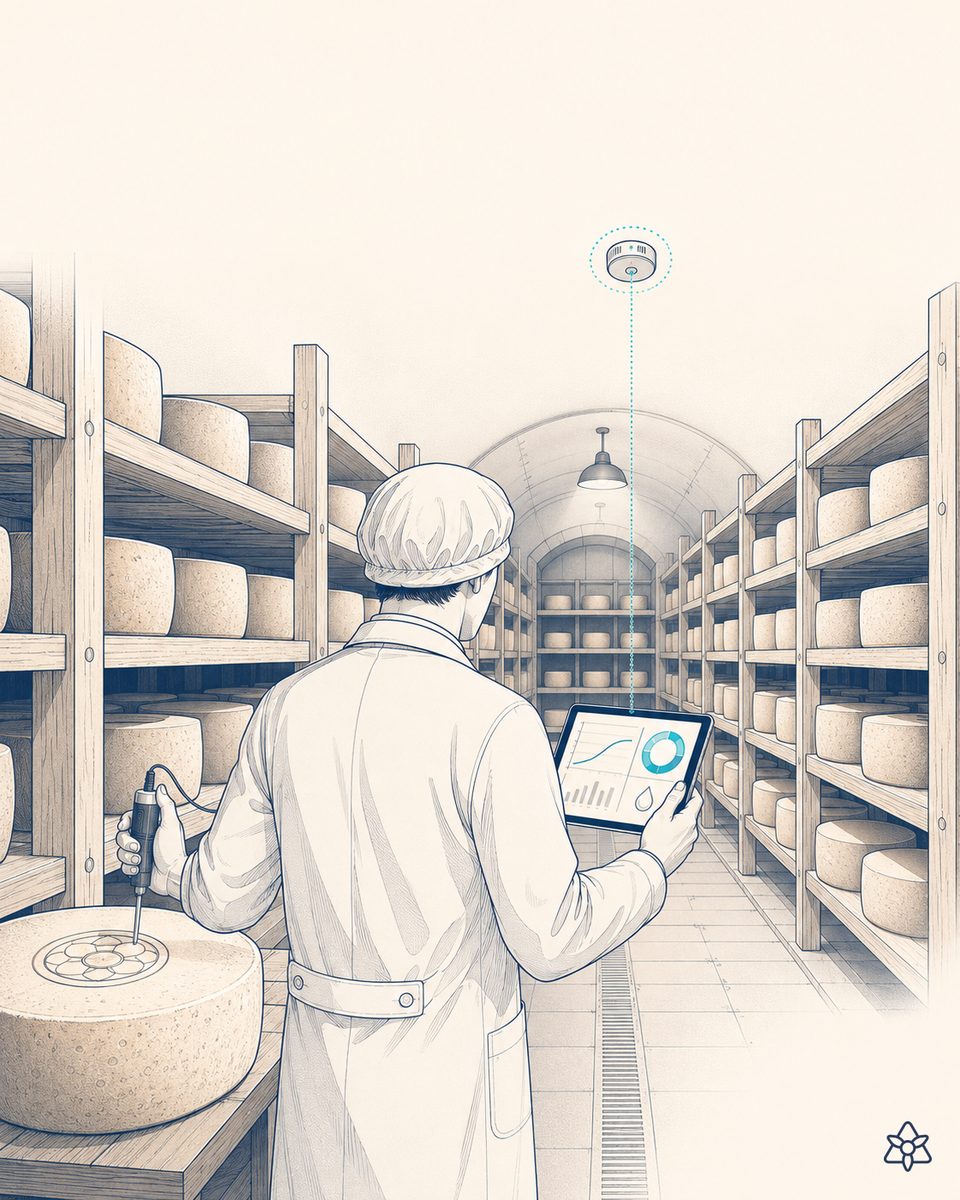
Lab sampling arrives too late — and the belt does not wait.
Grated Parmigiano Reggiano PDO and Grana Padano PDO are specification-bound products: granulometry, moisture and rind presence are regulated by the format declared on the pack. All three parameters drift instantly for operational reasons that classic control does not catch in time:
- Granulometry — the grater blade wears down over the shift; the particle size distribution shifts toward larger or smaller sizes; the final pack declares "fine" but contains a "medium" share.
- Moisture — the raw material changes from wheel to wheel; a drier or more aged wheel alters the moisture of the grated cheese and the shelf life of the pack.
- Rind — the upstream trimming step leaves residue above the PDO threshold when the tool is not properly set or the operator is in a hurry.
Control today: manual sampling, lab or sieve, a result half an hour later. Between one sample and the next the belt keeps grating and packing. When the lab returns an out-of-range result, hundreds of packs are already on the pallet. The quality manager blocks the batch, opens an incident, handles the return. A single incident at a PDO retailer is hard cost in returns, rework and reputation.
iLEAN Vision does not replace the lab — it brings the result forward, onto the belt.
The lab remains the reference. What changes is coverage: instead of one sample every half hour, iLEAN Vision analyzes the entire grated flow in real time, and if something falls outside the PDO range, the belt does not wait for the lab to react. iLEAN acts as the putty between the grater, the packing machine and the lab — and captures data that today is lost between one sample and the next.
Edge watches every meter of belt. The CNN segments particles, tells rind apart and estimates moisture. The agent cross-references the active SKU and, if the distribution falls outside the specification, it pauses or diverts. The person validates — the belt does not restart on its own.
The iLEAN pieces applied to PDO grating control:
- Edge — vision over the grating belt. A camera with calibrated lighting that segments particles, computes the size distribution (mean, spread, percentiles), detects rind residue by color and texture, and estimates moisture from reflectance and clumping. Continuous detection, not sampling.
- Connect — capture of the active SKU and of the PDO specifications. It reads from the ERP or the MES which SKU is being packed right now (fine / medium / coarse, 100 g / 1 kg) and loads the ranges from the relevant Consorzio specification. When the operator switches SKU, the thresholds change without anyone having to touch the camera.
- Agent. It cross-references the vision reading with the SKU, with the blade in use, with the lab history and with the wheel of origin. If the distribution shifts progressively — the blade is wearing down — the agent warns the technician before a pack goes out of range. If rind appears above the threshold, it pauses the packing machine and alerts quality. The agent does not approve a pack: it pauses. The person signs.
Sampling-based control vs. continuous control with iLEAN Vision
| Aspect | Sampling + lab | With iLEAN Vision (Edge + agent) |
|---|---|---|
| Coverage | One sample every 30 min | Every meter of belt, continuous |
| Time to react | 30 min — hundreds of packs already gone | Milliseconds — a pause before the bad pack |
| Rind detection | Visual inspection of a sample | CNN over the entire flow |
| Grater drift | Discovered at the end of the shift | The agent anticipates it from the shift in distribution |
| SKU changeover | The operator reconfigures the control | The agent reads the active SKU from the ERP and applies the specification |
| Operation without network | n/a | Edge keeps analyzing and pausing on the panel's own power |
Impact estimate for your plant — to be validated with your numbers.
The block below is an estimate to be validated with the specific data of your grating line. We put it forward so the committee has an order of magnitude; we refine it during the diagnostic.
- Plant with one Parmigiano / Grana Padano PDO grating and packing line, several SKUs (fine / medium / coarse, 100 g / 1 kg / foodservice bulk).
- iLEAN Vision pilot on the belt before the packing machine: camera + calibrated lighting + integration with the packing machine and the active SKU from the ERP. First value in a few weeks.
- Indicative payback between 4 and 9 months, depending on the current cost of off-spec incidents (retailer returns, rework, reputation) and on how often the grater blade drifts during the shift.
- Expected reduction in packs outside the declared granulometry of ≥ 30% compared with sampling-based control, given the typical lag between lab and line.
- The hard lever is one batch held instead of returned, plus capturing the moment of the blade change as reusable operational data.
And the quality manager's reasonable doubt
“What if the camera measures wrong and stops the line for nothing?” — hallucination is a problem of free generation, not of anchored tasks. Segmenting particles and comparing them against a declared range is an anchored task: the best models brought error below 1.5% [1]. And even so, the agent does not scrap a batch: it pauses and the person validates. The three safety rings exist precisely for this.
[1] OpenAI paper “Why Language Models Hallucinate”, 2025 — on the reliability of AI in anchored tasks.
What people ask about grating control for Parmigiano and Grana Padano PDO
What granulometry do Parmigiano Reggiano PDO and Grana Padano PDO require for grated cheese?
The Parmigiano Reggiano PDO and Grana Padano PDO product specifications set granulometry ranges according to the declared format (fine, medium, coarse) and maximum limits for moisture and for rind presence in packed grated cheese. Falling outside the range — particles too fine that cake together, too coarse that the consumer perceives as lumps, excess moisture that shortens shelf life, rind residue that the specification caps — means a non-conforming batch, a retailer return, or a downgrade to a lower category.
How is grated cheese granulometry controlled in line today?
Manual sampling: the operator takes a sample every so often, sends it to the lab or runs it through sieves, and reports back half an hour later. Between one sample and the next, the line keeps grating and packing — if the grater blade has worn down or the raw material has a drier zone, dozens or hundreds of packs have gone out off-spec before the lab returns the result. Control ends up being reactive, not preventive.
How does iLEAN Vision control granulometry in real time?
A camera with calibrated lighting over the conveyor belt carrying the grated cheese, right before packing. The CNN segments particles, computes the size distribution (mean, spread, percentiles), detects rind residue by color and texture, and estimates moisture from reflectance and clumping. It cross-references the result with the active SKU and, if the distribution falls outside the declared range, it signals the packing machine to pause, alerts the operator or diverts the batch. The person validates — the belt does not restart on its own.
What does iLEAN Vision do about rind residue?
The CNN identifies it by the difference in color (rind is darker and rougher) and in texture compared with the grated paste. Above the threshold in the PDO specification for that SKU, it triggers the actuator to divert the flow or pause the packing machine. The root cause is usually one of the usual suspects: a worn grater blade, a badly set rind-trimming step, or raw material with more invasive rind. The agent cross-references the history and proposes the most likely cause to the technician — without touching the machine on its own.
How much does AI grating control cost and how long does it take to deploy?
A typical pilot covers one grating and packing line: camera + calibrated lighting + integration with the packing machine and the ERP/MES, plus the annual license for the agent that learns the thresholds per SKU. First value in a few weeks (detection above the threshold agreed with quality). Indicative payback of several months, depending on how often batches currently go off-spec and the average cost of a return or rework. We ask for your plant's data and send you the estimated ROI in 48h.
More cases in food
- Fixed-weight cheese slicing — bring giveaway down without risking underweight.How iLEAN Vision 3D adapts the cut of the cheese block slice by slice to guarantee fixed portion weight…
- Controlling the aging of Gorgonzola DOP in natural caves — humidity, CO2 and needles, without touching the cave.iLEAN Edge uses AI to control needle piercing, humidity and CO2 in the natural cave aging of Gorgonzola…
- Gouda brine control with AI — the curve signs off, the person validates.How iLEAN Edge measures brine concentration and temperature (salometer) across a Gouda tank battery,…
- Halal and kosher rennet traceability — one certificate per wheel, not per act of good faith.iLEAN Tracer segregates halal and kosher rennet batches in multi-rite European dairies, with a…
- Halloumi PDO — hot whey cooking and the sheep-goat blend, watched batch by batch.iLEAN Edge watches Halloumi PDO cooking in hot whey with AI vision and traces the sheep-goat milk blend…
- Idiazabal PDO — the craft of beechwood smoking, assisted by a camera that never blinks.iLEAN Edge watches the beechwood smoking of Idiazabal PDO cheese with an AI profile of time, temperature…
Tell us your case and in 48h we'll send you the estimated ROI of PDO grating control for your plant.
We work on your line's real data, not ours. Diagnostic with no commitment.
Request estimated ROI in 48h See food industry