Gouda brine control with AI — the curve signs off, the person validates.
Gouda brine is measured with a salometer tank by tank; whoever does it ends up with cold hands and wet paperwork. iLEAN Edge reads concentration and temperature inline across the tank battery, without tapping the tank, and warns the supervisor when the concentration–temperature pair leaves the recipe corridor. The person signs — the line does not restart on its own.
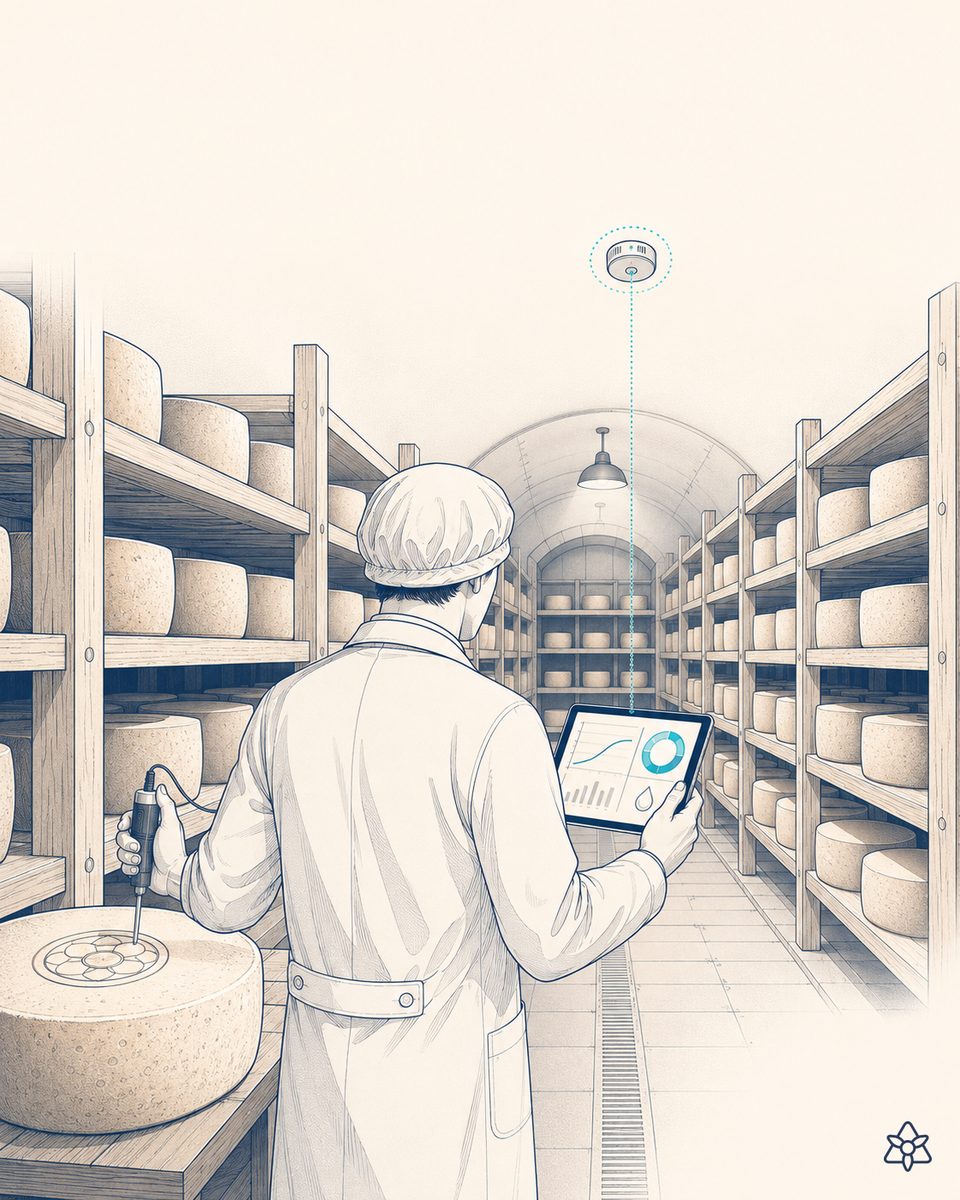
A dairy recipe that lives between the notebook and the thermocouple.
Gouda brine looks simple — water, salt, calcium, acid — and that is exactly why it fools you. In reality every wheel that goes into the tank takes salt out and puts water in, and every shift the concentration drifts a little. The classic system is an honest one: the brine tank supervisor walks round with the salometer, takes a sample from each tank, writes it in the notebook and passes the figure up to the plant manager's spreadsheet. But hours pass between one reading and the next, and in those hours:
- New wheels go in and dilute the tank without warning.
- The ambient conditions change — in a Dutch winter the room pulls the brine down and the diffusion kinetics are different.
- The operator readjusts by eye, going on what he remembers from the last shift, and the recipe drifts.
The defect does not show up in the tank: it shows up three weeks later, in the ripening room, when a run of Gouda comes through with a hard rind and an under-salted paste. By then it is scrap or a brand downgrade. The classic system works 95% of the time. It is that 5% that reaches ripening in bad shape and walks out of the committee meeting with a long face.
iLEAN Edge does not replace the brine tank supervisor — it spares him the notebook round.
The problem with brine is not that the veteran operator lacks knowledge: it is that his knowledge is never captured anywhere except in his head and in a notebook. iLEAN acts as the putty that fills that gap between the salometer, the thermocouple and the recipe, without asking you to change the tanks or the line.
Edge measures in every tank. Connect reads the recipe wherever it lives — ERP, the plant manager's spreadsheet, the water treatment panel. The agent cross-references concentration, temperature and recipe and warns the supervisor when the pair leaves the corridor. The person signs.
The iLEAN pieces applied to Gouda brine control:
- Edge — a terminal on the walkway above the tank battery with a non-invasive inductive probe per tank and a camera that reads the analog salometer or hydrometer where one exists. A CNN on the terminal itself extracts the reading, corrects it for temperature and logs it continuously. It works with no network: as long as the panel has power, Edge keeps reading and storing locally.
- Connect — captures the batch recipe whether it comes from the ERP, the MES, the plant manager's spreadsheet, or a photo of the panel on the vat water treatment unit. And it captures what comes in from outside (an email from the rennet supplier about a batch change, a WhatsApp from the master cheesemaker) at second zero.
- Agent — cross-references the concentration–temperature pair with the recipe corridor and the kinetics of the tank (wheels inside, immersion time, ambient conditions). If the pair leaves the corridor, it does not send an email at 10 p.m.: it warns the brine tank supervisor through whichever channel he uses and prepares the proposed adjustment. The person validates.
Manual salometer vs. brine read inline with iLEAN
| Aspect | Manual salometer + notebook | With iLEAN Edge + Connect + Agent |
|---|---|---|
| Measurement frequency | 2–3 times per shift, per tank | Continuous, per tank, inline |
| Temperature correction | From memory, or not done at all | Automatic, on the °C / Baumé pair |
| When the supervisor finds out | Next time he walks the round | The moment the recipe corridor is breached |
| Operation with no network | n/a — it is paper | Edge keeps reading on the power it has |
| Traceability per wheel | Handwritten note on the shift sheet | A curve per tank linked to the batch |
| PDO/PGI file | Rebuild the notebook for the auditor | Continuous dossier per batch and per tank |
Impact estimate for your plant — to be validated with your numbers.
The block below is an estimate to be validated with the specific data of your plant. We put it forward so the committee has an order of magnitude; we refine it during the diagnostic.
- Gouda dairy with a battery of 6–12 brine tanks, multi-recipe (young, aged, extra-aged), manual salometer readings 2–3 times per shift.
- Edge pilot across the full battery (inductive probe per tank + camera over the panel + temperature correction). First value within a few weeks: a continuous curve and the first useful alert on the concentration–temperature pair.
- Indicative payback between 4 and 9 months, depending on the documented incidence of runs with a hard rind / under-salted paste and on the average cost of a downgrade in your sales channel.
- Hard lever: scrap and downgrade cut by ≥30% on runs with a salting deviation. One single large badly salted run pays for the pilot.
And the quality manager's reasonable doubt
“What if the AI misreads the analog salometer?” — hallucination is a problem of free generation, not of anchored tasks. When the AI merely reads a value off a panel and normalizes it, the best models brought error below 1.5% [1]. And even so, what is critical is never decided alone: iLEAN proposes the adjustment and the person signs. The three safety rings exist precisely for this.
[1] OpenAI paper “Why Language Models Hallucinate”, 2025 — on the reliability of AI in anchored tasks.
What people ask about brine control in Gouda
What is a salometer and why does it matter in Gouda?
The salometer measures the salt concentration of the brine (Baumé scale or salometer degrees). In Dutch Gouda the brine sits between 16 and 20% NaCl depending on the recipe and the immersion time of the wheel. Below that, the wheel absorbs poorly and comes out soft; above it, the rind closes and the paste does not salt evenly. Concentration drops every time a new wheel goes in (it brings water from the curd) and every time the operator readjusts. Without continuous measurement, what is really happening inside the brine tank is not known for certain until several hours later, when the wheel has already been marked.
How does iLEAN Edge measure brine concentration without tapping the tank?
iLEAN Edge is mounted on the walkway above the brine tank battery with a non-invasive inductive probe per tank, plus a camera that reads the analog hydrometer/salometer where one exists. A convolutional neural network (CNN) on the terminal itself extracts the reading, corrects it for temperature and pushes it up as continuous data. If the plant loses the network, Edge keeps reading and storing locally — the curve is not lost because the WiFi went down.
What happens when the brine temperature drops in a Dutch winter?
In a Dutch dairy the brine works between 10 and 14 ºC. In winter the room temperature pulls the tank down and the kinetics of salt diffusion into the wheel change: same Baumé concentration, different result on the rind. iLEAN Edge measures concentration and temperature as a pair and warns the brine tank supervisor when the combination leaves the recipe corridor, not when a single variable crosses a threshold. The operator decides whether to heat or adjust salt — the line does not restart on its own.
How long does an Edge pilot take to deliver value in a Gouda dairy?
Like any Edge pilot in a food plant, first value (continuous reading, a curve per tank, the first useful alert) shows up in a few weeks. The complete pilot line, with the recipe corridor calibrated to your specific Gouda, in around 60 days. Rolling it out to the rest of the tanks is usually done by the customer with their own trained people, without us. We refine the concrete figures with your data during the diagnostic — we ask for three batches and come back with the estimated ROI in 48h.
Does it work if the dairy already has an online salometer?
Yes. iLEAN never asks you to throw anything away: if you already have online salometers integrated with SCADA, Edge consumes that data through Connect and focuses on what is not measured — the rest of the tanks in the battery, the vat hydrometer reading that lives in a notebook, the photo of the water treatment panel. The putty fills what is missing; it does not demolish what already works.
More cases in food
- Feta PDO — the file for the barrel and the tanker, closed at second zero.iLEAN Tracer records the origin of Greek sheep-goat milk and the brine barrel by barrel for Feta PDO. A…
- Fixed-weight cheese slicing — bring giveaway down without risking underweight.How iLEAN Vision 3D adapts the cut of the cheese block slice by slice to guarantee fixed portion weight…
- Controlling the aging of Gorgonzola DOP in natural caves — humidity, CO2 and needles, without touching the cave.iLEAN Edge uses AI to control needle piercing, humidity and CO2 in the natural cave aging of Gorgonzola…
- Grated Parmigiano and Grana Padano PDO — granulometry within specification, without stopping the belt.How iLEAN Vision checks granulometry, moisture and rind residue in line on packed Parmigiano Reggiano…
- Halal and kosher rennet traceability — one certificate per wheel, not per act of good faith.iLEAN Tracer segregates halal and kosher rennet batches in multi-rite European dairies, with a…
- Halloumi PDO — hot whey cooking and the sheep-goat blend, watched batch by batch.iLEAN Edge watches Halloumi PDO cooking in hot whey with AI vision and traces the sheep-goat milk blend…
Tell us your case and in 48h we'll send you the estimated ROI of this AI project for your Gouda dairy.
We work on your plant's real data, not ours. Diagnostic with no commitment.
Request estimated ROI in 48h See European cheeses