Halal and kosher rennet traceability — one certificate per wheel, not per act of good faith.
In multi-rite European dairies that share a plant with a conventional recipe, segregating the halal and kosher rennet batch is done with spreadsheets, PDF certificates and folders nobody wants to reconstruct. iLEAN Tracer cross-references the rennet batch, the vat it is added to and the final wheel, and issues the certificate per unit. The person signs.
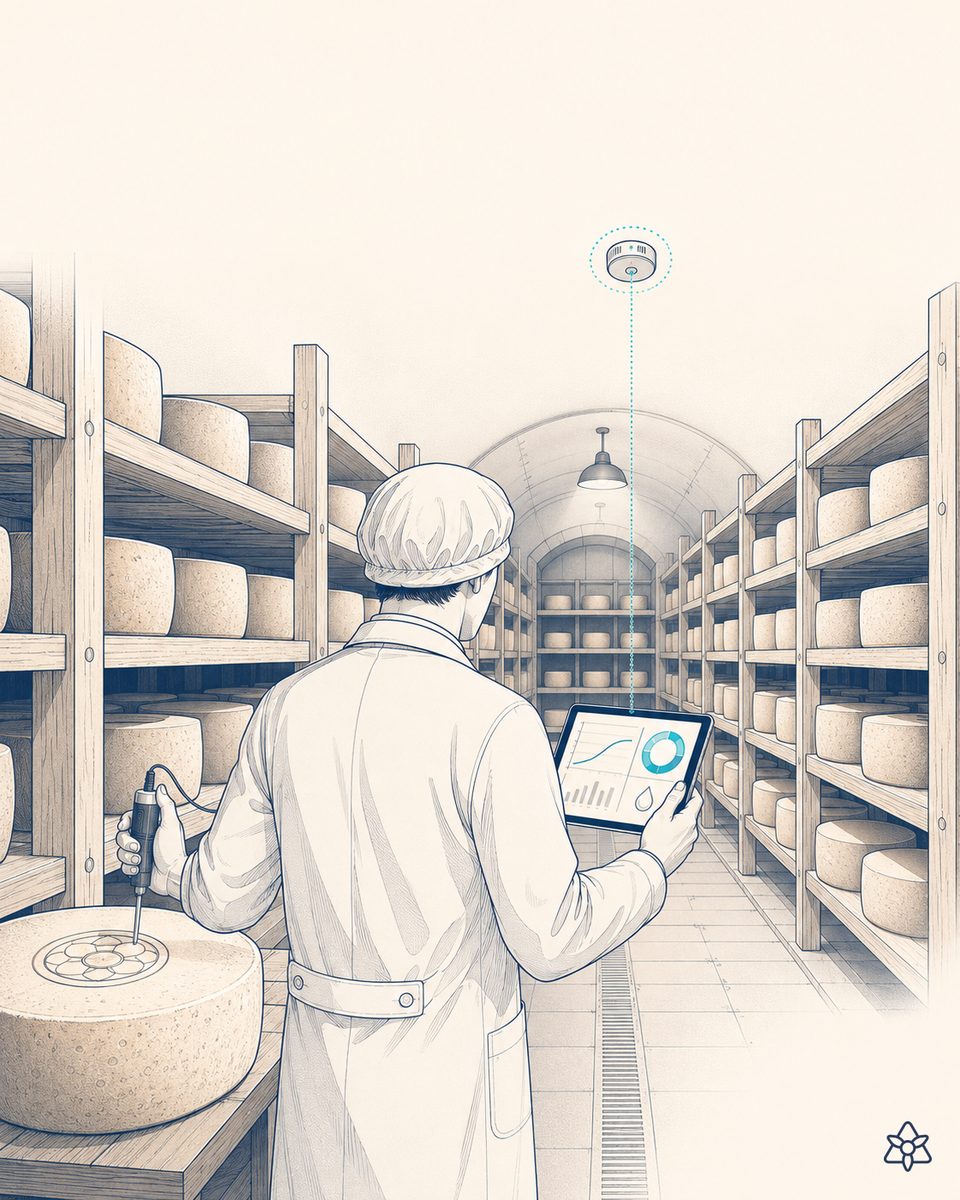
Three flows in the same plant, three certificates that never talk to each other.
The European dairy that produces halal, kosher and a conventional recipe in the same plant carries three problems that tangle together at the most vulnerable moment — the vat changeover:
- The supplier's certificate arrives as a PDF, someone files it in a folder and nobody opens it again until the audit.
- The history of the vat (which rennet went in before, which cleaning was done afterwards) lives in a plant notebook, in the shift lead's head, or in a spreadsheet updated at the end of the day.
- The per-wheel file that the halal or kosher certifier asks for at audit has to be rebuilt by hand — weeks of work, high risk of gaps.
The classic system (certified supplier + good faith + notebook) works until a rennet container gets mixed up, an intermediate cleaning goes undocumented, or a certifier asks to see the traceability of one specific wheel. That day the whole plant stops. The file has to exist beforehand, not be rebuilt afterwards.
iLEAN does not add a fourth system — it seals the cracks between the three you already have.
The problem with halal and kosher traceability is not a lack of data: the information exists (supplier's certificate, production order, intermediate cleaning). The problem is that it lives on separate islands and nobody cross-references it until audit day. iLEAN acts as the putty that fills that gap, without asking you to change your ERP, your MES, or your inoculation flow.
Edge reads the rennet container before it reaches the vat. Connect captures the supplier's certificate at second zero. The agent cross-references it with the order and issues the per-wheel certificate. The person signs.
The iLEAN pieces applied to halal and kosher rennet segregation:
- Edge (iLEAN Tracer) — a terminal with AI vision in the inoculation area. It reads the code on the rennet container right before it goes in, cross-references it with the production order and the rite declared for that vat, and triggers a stoplight signal or a rejecter if they do not match. It works with no network.
- Connect — captures the supplier's halal and kosher certificate at second zero (PDF by email, photo of the delivery note, scan). It also captures the intermediate cleaning between one vat and the next — whether it comes from the MES, from a spreadsheet or from a paper report photographed by the shift lead.
- Agent — cross-references the rennet batch + vat + production order + intermediate cleaning + final wheel, and issues the per-wheel file, cryptographically signed. When the halal or kosher certifier arrives, the dossier already exists — it is not reconstructed.
Manual halal/kosher traceability vs. cross-referenced traceability with iLEAN Tracer
| Aspect | Manual traceability + a folder | With iLEAN Tracer |
|---|---|---|
| Supplier's certificate | A PDF in a folder, nobody opens it until the audit | Captured at second zero, cross-referenced with every batch |
| Identifying the rennet container | Operator reads the label, signs a checklist | Edge reads the code + cross-references the production order |
| Intermediate cleaning between rites | Shift lead's notebook + good faith | Signed record + cross-referenced with the next vat |
| Per-wheel file | Rebuilt by hand, weeks of work | Already exists, signed, downloadable |
| Surprise audit | Panic + overtime for the quality manager | A handful of clicks + a cryptographically closed dossier |
| Wrong container at inoculation | Caught only if someone happens to see it | Edge holds the vat before it is inoculated |
Impact estimate for your plant — to be validated with your numbers.
The block below is an estimate to be validated with the specific data of your plant. We put it forward so the committee has an order of magnitude; we refine it during the diagnostic.
- Multi-rite European dairy with halal + kosher + conventional flows, several vats, several SKUs per day.
- Tracer pilot in one inoculation area (Edge over the vat + Connect to capture the supplier's certificate + the file agent). First value expected within a few weeks.
- Indicative payback between 4 and 9 months, depending on how many halal/kosher audits you face per year and on the cost of the quality manager's overtime spent rebuilding files.
- Audit time cut by ≥ 30% as a conservative floor. The hard lever is the audit closed in hours, not weeks, and preventing a single cross-contamination incident that could cost you the certification.
And the quality manager's reasonable doubt
“What if the AI gets it wrong and signs a certificate it shouldn't?” — hallucination is a problem of free generation, not of anchored tasks. In tasks where the AI simply reads a code off a container, cross-references it with a certificate and compares it against a production order, the best models brought error below 1.5% [1]. And even so, what is critical is never decided alone: iLEAN holds the vat and the person signs. The three safety rings exist precisely for this.
[1] OpenAI paper “Why Language Models Hallucinate”, 2025 — on the reliability of AI in anchored tasks.
What people ask about halal and kosher traceability in a dairy
What do halal and kosher certifications require of the rennet used in a European dairy?
Halal certification requires rennet from a permitted source (microbial, vegetable, or animal from animals slaughtered according to the rite) and batch traceability from the certified supplier all the way to the final wheel, with no contact with non-halal rennet in vats, tanks or tooling. Kosher adds rules on the origin of the rumen and on separation from non-kosher product. In a multi-rite European dairy that also runs a conventional recipe, the challenge is not picking a rennet: it is segregating three flows in the same plant so that they never mix, not even through residual rinse water.
How is the halal and kosher rennet batch segregated in a multi-rite plant?
By cross-referencing three realities that today live on separate islands: the incoming rennet batch (supplier, certificate, expiry date, batch number), the history of the vat it is about to be added to (which rennet went in before and how it was cleaned) and the production order for the wheel. iLEAN Tracer packages the three data points into a per-wheel file and issues the signed halal or kosher certificate. If the intermediate cleaning between one rite and the next is not documented as complete, the system holds the vat before it is inoculated — the person signs.
What happens if the halal or kosher certifier calls a surprise audit?
With iLEAN Tracer, the dossier for any wheel produced in recent months generates itself: the incoming rennet batch with a photo of the supplier's certificate, the vat it was added to, the previous intermediate cleaning, the production order and the operator who signed. The file is closed cryptographically so the certifier can see it was not rebuilt after the fact. What used to be weeks of spreadsheets and PDF folders comes down to a handful of clicks — and, above all, the dossier genuinely exists; it is not a good-faith reconstruction.
How does iLEAN stop an operator from adding the wrong rennet by mistake?
iLEAN Edge in the inoculation area reads the code on the rennet container right before it goes into the vat and cross-references it with the production order and the rite declared for that vat. If they do not match (halal container, kosher order; conventional container, halal order), the system holds the step with a stoplight signal and an alert to the shift lead. It works with no network — if the plant loses WiFi, the Edge keeps reading and keeps holding, because what is critical cannot depend on connectivity. The person validates and signs — the vat does not inoculate itself.
How much does it cost to deploy halal and kosher traceability with AI in a dairy?
The order of magnitude of a Tracer pilot in a multi-rite dairy is close to that of any iLEAN pilot in a food plant: an initial investment covering Edge in the inoculation area + Connect to capture the supplier's certificate + the file agent, plus an annual license. A reasonable payback to put in front of the committee is several months — the hard lever is an audit closed in hours (not weeks) and the guarantee of zero cross-contamination of rennet. We ask for your plant's data and send you the estimated ROI in 48h, with your numbers.
More cases in food
- Controlling the aging of Gorgonzola DOP in natural caves — humidity, CO2 and needles, without touching the cave.iLEAN Edge uses AI to control needle piercing, humidity and CO2 in the natural cave aging of Gorgonzola…
- Gouda brine control with AI — the curve signs off, the person validates.How iLEAN Edge measures brine concentration and temperature (salometer) across a Gouda tank battery,…
- Grated Parmigiano and Grana Padano PDO — granulometry within specification, without stopping the belt.How iLEAN Vision checks granulometry, moisture and rind residue in line on packed Parmigiano Reggiano…
- Halloumi PDO — hot whey cooking and the sheep-goat blend, watched batch by batch.iLEAN Edge watches Halloumi PDO cooking in hot whey with AI vision and traces the sheep-goat milk blend…
- Idiazabal PDO — the craft of beechwood smoking, assisted by a camera that never blinks.iLEAN Edge watches the beechwood smoking of Idiazabal PDO cheese with an AI profile of time, temperature…
- Listeria environmental program in soft cheese — the swab where the risk is, not where the grid says.iLEAN Edge guides Listeria monocytogenes environmental sampling in soft cheese under EU Reg. 2073/2005 —…
Tell us your case and in 48h we'll send you the estimated ROI of this AI project for your multi-rite dairy.
We work on your plant's real data, not ours. Diagnostic with no commitment.
Request estimated ROI in 48h See food industry