Listeria environmental program in soft cheese — the swab where the risk is, not where the grid says.
Soft cheese is the perfect medium for Listeria monocytogenes; environmental sampling on a fixed grid never notices the hot spots that move. iLEAN Edge sees the plant — humidity, condensation, traffic through the room — and guides the swab towards the points EU Reg. 2073/2005 expects you to control. The technician signs — the program does not restart on its own.
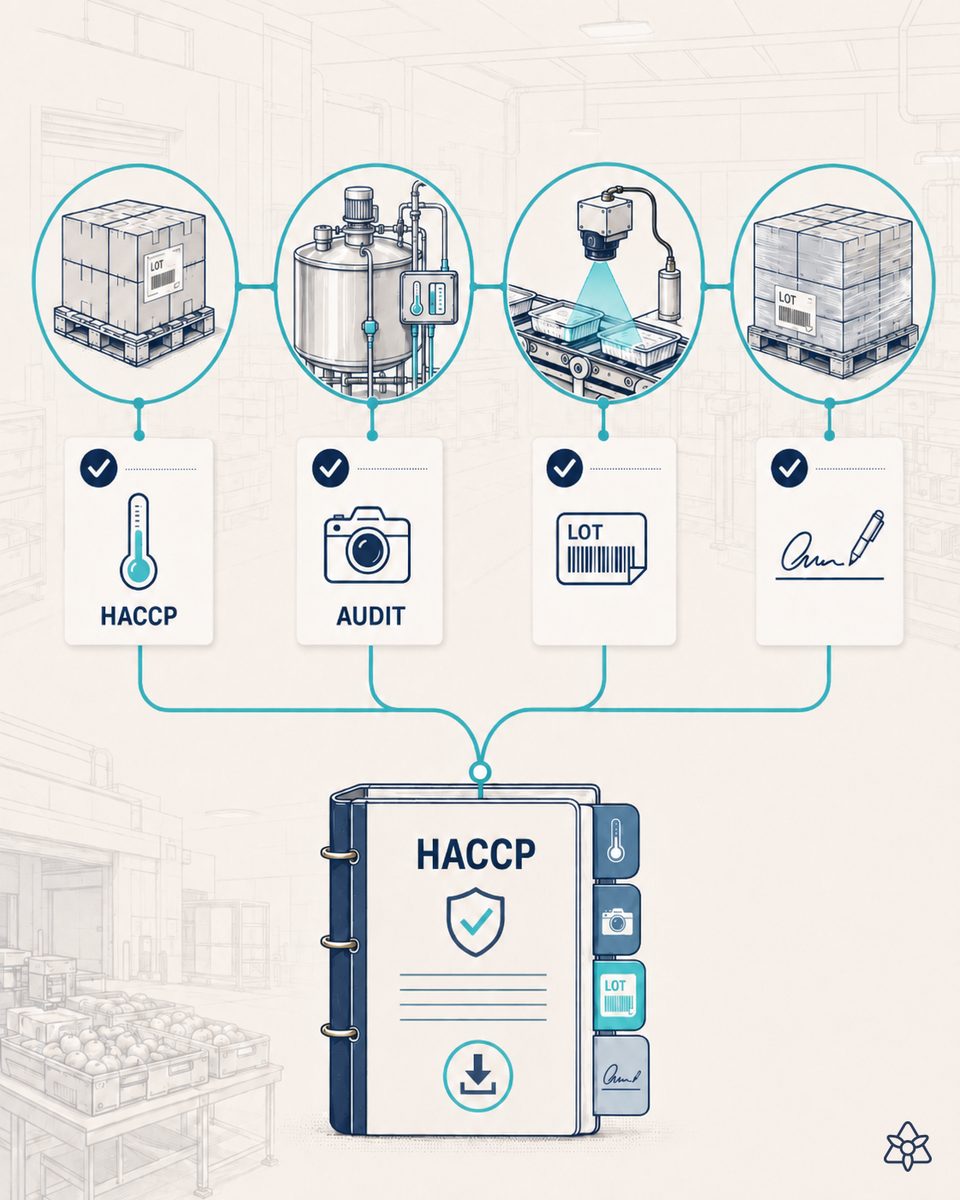
Listeria does not stay still — the grid does.
The classic Listeria monocytogenes environmental program runs on a fixed grid: so many points per room, one round a week, always the same spots. The quality manager designs it with care, HACCP approves it and it is followed to the letter. The problem is that in a soft cheese dairy the risk does not stay still:
- Condensation moves — it depends on the relative humidity of the room, on how often doors are opened, on the shift change.
- Traffic moves — the soles coming through change: the route of a new operator is not the route of the veteran who knows the sticky patch by the drain.
- Biofilm moves — the moment the cleaning schedule slips a few hours or the detergent falls short on one seal, biofilm finds shelter in places you are not looking.
The classic system works 95% of the time. That 5% is the positive that turns up in an area the grid never reached and that turns into a product recall in any Member State. And the committee's question, when RASFF publishes the alert, is not “did you sample?” but “did you sample where the risk was?”.
iLEAN Edge does not increase the number of swabs — it puts them where they are needed.
The problem with Listeria sampling is not the number of swabs: it is where they are spent. iLEAN acts as the putty between what the plant shows and what the quality technician decides — without asking you to change the HACCP plan, the lab or the kits.
Edge sees the room. The agent cross-references condensation, traffic, the cleaning schedule and the history of positives, and proposes the week's swab map. The technician adjusts and signs. The swab goes where the risk has moved.
The iLEAN pieces applied to the Listeria environmental program:
- Edge — terminals with machine vision (CNN) in the ripening and packing rooms. They detect condensation, a persistent puddle, a door opened over and over, a cart passing through, boot soles carrying soil into a clean zone. They work without a network: as long as the panel has power, capture continues, because what is critical cannot depend on WiFi.
- Connect — captures the cleaning plan (wherever it lives: an app, a spreadsheet, the hygiene manager's notebook), the lab's history of positives (wherever it lives: a LIMS PDF, an email from the external lab, a photo of the report) and the HACCP list of zones.
- Agent — cross-references what Edge sees with what Connect captures and proposes the week's sampling map, prioritizing areas where the risk has moved. The quality technician reviews, adjusts and signs. The sampling round does not restart on its own.
Fixed grid vs. sampling guided by iLEAN
| Aspect | Classic environmental program | With iLEAN Edge + Connect + Agent |
|---|---|---|
| Plan design | Fixed grid, reviewed once a year | A living plan, adjusted by risk every week |
| Hot spots detected | Only after a positive | Before sampling, from the image of the plant |
| History of positives | A PDF in a folder, checked “when there is time” | Cross-referenced automatically with the weekly map |
| The technician's work | Wheeling the swab cart around | Investigating positives and adjusting the plan |
| Operation without a network | n/a | Edge keeps capturing on the panel's power |
| File for IFS/BRC/FSSC | Rebuild the grid and the results | Weekly dossier justifying every single point |
Impact estimate for your plant — to be validated with your numbers.
The block below is an estimate to be validated with the specific data of your plant. We put it forward so the committee has an order of magnitude; we refine it during the diagnostic.
- Soft cheese dairy with 1–3 ripening rooms plus packing, a classic environmental program on a fixed grid, several dozen swabs a week.
- Edge pilot in the highest-risk room + Connect over the LIMS history of positives. First value within a few weeks: the first risk-guided weekly map, the first real adjustment to the plan.
- Indicative payback between 4 and 9 months, factoring in the avoided cost of a single recall caused by a positive in product and the qualified time saved for the quality technician.
- Hard lever: a ≥30% reduction in sampling time spent on low-risk areas, redirected to critical areas and to investigating positives. A single avoided recall pays for the pilot.
And the quality manager's reasonable doubt
“What if the AI prioritizes badly and we stop sampling an area where the positive later turns up?” — hallucination is a problem of free generation, not of anchored tasks. When AI merely recontextualizes what it sees (humidity, traffic, condensation) against the real history, the best models brought error below 1.5% [1]. And even so, the plan is not decided alone: iLEAN proposes the weekly map and the quality technician signs. The HACCP plan is still the framework; the agent only adjusts within the corridor.
[1] OpenAI paper “Why Language Models Hallucinate”, 2025 — on the reliability of AI in anchored tasks.
What people ask about Listeria in soft cheese
Why is Listeria monocytogenes the critical pathogen in soft cheese?
Listeria monocytogenes grows at refrigeration temperatures (down to 0–4 ºC), tolerates salty and humid environments, and forms biofilm on cold plant surfaces — drains, chiller door seals, cart wheels, boot soles. Soft cheese combines a not-quite-acidic pH, high water activity and consumption with no final heat treatment. It is the perfect medium and the perfect vector, which is why it appears again and again in RASFF alerts for European dairy products.
What does EU Reg. 2073/2005 say about environmental sampling?
EU Regulation 2073/2005 on microbiological criteria for foodstuffs sets food safety criteria for Listeria monocytogenes in ready-to-eat foods and, on top of that, requires plants making these products to run a sampling program covering processing areas and equipment as part of their hazard analysis. The regulation does not dictate the specific grid — that is the job of the plant's HACCP system — but it does require sampling to be representative of the real risk.
How does iLEAN Edge decide where the next swab goes?
iLEAN Edge observes the ripening and packing rooms with machine vision (CNN): condensation on the ceiling, puddles on the floor, cart movements, a chiller door opened over and over, boot soles carrying soil into an area, a leaking seal. It cross-references those events with the program's history of positives and with the cleaning schedule. The agent builds a weekly map of sampling priorities: the swab goes where the risk has moved, not where last year's grid said it should. The quality technician adjusts and signs.
Does it work for raw milk cheese as well as pasteurized cheese?
Yes. The Listeria environmental program is relevant in both cases, because critical contamination usually does not come from the milk but from the plant environment — biofilms in drains, seals and soles travel to the product in the post-pasteurization or post-curd stage. The difference lies in the relative weight of product sampling: with raw milk you add farm traceability (Reg. 853/2004); with pasteurized milk, alkaline phosphatase control (which is the process-side cousin, not the environmental one).
How many swabs a week are reasonable in a mid-sized plant?
There is no magic number — EU Reg. 2073/2005 asks for a plan proportionate to the risk. In a mid-sized soft cheese dairy it is common to run several dozen swabs a week spread across zones (Zone 1, direct product contact; Zone 2, nearby surfaces; Zone 3, structure; Zone 4, adjoining areas). iLEAN Edge does not increase the total number: it redistributes it by risk and frees up the quality technician's time to investigate positives instead of wheeling the swab cart around. We fine-tune the specific figures with your plan during the diagnostic.
More cases in food
- Halal and kosher rennet traceability — one certificate per wheel, not per act of good faith.iLEAN Tracer segregates halal and kosher rennet batches in multi-rite European dairies, with a…
- Halloumi PDO — hot whey cooking and the sheep-goat blend, watched batch by batch.iLEAN Edge watches Halloumi PDO cooking in hot whey with AI vision and traces the sheep-goat milk blend…
- Idiazabal PDO — the craft of beechwood smoking, assisted by a camera that never blinks.iLEAN Edge watches the beechwood smoking of Idiazabal PDO cheese with an AI profile of time, temperature…
- Mahón-Menorca PDO — the fogasser fold does not show up on the scale, it shows up on the cloth.iLEAN Vision verifies the fogasser cloth folding and the characteristic shape of Mahón-Menorca PDO at…
- Manchego PDO cheese — Manchega breed, farm of origin and Regulatory Council, signed from second zero.iLEAN Tracer records the Manchega breed and farm of origin of every raw milk tanker for Manchego PDO…
- OEE in a multi-PDO cheese plant — the changeover between European formats stops eating hours.iLEAN Brain orchestrates recipe changes between PDO formats in a multi-PDO cheese plant, validates the…
Tell us your case and in 48h we'll send you the estimated ROI of this AI project for your soft cheese dairy.
We work on your plant's real data, not ours. Diagnostic with no commitment.
Request estimated ROI in 48h See European cheeses