OEE in a multi-PDO cheese plant — the changeover between European formats stops eating hours.
In a plant that produces several PDO formats, every recipe change eats hours of OEE: a long CIP "just in case", adjustments run in series, a first start-up at half speed. iLEAN Brain orchestrates the changeover in parallel, validates the hygienic cleaning with real data and releases the start-up when everything lines up. The person signs.
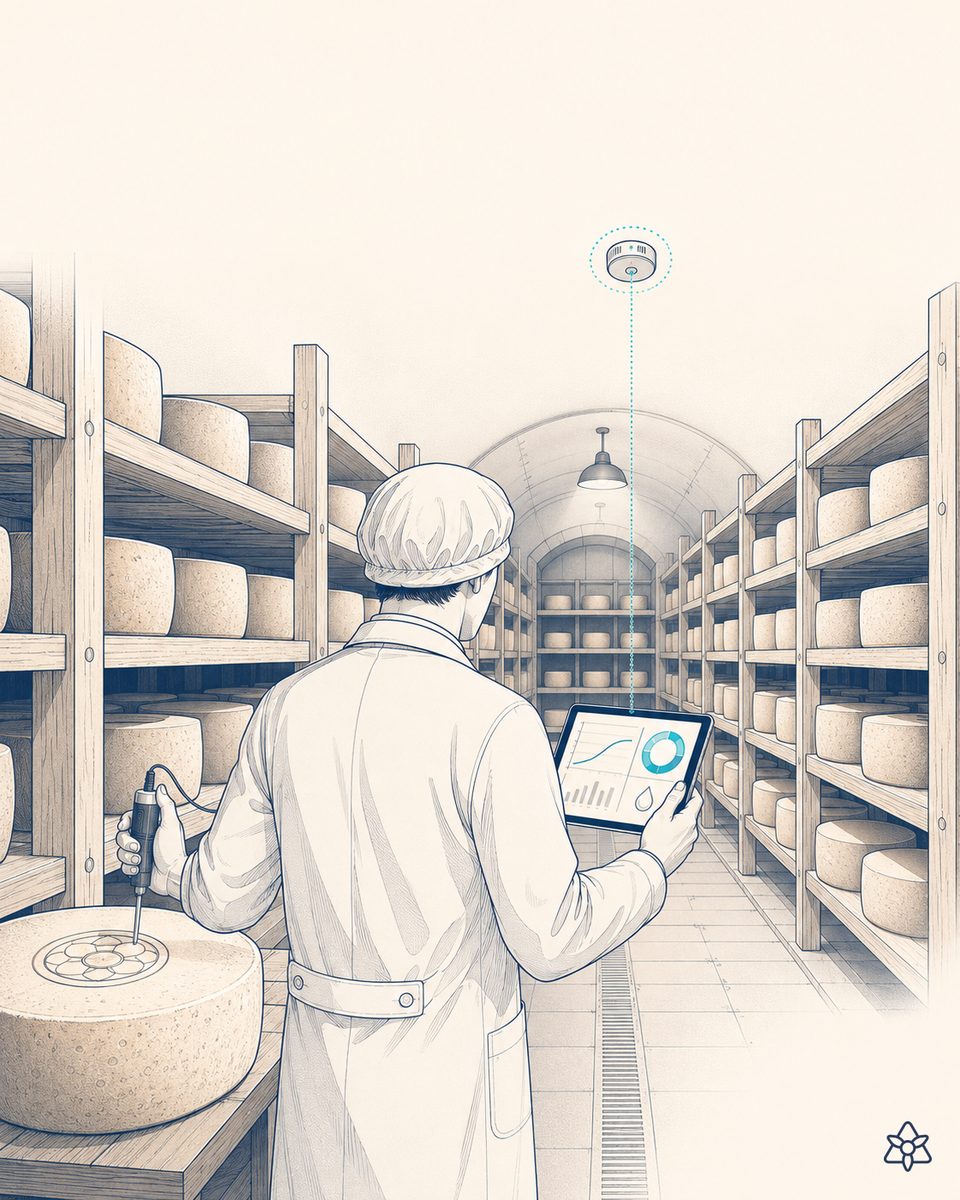
Every PDO change is a linear chain of tasks — and OEE picks up the bill.
A multi-PDO cheese plant lives with three constraints that drag OEE down on every recipe change:
- The "just in case" CIP — cleaning between two different PDOs is done with a generous margin because nobody wants to risk cross-contamination. If it is not measured, it is compensated with time.
- Adjustments run in series — molds, presses, brining room, ripening room. Each one waits for the previous one to finish even though they could move in parallel. The linear chain doubles the time actually needed.
- Start-up at half speed — the first run after the change does not come out at nominal speed because the operator plays it safe until he can see that "everything is fine". Without data, that "everything is fine" arrives late.
The classic setup (shift lead + checklist + Excel sheet) works and keeps the plant hygienic. The problem is not the what — it is the how much: a linear changeover takes hours of OEE away from the plant, hours that are sitting right there, waiting for someone to orchestrate them in parallel.
iLEAN Brain does not remove hygiene steps — it overlaps the ones that can be overlapped.
The problem with the multi-PDO changeover is not excess caution — it is a lack of orchestration. The caution is necessary, but it can now be spread in parallel across the vat, the press, the brining and the ripening room without losing the hygiene sign-off. iLEAN acts as the putty between the production order, the real state of the equipment and each operator's plan, without touching the ERP, the MES or the protected hygiene procedures.
Brain (agents in Central) cross-references the real state with the next PDO. Connect takes the sub-task to each operator's earpiece. Edge validates the cleaning with data. The person signs off the start-up.
The iLEAN pieces applied to the multi-PDO changeover:
- Brain (agents in Central) — cross-references the production order for the next PDO with the current state of every piece of equipment on the line and generates a plan of parallel sub-tasks, each with an owner and a window. The vat's CIP cleaning starts at the same time as the mold adjustment and the press calibration — not after. The agents follow progress and replan if a sub-task drifts.
- Connect — delivers each sub-task to the earpiece of the operator who has to carry it out, full duplex. The operator confirms by voice; the quality manager receives the electronic signature. It also captures the data wherever it comes from — the MES, the CIP record, the plant notebook.
- Edge — verifies the critical cleaning points (vat, bottom valve, cutting harp) with machine vision and cross-references the photo with the CIP curve. If everything lines up, it releases the start-up; if not, it holds the line. It works with no network.
Linear changeover vs. changeover orchestrated with iLEAN Brain
| Aspect | Classic recipe change | With iLEAN Brain + Connect + Edge |
|---|---|---|
| Task sequence | Linear — each machine waits for the previous one | In parallel wherever possible, with a plan per operator |
| "Just in case" CIP | Generous time for safety | Measured time, validated with real data |
| Hygiene validation | Checklist signed at the end | Triple cross-check: CIP + Edge photo + operator signature |
| First start-up after the change | Half speed "just in case" | Nominal speed as soon as the data confirms the state |
| Changeover traceability | Rebuilt by hand for the audit | Automatic dossier for every recipe change |
| Visible OEE | Excel sheet at the end of the shift | Continuous availability / performance / quality curve |
Impact estimate for your plant — to be validated with your numbers.
The block below is an estimate to be validated with the specific data of your plant. We put it forward so the committee has an order of magnitude; we refine it during the diagnostic.
- European cheese plant with several PDOs under the same roof, several recipe changes a week, a known current OEE and an identified bottleneck in the changeover.
- Brain pilot on one line (orchestration agents + Connect on the earpiece + Edge at the critical cleaning points). First value expected within a few weeks: an OEE baseline per PDO that the plant did not have.
- Indicative payback between 4 and 9 months, depending on the number of recipe changes per year and the hourly cost of a plant stopped for changeover.
- Recovery of OEE hours per PDO change of ≥ 30% as a conservative floor. The hard lever is the overlapping of tasks that are run in series today with no need, and nominal speed recovered from the very first start-up.
And the plant manager's reasonable doubt
"What if the agents orchestrate something wrong and we skip a hygiene step?" — hallucination is a problem of free generation, not of anchored tasks. In tasks where the agents simply cross-reference the production order with the real state of the equipment and propose a plan, the best models brought error below 1.5% [1]. And even so, the changeover never runs itself: iLEAN proposes and orchestrates, the operators confirm every sub-task and the manager signs the start-up. The three safety rings exist precisely for this.
[1] OpenAI paper "Why Language Models Hallucinate", 2025 — on the reliability of AI in anchored tasks.
What people ask about OEE in a multi-PDO cheese plant with AI
Why does the OEE of a multi-PDO cheese plant drop with every recipe change?
Because every PDO format changes the three factors that define OEE — availability, performance and quality — all at once. Availability: the changeover between, say, a soft-paste recipe and a hard-paste one can take hours (CIP cleaning, vat adjustments, mold changes, press calibration, brining room settings). Performance: the first run after the change rarely comes out at nominal speed. Quality: the risk of cross-contamination from incomplete cleaning between two different PDOs is real, and it is covered with extra time "just in case". Added up, every change eats hours out of your OEE.
How does iLEAN compress changeover time between PDO formats?
By orchestrating in parallel what is done in series today. iLEAN Brain (agents in Central) cross-references the production order for the next PDO with the real state of every piece of equipment on the line (vat, press, brining room, ripening room) and issues a changeover plan broken into sub-tasks assigned to each operator through their earpiece. The vat's CIP cleaning starts at the same time as the mold adjustment and the press calibration, not after. What used to be a linear chain of hours now overlaps wherever overlapping is possible — without skipping a single hygiene step.
How does iLEAN validate line hygiene before the next PDO starts up?
By cross-referencing three sources at second zero: the CIP record (temperature, concentration, time) from the cleaning system, the verification photo of the critical points (vat, bottom valve, cutting harp) that iLEAN Edge captures, and the checklist signed by the operator through their earpiece. If all three line up, the next PDO starts. If one fails — CIP temperature out of range, visible residue in the photo, an unsigned step — the agent holds the start-up and alerts the quality manager. The line never restarts on its own.
Can you measure the OEE of a cheese line without putting sensors on every machine?
Yes. iLEAN Connect captures the data however it can: modern integration where the machine allows it, screen reading of the old PLC where it does not, a photo of the analog panel where there is no other option. What matters is that the three curves — availability, performance, quality — exist wheel by wheel and minute by minute, not in an Excel sheet updated at the end of the shift. Without a baseline you cannot prove improvement; iLEAN builds the baseline while it runs the changeover.
How much does it cost to bring AI recipe-change orchestration into a multi-PDO cheese plant?
The order of magnitude of an iLEAN Brain pilot in a multi-PDO cheese plant is close to that of any iLEAN pilot in a food plant of some complexity: an initial investment covering Edge at the critical points + Connect to capture the CIP and the production order + the orchestration agent, plus an annual license. A reasonable payback to put in front of the committee is several months — the hard lever is the OEE hours recovered on every PDO change. We ask for your plant's data and send you the estimated ROI in 48h, with your numbers.
More cases in food
- Listeria environmental program in soft cheese — the swab where the risk is, not where the grid says.iLEAN Edge guides Listeria monocytogenes environmental sampling in soft cheese under EU Reg. 2073/2005 —…
- Mahón-Menorca PDO — the fogasser fold does not show up on the scale, it shows up on the cloth.iLEAN Vision verifies the fogasser cloth folding and the characteristic shape of Mahón-Menorca PDO at…
- Manchego PDO cheese — Manchega breed, farm of origin and Regulatory Council, signed from second zero.iLEAN Tracer records the Manchega breed and farm of origin of every raw milk tanker for Manchego PDO…
- Morge in Munster AOP — the master affineur's craft, replicable wheel by wheel.iLEAN Edge sees the Munster AOP rind in the cave and proposes the optimal morge washing frequency wheel…
- Casein mark traceability per wheel in PDO Parmigiano Reggiano — a dossier per wheel, not an Excel per shift.iLEAN Tracer links the casein mark of every PDO Parmigiano Reggiano wheel to the Consorzio file: milk…
- Payoyo cheese — "which goat is this cheese from?" should not be a question without a concrete answer.iLEAN Tracer ties every batch of Payoyo cheese from the Sierra de Cádiz to its payoya goat and…
Tell us your case and in 48h we'll send you the estimated ROI of this AI project for your multi-PDO plant.
We work on your plant's real data, not ours. Diagnostic with no commitment.
Request estimated ROI in 48h See food industry