Feta PDO — the file for the barrel and the tanker, closed at second zero.
The Feta PDO requires you to document where every tanker of Greek sheep-goat milk comes from, and to record the brine barrel by barrel. Today that file lives in spreadsheets and paper delivery notes — and rebuilding it when the inspector arrives is a week of work. iLEAN Tracer (Connect + Agents) closes the file for each barrel at second zero. The person signs.
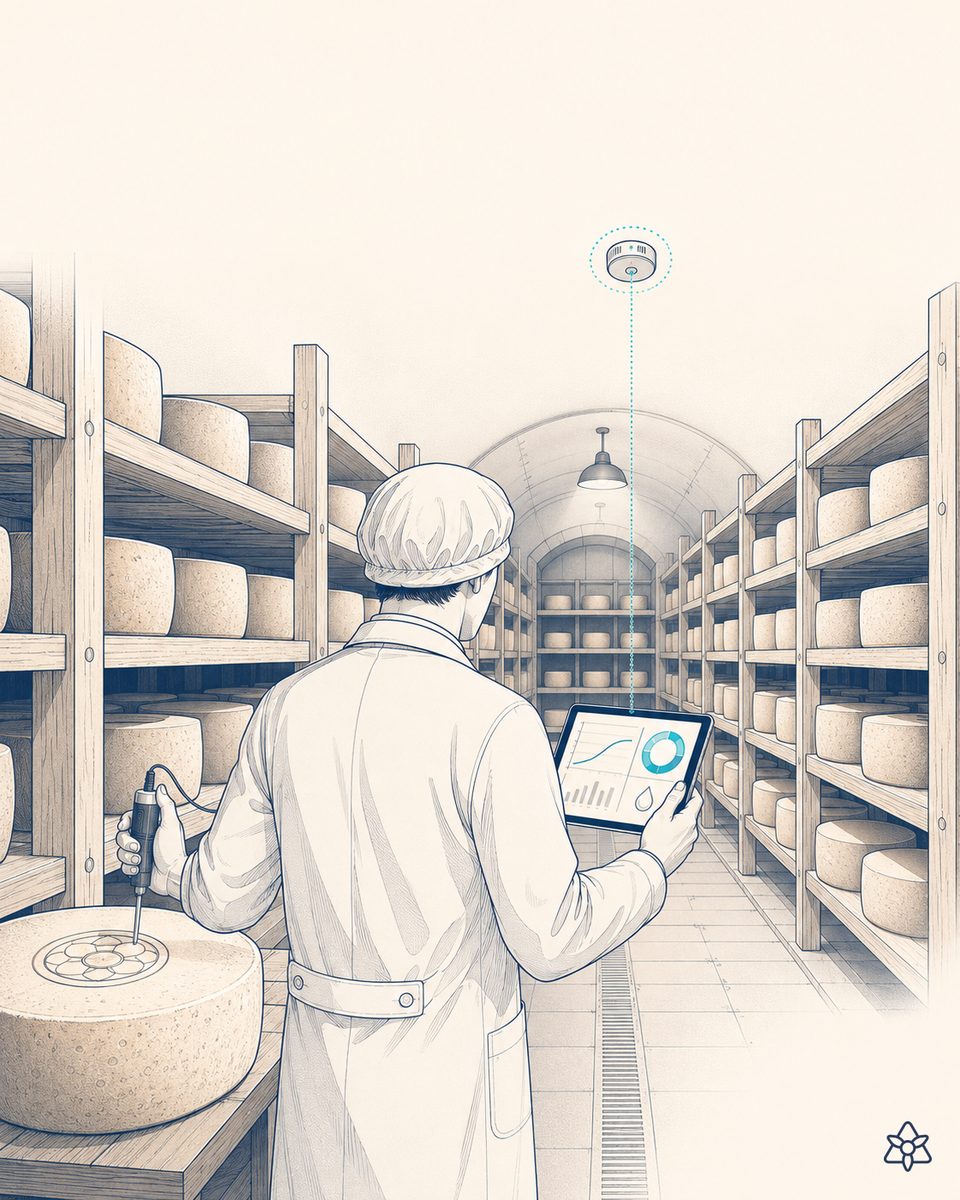
The Feta PDO file gets closed by hand, weeks after the product.
A Feta PDO plant runs against two clocks at once: the production clock (the tanker that arrives, the barrel that gets filled, the brine that gets adjusted, the pack that goes out) and the traceability clock (which breed, which farm, which area of mainland Greece or Lesbos, what sheep-goat ratio, what temperature and concentration in the barrel). The two clocks should advance together. In most plants they advance separately.
- The tanker's delivery note arrives however it arrives. Email from the haulier, WhatsApp from the farmer, paper in the truck cab, a spreadsheet kept by the collection manager. Each channel ends up on a different island.
- The brine per barrel gets written into a spreadsheet. The vat supervisor walks round with a notebook, jots down the concentration, the temperature, the time; at the end of the shift someone types it into a spreadsheet; at the end of the month someone cross-references it with the batches.
- The PDO file is rebuilt afterwards. When the Regulatory Council's audit lands, someone cross-references spreadsheets, delivery notes and notebooks to produce the batch file. Rebuilding it is a week of work. And the inspection arrives when it arrives.
Meanwhile, the critical information about the Feta lives in dead zones that no ERP, MES or BI covers. It is not carelessness — for decades there was no affordable way to join those islands. Now there is.
iLEAN Tracer does not replace the cahier — it captures the data and leaves it signed.
The problem with the Feta PDO file is not a lack of rules — the rules are clear. It is information that lives on islands and reaches the place where decisions are made too late. iLEAN Tracer (the Connect + Agents combination focused on traceability) acts as the putty that fills the cracks between the farmer's delivery note, the vat supervisor's notebook, the ERP, the MES and the Regulatory Council's cahier, without asking you to change any of them.
Connect captures every tanker's delivery note however it arrives. The agent cross-references it with the batch recipe, the barrel's brine and the cahier logbook. The barrel's file is signed at second zero. The person validates — the barrel does not close itself.
The iLEAN pieces applied to Feta PDO traceability:
- Connect — inward and outward listening. It captures the haulier's delivery note (email, WhatsApp, transcribed call or a photo of the paper), the batch recipe from the ERP/MES, the R&D manager's spreadsheet and the vat supervisor's notebook entries (photo of the notebook or voice dictation). Capture is graduated to fit each source, without asking the farmer to change channel.
- Agent — the file per barrel. It cross-references milk origin (breed, farm, area), sheep-goat ratio, brine parameters (concentration, temperature, time) and the requirements of the PDO cahier. If something is missing or drifting, it does not send an email at 10 p.m.: it asks the person in charge for the information through whichever channel they use and folds it into the file with a signature. The barrel's file is closed when the barrel is closed.
- Three rings — the cahier in ring 1. The signed PDO file lives in the inner ring, isolated from the Internet, in a cryptographically signed file drop. When the inspector arrives, you do not show them the cloud — you show them the local file, signed, intact.
A PDO file rebuilt by hand vs. a file closed with iLEAN Tracer
| Aspect | Classic PDO file | With iLEAN Tracer (Connect + Agents) |
|---|---|---|
| Capturing the tanker delivery note | Email/WhatsApp/paper on different islands | Unified at second zero, without changing the farmer's channel |
| Milk origin per tanker | Spreadsheet; filled in at the end of the day | Breed, farm and area in the batch file from the moment it enters |
| Brine per barrel | The vat supervisor's notebook | Captured by photo/voice; the agent cross-references recipe and regulation |
| PDO dossier for inspection | Rebuilt by cross-referencing spreadsheets and paper | Closed per barrel at second zero, with a human signature |
| Time to prepare for the inspection | A week, with operations disrupted | Half an hour reviewing a dossier that is already closed |
| Sovereignty over regulated data | Spreadsheets in email, risk of leakage | Dossier in ring 1, signed file drop, isolated from the Internet |
Impact estimate for your plant — to be validated with your numbers.
The block below is an estimate to be validated with the specific data of your plant. We put it forward so the committee has an order of magnitude; we refine it during the diagnostic.
- Feta PDO plant with several dozen associated farmers, daily tanker collection, brine in barrels recorded today in a spreadsheet and a notebook.
- Connect + Agent pilot on tanker intake and barrel records (no change to ERP/MES, nothing asked of the farmer). First value expected within a few weeks: the barrel's file closed and signed.
- Indicative payback between 4 and 9 months, depending on the man-hours it costs you to prepare a PDO inspection and on how often documentary non-conformities show up in your history.
- Hard lever: cutting PDO audit preparation time by the order of ≥30%, based on cross-sector experience with regulated dossiers in other industries.
And the quality manager's reasonable doubt
“What if the AI misreads the handwritten delivery note and puts the wrong breed in the file?” — hallucination is a problem of free generation, not of anchored tasks. Recontextualizing a delivery note (reading a piece of paper and putting its fields into another format) is precisely an anchored task — the AI does not invent, it translates. In tasks like that the best models brought error below 1.5% [1]. And even so, what is critical is never decided alone: the agent proposes the file; the person signs. The three safety rings exist precisely for this.
[1] OpenAI paper “Why Language Models Hallucinate”, 2025 — on the reliability of AI in anchored tasks.
What people ask about Feta PDO traceability with AI
What does the Feta PDO require regarding the origin of the milk?
Regulation (EC) 1829/2002 reserves the name Feta for cheese made in specific regions of mainland Greece and Lesbos, from sheep's milk or a sheep-goat blend (at least 70% sheep) coming from local breeds grazed in those areas. That means documenting where every milk tanker comes from, which breed produced it and on which farm it grazes. Without tanker-level traceability, the cheese cannot carry the name Feta on the label.
Why is the brine record per barrel so critical for Feta?
Because Feta matures inside the barrel, in brine. Concentration, temperature and immersion time define the final paste — a badly brined barrel gives you a Feta the buyer rejects. The cahier requires a record per barrel, and in many plants today that record is kept in a spreadsheet or a notebook. iLEAN Tracer makes the record automatic: every barrel has its file closed with data captured at second zero.
How does iLEAN capture the sheep breed and the farm?
Through Connect. When a tanker arrives at the plant, the delivery note header comes in by email from the haulier, by WhatsApp from the farmer, or on paper. Connect reads the delivery note (photo, email, transcription), extracts breed, farm and area, and puts it into the batch file at second zero. The integration does not force the farmer to use an app — the data comes in through whatever channel they already use.
What if the delivery note arrives handwritten on paper?
That is the most common case, and it is exactly what Connect's graduated capture is for. Someone in goods-in takes a photo of the delivery note with a phone, Connect recontextualizes the content with anchored AI (recontextualizing is what AI does exceptionally well, with error below 1.5% according to the OpenAI 2025 paper) and returns clean fields. The person validates once and signs. The forgotten spreadsheet stops existing.
Does iLEAN replace the Regulatory Council or the PDO inspector?
No. iLEAN is neither a regulatory body nor a certifier. What iLEAN does is make sure that when the PDO inspector walks into the plant, the file for each batch and each barrel is closed, indexed and signed by the person who validated every step — milk origin, breed, farm, brine, time in barrel, temperature. The inspection stops being a week of hunting for paperwork and becomes half an hour of reviewing a dossier.
More cases in food
- A Digital Product Passport for every PDO cheese wheel — without slowing the ripening room.How iLEAN Tracer builds the Digital Product Passport for every PDO cheese wheel under ESPR Reg. EU…
- Eye formation in Emmental AOP — anticipating the warm room before the defect is born.How iLEAN Edge anticipates Propionibacterium eye formation in Emmental AOP with CO2 sensors and vision,…
- EU Regulation 2024/1143 in a PDO/PGI dairy — the specification changes, the dossier does not fall behind.How iLEAN Writer keeps your dairy's PDO/PGI dossier current with EU Regulation 2024/1143 — without…
- Fixed-weight cheese slicing — bring giveaway down without risking underweight.How iLEAN Vision 3D adapts the cut of the cheese block slice by slice to guarantee fixed portion weight…
- Controlling the aging of Gorgonzola DOP in natural caves — humidity, CO2 and needles, without touching the cave.iLEAN Edge uses AI to control needle piercing, humidity and CO2 in the natural cave aging of Gorgonzola…
- Gouda brine control with AI — the curve signs off, the person validates.How iLEAN Edge measures brine concentration and temperature (salometer) across a Gouda tank battery,…
Tell us your case and in 48h we'll send you the estimated ROI of this AI project for your Feta PDO plant.
We work on your plant's real data, not ours. Diagnostic with no commitment.
Request estimated ROI in 48h See food industry