A Digital Product Passport for every PDO cheese wheel — without slowing the ripening room.
Reg. EU 2024/1781 (ESPR) requires every product placed on the market to carry a Digital Product Passport. In a PDO dairy, that means building the DPP wheel by wheel, cross-referencing ERP, MES, raw-milk certificates and the affineur's notebook. iLEAN Tracer captures all five sources and builds the DPP in real time across the whole chain. The wheel reaches packing with the DPP already closed — the person signs.
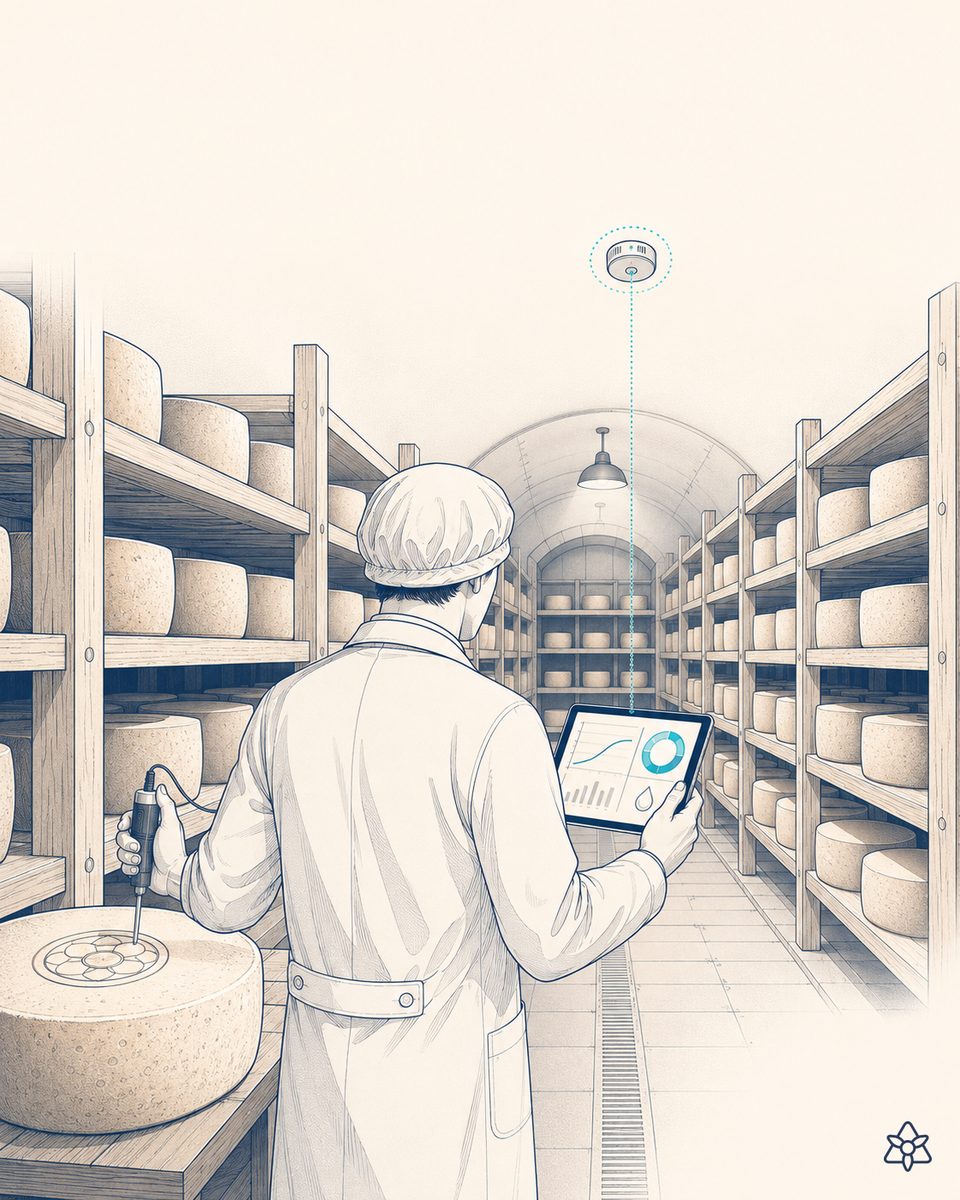
Five islands of information for a single wheel.
For a PDO wheel to reach the market with a valid DPP under the ESPR, you have to be able to retrieve — for the individual wheel, not per shift — a mosaic of data that today lives in places that never talk to each other:
- The ERP — milk purchases, cooperative certificates, document traceability.
- The MES or the vat logbook — coagulation parameters, cutting time, pressing, salting.
- The ripening room — temperature, humidity, days of aging, turnings.
- The origin certificates — breed, feed, milking, the cooperative's PDO seal.
- The affineur's notebook — handwritten notes on each wheel, decisions to extend aging, marks on the rind.
The operator sealing the box in shipping has access to none of the five. The quality manager knows it, but cannot rebuild every wheel by hand when a PDO audit lands or when a European retailer asks for the DPP before paying the invoice. The ESPR does not accept "nobody wrote it down for that batch" — a wheel with no passport stays in the ripening room.
iLEAN Tracer does not add a sixth system — it seals the cracks between the five you already have.
The problem with the DPP is not a lack of information: the information already exists, written down in five different places. The problem is that it lives on separate islands and has never been cross-referenced wheel by wheel. iLEAN acts as the putty that fills the gaps between ERP, MES, ripening room, certificates and the affineur's notebook — without asking you to change anything that already works.
Connect captures every island exactly where it sits. The agent builds the DPP wheel by wheel and signs it cryptographically. The person validates. The wheel reaches packing with its passport closed, and the ripening room never slows down.
The iLEAN pieces applied to the DPP for PDO cheese:
- Connect — captures the ERP, the MES, the ripening room data and, above all, whatever was never connected: the affineur's spreadsheet, handwritten notes transcribed through the earpiece app, the PDF certificate the cooperative emailed over, the message from the German retailer with the new DPP rule. It all comes in at second zero, with no forwarding chains.
- Edge — a vision-equipped terminal over the turning trolley or over the packing belt. It reads the casein plate on every wheel (which PDO rules already require to be embedded at coagulation), keeps its identity all the way through ripening and cross-references it with the affineur's notebook. Wheel-level identity is never lost.
- Agent — cross-references the five sources and builds the per-wheel DPP in the schema the ESPR delegated act requires. It signs it with a per-plant asymmetric key and files it ready for the quality manager to validate. If a critical data point is missing, the agent holds the wheel in shipping and raises an alert through whichever channel the person uses. The person signs — the agent never ships on its own.
Rebuilding the DPP by hand vs. a DPP closed in real time with iLEAN Tracer
| Aspect | Manual reconstruction (today) | With iLEAN Tracer (Connect + Agents) |
|---|---|---|
| Wheel-level identity | Casein plate + the affineur's memory | Plate read by vision and cross-referenced with the notebook at every turning |
| Source of ripening data | Probes + separate room logbooks | Connect unifies probes, logbooks and handwritten notes wheel by wheel |
| Raw-milk certificate | Cooperative PDF in a shared folder | Ingested and linked to the wheel at second zero |
| Building the DPP | Reconstructed after the fact — weeks per audit | DPP closed and signed when ripening ends |
| Wheel missing a critical data point | Discovered when the retailer complains | The agent holds the wheel in shipping and raises an alert |
| PDO audit / Regulatory Council | Rebuild the batch by hand | Per-wheel dossier, instant, exportable |
Impact estimate for your plant — to be validated with your numbers.
The block below is an estimate to be validated with the specific data of your ripening room. We put it forward so the committee has an order of magnitude; we refine it during the diagnostic.
- PDO dairy making aged cheese, one ripening room, several thousand wheels a month, ERP + affineur's notebook + cooperative certificates.
- iLEAN Tracer pilot in one room (casein plate readers + ERP/MES ingestion + notebook capture + the agent that closes the DPP). First DPP closed and signed within a few weeks.
- Indicative payback between 4 and 9 months, depending on what it currently costs to rebuild traceability by hand for PDO audits and on the cost of holding wheels in the ripening room when a retailer complains.
- The hard lever is reaching the ESPR deadline with a per-wheel DPP already closed before the regulator or the retailer demands it — and no longer rebuilding traceability by hand, which is quality hours burned month after month.
And the quality manager's reasonable doubt
“What if the agent invents a data point that was never recorded anywhere?” — hallucination is a problem of free generation, not of anchored tasks. In tasks where the AI merely recontextualizes a data point from one system into another (reading the casein plate, cross-referencing it with the affineur's notebook and assembling a DPP in the ESPR schema), the best models brought error below 1.5% [1]. And even so, the DPP is never issued on its own: the agent builds it, the person signs it. The three safety rings exist precisely for this.
[1] OpenAI paper “Why Language Models Hallucinate”, 2025 — on the reliability of AI in anchored tasks.
What people ask about the DPP for PDO cheese wheels
What does ESPR Reg. EU 2024/1781 require of a PDO cheese?
Regulation EU 2024/1781 (ESPR) introduces the Digital Product Passport (DPP) as a mandatory piece of digital information attached to every product placed on the market, with a rollout calendar by category and delegated acts. For a PDO cheese, the DPP has to be able to bring together the origin and traceability of the milk, the identity of the batch and of the wheel, the coagulation and ripening parameters, PDO/IFS/BRC certifications and sustainability data. The PDO wheel is one of the most demanding formats of all: the data has to be retrievable for an individual wheel, not per shift and not per batch.
Where does the DPP information come from in a PDO dairy?
From separate islands that today do not talk to each other: the ERP (purchasing and document traceability), the MES or the vat logbooks (coagulation and pressing parameters), the ripening room (temperature, humidity, days), the dairy cooperative's certificates (breed, feed, milking), and the affineur's notebook with handwritten notes on every wheel. The operator sealing the box has access to none of those five sources. iLEAN Connect captures all five; the agent builds the DPP wheel by wheel; the person signs.
What happens if a wheel does not have a complete DPP at the moment of shipping?
The operational reading of the ESPR is that the product cannot go to market without a valid DPP. A PDO wheel without a complete digital passport stays on hold in the ripening room — and that means logistics grind to a halt and, in long-aged cheeses, a risk of over-ripening. iLEAN Tracer closes the DPP in real time across the whole chain — from coagulation to ripening — so the wheel reaches packing with the DPP already closed and signed, ready to ship.
How is each wheel identified individually without marking the rind?
With the combination the industry already uses: casein plates (PDO rules usually require them at coagulation), a mark embossed on the rind and a code on the packing label. iLEAN does not force you to change anything: it uses vision to read the casein plate at turning, cross-references it with the affineur's notebook and with the final label, and keeps wheel-level identity throughout the whole aging period. The PDO does not have to fit a chip where there never was one.
How much does a per-wheel DPP cost and how long does it take to deploy in a PDO dairy?
The typical pilot covers one line or one ripening room, not the whole plant. An initial investment covering capture (casein plate readers, integration with ERP/MES, ingesting the affineur's notebook), plus the annual license for the agent that builds and signs the DPP. First DPP closed in a few weeks; indicative payback of several months, depending on what it currently costs you to rebuild traceability by hand for a PDO audit. We ask for your ripening room's data and send you the estimated ROI in 48h.
More cases in food
- Industrial Cheddar — the belt never stops, and the acidity curve drifts before anyone has time to correct it.iLEAN Edge controls industrial Cheddar cheddaring — stacking, turning and the acidity curve on a…
- Predictive maintenance for cheese vats — the batch of milk is saved before the breakdown.iLEAN Edge predicts cheese vat and cutting harp failures by combining vibration, torque and temperature.…
- Continuous audit of the Comté AOP cahier des charges — the inspection does not catch you out, you are already inside.iLEAN Brain uses AI to cross-reference milk, vat and cave of Comté AOP against the CIGC cahier des…
- Eye formation in Emmental AOP — anticipating the warm room before the defect is born.How iLEAN Edge anticipates Propionibacterium eye formation in Emmental AOP with CO2 sensors and vision,…
- EU Regulation 2024/1143 in a PDO/PGI dairy — the specification changes, the dossier does not fall behind.How iLEAN Writer keeps your dairy's PDO/PGI dossier current with EU Regulation 2024/1143 — without…
- Feta PDO — the file for the barrel and the tanker, closed at second zero.iLEAN Tracer records the origin of Greek sheep-goat milk and the brine barrel by barrel for Feta PDO. A…
Tell us your case and in 48h we'll send you the estimated ROI of a per-wheel PDO cheese DPP for your plant.
We work on your ripening room's real data, not ours. Diagnostic with no commitment.
Request estimated ROI in 48h See food industry