Predictive maintenance for cheese vats — the batch of milk is saved before the breakdown.
A vat or cutting harp failure in the middle of curdling is not a breakdown: it is a lost batch and a shift thrown off schedule. iLEAN Edge combines vibration, torque and temperature to anticipate the failure and schedule the stop in the window where it hurts least. The person signs the maintenance plan.
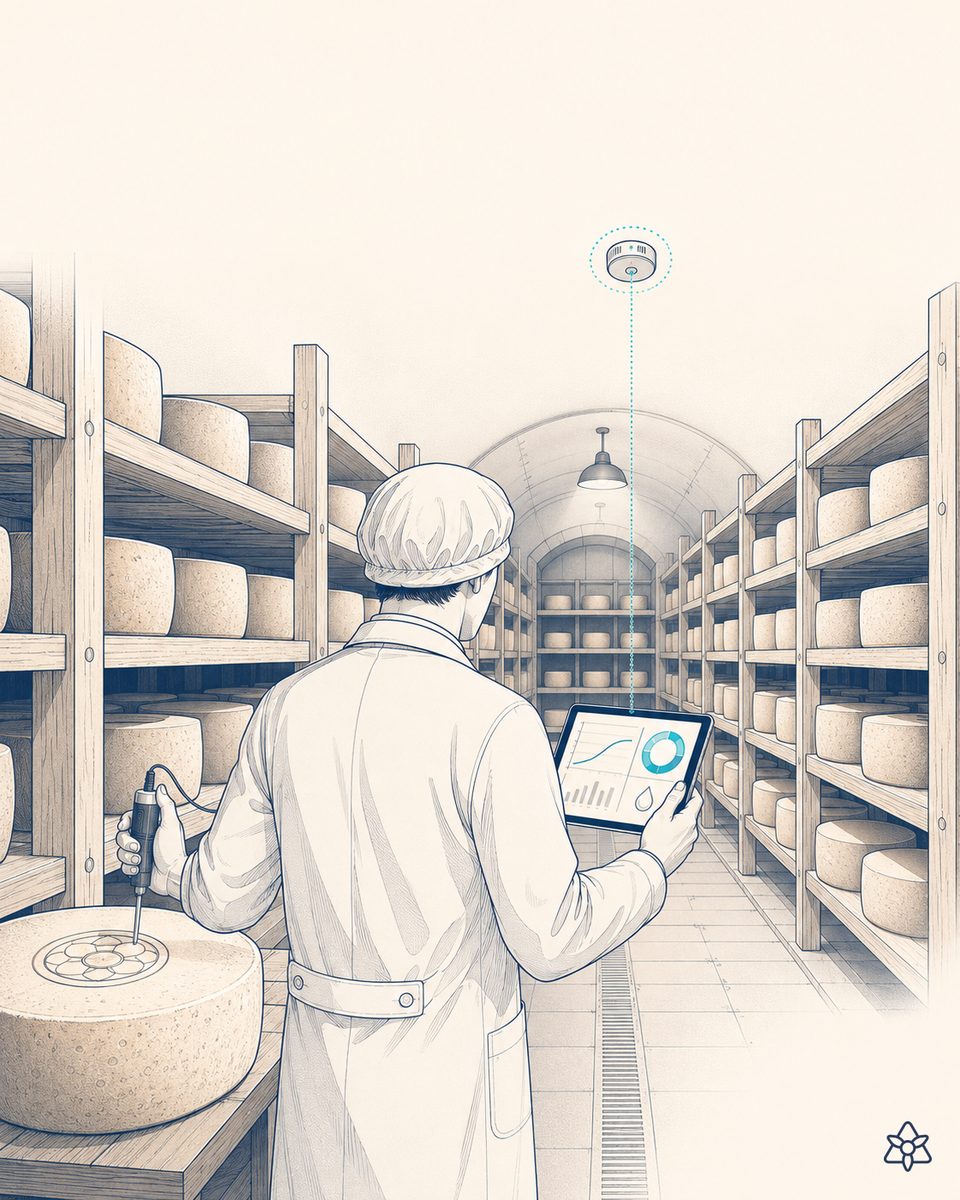
Calendar-based maintenance does not know which vat is the cheapest one to stop.
In a cheese plant with several vats and several cutting harps, maintenance is done by the calendar or "until it breaks". And both routes have the same problem, told two different ways:
- By the calendar — you replace a bearing that still had life left in it and leave alone the harp that was going to fail next week. The cost is high and reliability is not guaranteed.
- Until it breaks — it works cheaply right up until it fails in the middle of curdling. You lose the batch of milk, the culture, the rennet and the time, and the next vat cannot start until the broken one has been cleaned out. The real cost is not the broken part — it is the lost batch and the shift thrown off schedule.
- The maintenance lead's know-how — the veteran can hear when a vat is about to fail. What he knows is in no system. The day he retires, half the plant walks out with him.
The classic setup (calendar + the veteran's ear + luck) works almost every time. It is that "almost" that costs you a batch of milk and a whole morning of plant downtime.
iLEAN does not replace the maintenance lead — it gives him ears 24 hours a day.
The problem with cheese vat maintenance is not a lack of judgment — the maintenance lead has plenty. The problem is that that judgment depends on him being there at the right moment, and the vat likes to fail at 4 a.m. on a Sunday. iLEAN acts as the putty that fills that gap, without asking you to change the vat or the maintenance system.
Edge measures vibration, torque and temperature. The agent cross-references them with the batch recipe and proposes when to stop. The person signs the plan — the stop is scheduled, not suffered.
The iLEAN pieces applied to predictive maintenance on cheese vats:
- Edge — a terminal in the vat's electrical panel with accelerometer vibration sensors bolted to the agitator motor and the cutting harp motor, a clamp on the variable-frequency drive to read torque, and external probes on the jacket for temperature. It measures continuously, without touching the vat. It works with no network.
- Connect — captures the batch recipe (milk volume, cheese type, harp speed profile, day of the week) whether it comes from the MES, the vat panel or the plant notebook. It also captures the history of breakdowns and repairs — including what the maintenance lead knows and nobody has ever typed in.
- Agent — cross-references vibration + torque + temperature + recipe + history to anticipate the failure and propose the stop window. It does not stop the vat on its own: it warns the maintenance lead with enough time to schedule. The person validates and signs.
Calendar-based maintenance vs. predictive maintenance with iLEAN Edge
| Aspect | Classic maintenance | With iLEAN Edge + Agent |
|---|---|---|
| Replacement trigger | Fixed calendar or breakage | Real vat condition, anticipated with lead time |
| Failure during curdling | Lost batch + shift thrown off schedule | Stop scheduled in a favorable window |
| Cost of parts with life left | Bearings replaced while still performing | Replaced exactly when needed |
| The veteran's know-how | In his ear — it retires with him | Captured in the system as a permanent capability |
| Vat health history | Paper log + memory | Continuous vibration / torque / temperature curve |
| Dossier for the IFS/BRC auditor | Rebuilt by hand | Complete history, automatic |
Impact estimate for your plant — to be validated with your numbers.
The block below is an estimate to be validated with the specific data of your plant. We put it forward so the committee has an order of magnitude; we refine it during the diagnostic.
- Cheese plant with several vats (traditional kettle or modern), continuous production or by working day, one or two significant unplanned failures a year.
- Edge pilot on one vat (vibration + torque + temperature sensors + integration with the MES recipe). First value expected within a few weeks: a health baseline the plant did not have.
- Indicative payback between 4 and 9 months, depending on the historical frequency of failures during curdling and the average cost of a lost batch (milk + culture + rennet + shift).
- Reduction of unplanned stops of ≥ 30% as a conservative floor. The hard lever is a single batch saved — it pays for the pilot.
And the maintenance lead's reasonable doubt
"What if the AI makes me stop a vat that would have held out another month?" — hallucination is a problem of free generation, not of anchored tasks. In tasks where the AI simply reads vibration and torque and compares them against failure patterns from the plant's own history, the best models brought error below 1.5% [1]. And even so, the maintenance plan does not execute itself: iLEAN proposes and the maintenance lead signs. The three safety rings exist precisely for this.
[1] OpenAI paper "Why Language Models Hallucinate", 2025 — on the reliability of AI in anchored tasks.
What people ask about predictive maintenance on cheese vats
Why is a cheese vat failure during curdling so expensive?
Because when a vat (or kettle) stops while the milk is curdling, there is no way back. If the agitator or the cutting harp fails halfway through coagulation, the curd goes out of balance and the entire batch is lost: milk, culture, rennet and crew time. And the plant cannot start another vat without first emptying and cleaning the broken one — a domino effect on the rest of the shift. The cost is not the broken part; it is the lost batch and the shift thrown off schedule.
What can be predicted in a cheese vat with vibration, torque and temperature sensors?
Far more than it seems. The vibration of the agitator motor and of the cutting harp changes weeks before a failure — misalignment, bearing wear, play. Instantaneous torque (the motor's electrical draw) rises when the harp meets abnormal resistance. Jacket temperature reveals leaks, scaling and seal degradation. By combining the three with the batch recipe (milk volume, cheese type, speed), an agent can anticipate the failure and schedule the stop in the window where it hurts least.
How is iLEAN Edge installed on an existing cheese vat?
Without touching the vat. iLEAN Edge connects to accelerometer vibration sensors bolted to the housing of the agitator motor and the harp motor, measures torque from the electrical panel (a clamp on the variable-frequency drive) and jacket temperature with external probes. There is nothing to drill and no vat electronics to replace. If the vat is old and isolated, Connect captures the data through whatever door is open — a photo of the panel display, the drive's serial output, the operator's paper log. It works with no network.
How long does a predictive maintenance pilot in a cheese plant take to deliver results?
The first value comes quickly — weeks — because the Edge readings already give you a vat health baseline the plant did not have. Fine-tuned prediction (anticipating failures with enough lead time) arrives once there is data from several complete cycles: typically a few more weeks in a plant with continuous production. The relevant piece is not the detection figure, but the first failure avoided: one batch saved pays for the pilot.
How much does it cost to bring AI predictive maintenance into a cheese plant?
The order of magnitude of an Edge predictive maintenance pilot in a cheese plant is close to that of any Edge pilot in a food plant: an initial investment covering sensors + Edge terminal + integration with your maintenance system, plus an annual license. A reasonable payback to put in front of the committee is several months — the hard lever is the batch of milk saved and the unplanned stop that becomes a scheduled one. We ask for your plant's data and send you the estimated ROI in 48h, with your numbers.
More cases in food
- Brie and Camembert — the affineur's eye, extended to every piece in the cellar.iLEAN Edge uses AI vision to watch the progress of the Penicillium camemberti bloom on Brie and…
- Filatura control for PDO Mozzarella di Bufala Campana — the filatore's hands, assisted by vision.iLEAN Edge controls the filatura of PDO Mozzarella di Bufala Campana through whey temperature and curd…
- Industrial Cheddar — the belt never stops, and the acidity curve drifts before anyone has time to correct it.iLEAN Edge controls industrial Cheddar cheddaring — stacking, turning and the acidity curve on a…
- Continuous audit of the Comté AOP cahier des charges — the inspection does not catch you out, you are already inside.iLEAN Brain uses AI to cross-reference milk, vat and cave of Comté AOP against the CIGC cahier des…
- A Digital Product Passport for every PDO cheese wheel — without slowing the ripening room.How iLEAN Tracer builds the Digital Product Passport for every PDO cheese wheel under ESPR Reg. EU…
- Eye formation in Emmental AOP — anticipating the warm room before the defect is born.How iLEAN Edge anticipates Propionibacterium eye formation in Emmental AOP with CO2 sensors and vision,…
Tell us your case and in 48h we'll send you the estimated ROI of this AI project for your cheese vats.
We work on your plant's real data, not ours. Diagnostic with no commitment.
Request estimated ROI in 48h See food industry