Eye formation in Emmental AOP — anticipating the warm room before the defect is born.
The master cheesemaker finds out whether the eyes in an Emmental AOP came out right at the sample cut, weeks after the warm room — and by then the defect cannot be undone. iLEAN Edge cross-references CO2 sensors in the warm room with vision at the cut and the thermal curve of each wheel, and warns the master cheesemaker with room to correct the room before the defect is born. The person signs the decision.
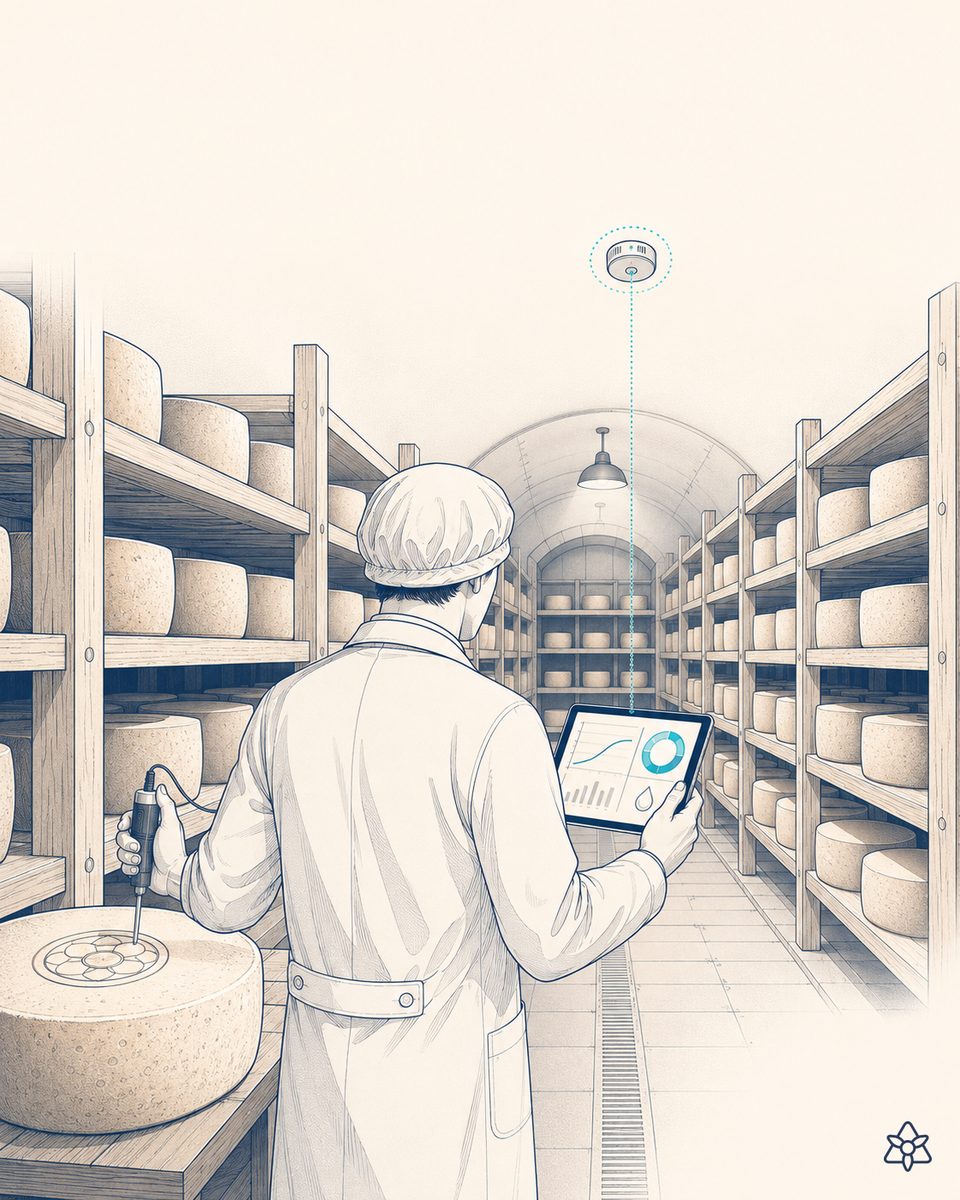
The defect shows up when it can no longer be corrected.
Emmental AOP is one of the most technically demanding cheeses in the world. The AOP specification defines eyes that are bright, regular, from the size of a hazelnut to a walnut (≈1–3 cm), evenly spread through the paste. And a single organism produces them: Propionibacterium freudenreichii, which consumes lactic acid and releases CO2; the CO2 stays trapped in the closed paste and forms the eyes.
There are three ways for a wheel to come out wrong and lose AOP grade:
- Sparse or blind eyes — the propionic fermentation never started, or was cut short.
- Eyes that are too large or irregular — the fermentation ran away through excess temperature or time.
- Cracks (Nachgärung) — a late secondary fermentation that splits the paste open.
The operational problem: classic control is temperature and humidity probes + the master cheesemaker's eye + a sample cut at the end. By the time the master cuts the sample and sees something went wrong, weeks in the warm room and months of ripening have passed; the decision that caused the defect is far behind. AOP does not accept "we'll fix it on the next batch" — this wheel loses several euros a kilo. On an 80–100 kg wheel, that is thousands of euros.
iLEAN Edge does not replace the master cheesemaker — it gets the information to him sooner.
The master cheesemaker knows what has to happen in the warm room. What he lacks is early feedback: a signal saying "the propionic fermentation on this run is falling short" or "it is running long" while he can still act on temperature, on airflow or on the exit time. iLEAN acts as the putty between what already exists (probes, culture, curve, sample at the cut) and what was missing (CO2 kinetics measured live, eyes counted and mapped by vision).
Edge measures CO2 in the warm room and learns the kinetics of each run. Vision counts and measures the eyes at the sample cut. The agent cross-references both with the culture and the thermal curve. The master gets the alert days ahead — and signs the correction.
The iLEAN pieces applied to eye formation in Emmental AOP:
- Edge — CO2 sensors in the warm room. They measure the CO2 release kinetics of each run. Trained on your history, the system tells a propionic fermentation that is "below target" from one that is "running normally" and from one that is "about to run away" — days before the result becomes visible at the cut.
- Edge — vision at the sample cut. A CNN counts eyes per unit of surface, measures their size distribution and detects cracks. It builds quantitative feedback for the master: not "it came out fine", but "mean 1.7 cm, σ 0.4, no cracks".
- Agent. Cross-references CO2 + vision + culture + thermal curve + recipe. If the kinetics of a run drift away from the AOP pattern, it proposes the correction to the master (raise or drop 1 ºC, extend or shorten the warm room) with days to spare. The person validates and signs; the system never touches the room on its own.
Classic control vs. a warm room assisted by iLEAN Edge
| Aspect | Classic control (probes + the eye) | With iLEAN Edge (CO2 + vision + agent) |
|---|---|---|
| Feedback on the result | Sample cut, weeks later | CO2 kinetics days earlier + quantitative vision at the cut |
| Room to correct the warm room | Effectively none | Days — the real time frame of propionic fermentation |
| Detecting cracks (Nachgärung) | Only at the final cut | An abnormal CO2 signal raises the alert before long ripening |
| Counting and sizing the eyes | The master's visual estimate | CNN — mean, spread, spatial distribution |
| Operation with no network | n/a | Edge keeps measuring and alerting on the power it has |
| The master's knowledge when he retires | It leaves with him | Captured as a reusable pattern for the next generation |
Impact estimate for your plant — to be validated with your numbers.
The block below is an estimate to be validated with the specific data of your warm room. We put it forward so the committee has an order of magnitude; we refine it during the diagnostic.
- AOP dairy with 1–2 warm rooms, several hundred wheels a week, documented occasional drift in eye size and distribution.
- Edge pilot in one room (CO2 sensors + a vision head over the sample-cutting table + the agent that learns the kinetics of each culture). First early warning within a few weeks.
- Indicative payback between 4 and 9 months, depending on how many wheels a year currently drop out of AOP grade and on the price gap between AOP and second grade at your retailer.
- The hard lever is every wheel that stays in AOP instead of dropping to second grade — plus capturing the master's knowledge as a reusable pattern for when the next generation walks into the room.
And the master cheesemaker's reasonable doubt
“What if the system gets it wrong and makes me touch a run that was doing fine?” — hallucination is a problem of free generation, not of anchored tasks. Here the AI merely recontextualizes measured signals (CO2, thermal curve, eye count) into a recommendation; the best models brought error below 1.5% [1]. And the system never touches the room: it warns you, you decide. The three safety rings exist precisely for this.
[1] OpenAI paper “Why Language Models Hallucinate”, 2025 — on the reliability of AI in anchored tasks.
What people ask about eye formation in Emmental AOP
Why is eye formation so critical in Emmental AOP?
The Emmental AOP specification calls for bright, regular eyes, from the size of a hazelnut to a walnut (roughly 1–3 cm). A wheel with too few eyes, blind eyes, cracks instead of eyes, or eyes that are too large loses AOP grade. The gap between an AOP wheel and a second-grade wheel is several euros a kilo — thousands of euros on an 80–100 kg wheel. And the defect only becomes visible at the sample cut, several weeks after the warm room — by which time the decision that caused it can no longer be undone.
What causes the eyes in Emmental, and how is it controlled today?
Propionibacterium freudenreichii consumes lactic acid and releases CO2 which, unable to escape the closed paste, forms the eyes. The kinetics depend on the culture, the temperature and the time in the warm room (typically 18–24 ºC, several weeks). Today the control is temperature and humidity probes + the experience of the master cheesemaker, who decides when to pull the wheels out of the warm room. Feedback on the final result arrives at the cut, weeks later.
How does iLEAN Edge help anticipate the outcome of the warm room?
With two sources that classic control does not use: CO2 sensors in the warm room (propionic fermentation releases measurable CO2) and vision at the sample cut with convolutional neural networks that count eyes, measure their size and detect cracks or blind eyes. The Edge cross-references both signals with the culture and the thermal curve of each wheel, and warns the master cheesemaker with room to correct the warm room — before the defect is born. The person signs the decision.
Isn't this exactly what was done at Marmaris 30 years ago?
Yes — it is the same figure, in another industry. At Marmaris (ceramics) a semi-expert system read the thermocouples and the firing curve of each piece and anticipated 30 minutes ahead the warping that was going to break it, leaving room to correct the curve and break the trend before the defect was born. In Emmental AOP the margin is not 30 minutes but several days of warm room, yet the logic is identical: predictive jidoka. Industrial AI has known how to do this for decades.
Does the warm room stop if Edge loses the network?
No. iLEAN Edge is designed so that, if the plant loses the network or the Internet, its basic cycle (measuring CO2, logging the curve, firing a local alarm) keeps running as long as it has power. Synchronization with the central platform happens as soon as the connection comes back. In an Emmental warm room, what is critical cannot depend on there being WiFi.
More cases in food
- Predictive maintenance for cheese vats — the batch of milk is saved before the breakdown.iLEAN Edge predicts cheese vat and cutting harp failures by combining vibration, torque and temperature.…
- Continuous audit of the Comté AOP cahier des charges — the inspection does not catch you out, you are already inside.iLEAN Brain uses AI to cross-reference milk, vat and cave of Comté AOP against the CIGC cahier des…
- A Digital Product Passport for every PDO cheese wheel — without slowing the ripening room.How iLEAN Tracer builds the Digital Product Passport for every PDO cheese wheel under ESPR Reg. EU…
- EU Regulation 2024/1143 in a PDO/PGI dairy — the specification changes, the dossier does not fall behind.How iLEAN Writer keeps your dairy's PDO/PGI dossier current with EU Regulation 2024/1143 — without…
- Feta PDO — the file for the barrel and the tanker, closed at second zero.iLEAN Tracer records the origin of Greek sheep-goat milk and the brine barrel by barrel for Feta PDO. A…
- Fixed-weight cheese slicing — bring giveaway down without risking underweight.How iLEAN Vision 3D adapts the cut of the cheese block slice by slice to guarantee fixed portion weight…
Tell us your case and in 48h we'll send you the estimated ROI of predictive eye control in Emmental AOP for your plant.
We work on your warm room's real data, not ours. Diagnostic with no commitment.
Request estimated ROI in 48h See food industry