Industrial Cheddar — the belt never stops, and the acidity curve drifts before anyone has time to correct it.
Industrial cheddaring is continuous: stacking, turning and the pH drop happen in minutes on a belt. When the curve drifts — a less active starter culture, half a degree more in the room — the curd falls to a lower grade before the shift lead notices. iLEAN Edge cross-references vision, sensors and pH on the belt, and warns with room to correct. The person signs.
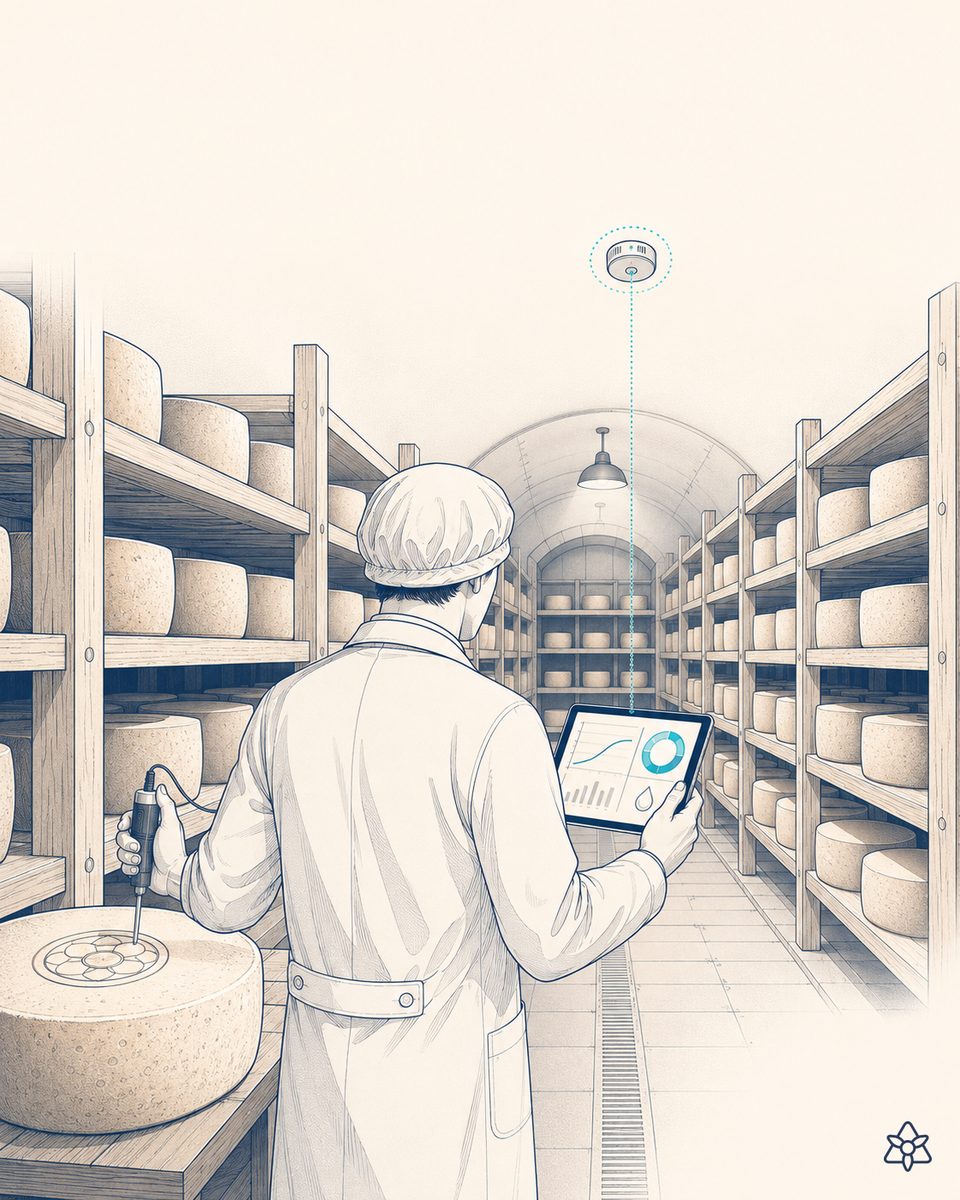
Four variables moving at once, on a belt that never stops.
Industrial cheddaring is the stage where the curd drains whey, is stacked, turned and restacked to acidify and build texture. On a continuous line, control is hard because four variables move at the same time:
- The day's starter culture — its real activity changes from one supplier batch to the next.
- Room temperature and humidity — half a degree moves the pH by several tenths.
- Stacking weight and the number of turns — they define whey drainage, and they are the levers the shift lead actually has at hand.
- Dwell time on the belt — set by line speed, and not negotiable without stopping production.
The shift lead adjusts weight and turns from the last hour's history and from spot pH probe readings. When something changes and the curve drifts, they notice it — but often when the curd is already coming off the belt. The result: the batch comes out firm or crumbly and drops to a lower commercial grade, at a noticeably lower price per kg. Or straight to rework. On a line running several tons per shift, those downgraded batches add up fast.
iLEAN Edge gives the shift lead the cross-referenced data before the end of the belt.
The problem with continuous cheddaring is not a lack of judgment from the shift lead: it is scattered information that does not arrive cross-referenced in time. SCADA has flows and temperatures, the probes have spot pH readings, the belt has a visual history nobody records, and the day's culture batch is on a delivery note. iLEAN acts as the putty that cross-references those islands on the belt itself, without asking you to change the MES, the SCADA or the line.
Edge sees the belt (stacking, turning, thickness). Connect captures the day's culture and the room conditions. The agent cross-references it with the pH curve and warns before the end of the belt. The shift lead decides and signs.
The iLEAN pieces applied to industrial cheddaring:
- iLEAN Vision (Edge) — a terminal with a camera and a CNN over the cheddaring belt: it identifies stacks, counts turns, measures stack thickness and the apparent texture of the curd. It works with no network: if the plant loses WiFi, Edge keeps reading and recording.
- iLEAN Edge on sensors — captures the continuous pH curve from the inline probes (existing or new), plus room temperature and humidity. It cross-references them with vision without going through the cloud.
- iLEAN Connect — captures the day's culture batch (which supplier, which date, which reported activity) and the recipe of the SKU in progress. It closes the loop between what went onto the belt and what comes off it.
- Agent — cross-references vision + pH + conditions + culture batch. It builds the line's historical pattern: which combination of weight, turns and time keeps the curve inside the optimal window for each SKU. When a new batch comes in off pattern, it warns the shift lead before the end of the belt, with room to adjust weight or turns. The shift lead signs; the agent never touches the parameters on its own.
Cheddaring controlled by spot probes vs. cheddaring cross-referenced with iLEAN Edge
| Aspect | Classic control | With iLEAN Edge + Connect |
|---|---|---|
| Reading stacking and turning | The shift lead's eye, on walk-throughs | Continuous CNN, count and thickness per stack |
| pH curve | Spot probes, alarm only when out of range | Cross-referenced with vision and culture, batch by batch |
| Detecting drift | When the curd is already coming out firm | Before the end of the belt, with room to correct |
| Memory of which culture / which pattern | Lives with the veteran shift lead | Pattern learned batch by batch, reusable |
| Rework and drops to a lower grade | Frequent on culture changes | Expected reduction ≥ 30% (estimate) |
| File for an IFS/BRC audit | Rebuilt by hand | Automatic dossier per batch |
Impact estimate for your plant — to be validated with your numbers.
The block below is an estimate to be validated with the specific data of your line. We put it forward so the committee has an order of magnitude; we refine it during the diagnostic.
- Continuous industrial Cheddar line running several tons per shift, two or three shifts, multi-SKU (Mild / Mature / Extra Mature) with different pH windows.
- Edge pilot on the cheddaring belt (overhead + side cameras + integration with the pH probes + the room SCADA + the starter culture delivery note). First value expected within a few weeks: a pattern-drift warning before the end of the belt, agreeing with the veteran shift lead's judgment ≥ 90% of the time.
- Expected reduction in batches dropping to a lower grade and in rework ≥ 30%, conservatively. Indicative payback between 4 and 9 months depending on tonnage per shift and the price gap between commercial grades.
- The hard lever is the batch that stays in its commercial grade — a Mature that does not fall to Mild pays for the pilot fast on a large line.
And the shift lead's reasonable doubt
“What if the AI gets the recommendation wrong and costs me a batch?” — the AI does not touch weight or turns. It warns. Hallucination is a problem of free generation, not of anchored tasks. In tasks where the AI merely cross-references time series (vision, pH, conditions, culture batch) and warns early, the best models brought error below 1.5% [1]. And even so: the agent proposes, the shift lead signs. The line does not readjust itself.
[1] OpenAI paper “Why Language Models Hallucinate”, 2025 — on the reliability of AI in anchored tasks.
What people ask about AI control of industrial cheddaring
What is cheddaring and why is it hard to control continuously?
Cheddaring is the stage of the Cheddar process where slabs of curd drain whey, are stacked (stacking), turned and restacked repeatedly to encourage whey drainage and acidification. The acidity curve (the pH drop) during that stage sets texture, flavor and suitability for grating. On a continuous industrial line, that stage happens on a cheddaring belt or tower with short dwell times — and the parameters that govern it (weight, number of turns, temperature, ambient humidity, culture batch) move against each other with no single point of control.
Why does getting cheddaring wrong cost so much in continuous production?
Because the belt does not stop. When the acidity curve drifts — because the day's starter culture came in slightly less active, or because the room temperature rose half a degree at shift change — the curd that reaches the end of the belt arrives with a pH outside the optimal range, and the texture can no longer be corrected downstream. The product comes out firm or crumbly and no longer fits the commercial grade it was destined for: it drops to a lower grade with a lower price per kg, or straight to rework.
How does iLEAN Edge cross-reference stacking vision with the pH curve?
iLEAN Edge is an industrial terminal with AI vision (CNN) that reads the cheddaring belt in real time — it identifies the stacks, counts turns, measures the thickness of each stack and the apparent texture of the curd. In parallel it captures the pH curve from the inline probes (existing or new), the room temperature and the day's culture batch. An agent cross-references all of it batch by batch: when the pattern moves away from the optimal window, it warns the shift lead before the curd leaves the belt, with room to correct weight, time or the number of turns.
Does this compete with the MES of a large dairy plant?
No — it sits on top. The philosophy is putty: iLEAN does not replace the MES or the SCADA, it fills the gaps between them. The MES manages the order and the global trace; SCADA controls temperatures and flows; iLEAN Edge contributes the piece neither of them had: real-time vision of the belt cross-referenced with sensors and the culture batch, and an agent that works on top of all of it. The line does not change, the existing systems are not touched, and the new capability shows up as an acidity curve controlled batch by batch.
How much does it cost to deploy AI cheddaring control in an industrial plant?
The order of magnitude of an Edge pilot on an industrial cheddaring line is close to that of any Edge pilot in a mid-sized food plant: an investment covering terminals + cameras + integration with probes and the MES, plus an annual license. A reasonable payback is in the order of several months — the hard lever is the batch that stays in the higher commercial grade because it stayed inside the optimal acidity window instead of dropping a grade, plus the reduction in rework. We send you the estimated ROI in 48h with the real data from your line.
More cases in food
- Alkaline phosphatase test after pasteurization — the data out of the lab notebook.iLEAN Connect captures the post-pasteurization alkaline phosphatase test and links it to the milk batch…
- Brie and Camembert — the affineur's eye, extended to every piece in the cellar.iLEAN Edge uses AI vision to watch the progress of the Penicillium camemberti bloom on Brie and…
- Filatura control for PDO Mozzarella di Bufala Campana — the filatore's hands, assisted by vision.iLEAN Edge controls the filatura of PDO Mozzarella di Bufala Campana through whey temperature and curd…
- Predictive maintenance for cheese vats — the batch of milk is saved before the breakdown.iLEAN Edge predicts cheese vat and cutting harp failures by combining vibration, torque and temperature.…
- Continuous audit of the Comté AOP cahier des charges — the inspection does not catch you out, you are already inside.iLEAN Brain uses AI to cross-reference milk, vat and cave of Comté AOP against the CIGC cahier des…
- A Digital Product Passport for every PDO cheese wheel — without slowing the ripening room.How iLEAN Tracer builds the Digital Product Passport for every PDO cheese wheel under ESPR Reg. EU…
Tell us your case and in 48h we'll send you the estimated ROI of this AI project for your Cheddar line.
We work on your plant's real data, not ours. Diagnostic with no commitment.
Request estimated ROI in 48h See European cheeses