Alkaline phosphatase test after pasteurization — the data out of the lab notebook.
The post-pasteurization alkaline phosphatase test is worth little if it lives in a lab notebook and never reaches the batch file. iLEAN Connect captures the result from a photo of the kit or from a digital reading and links it to the milk batch, to the pasteurizer curve and to the person who signed. The file is complete. The lab manager signs — the data is not rewritten by hand.
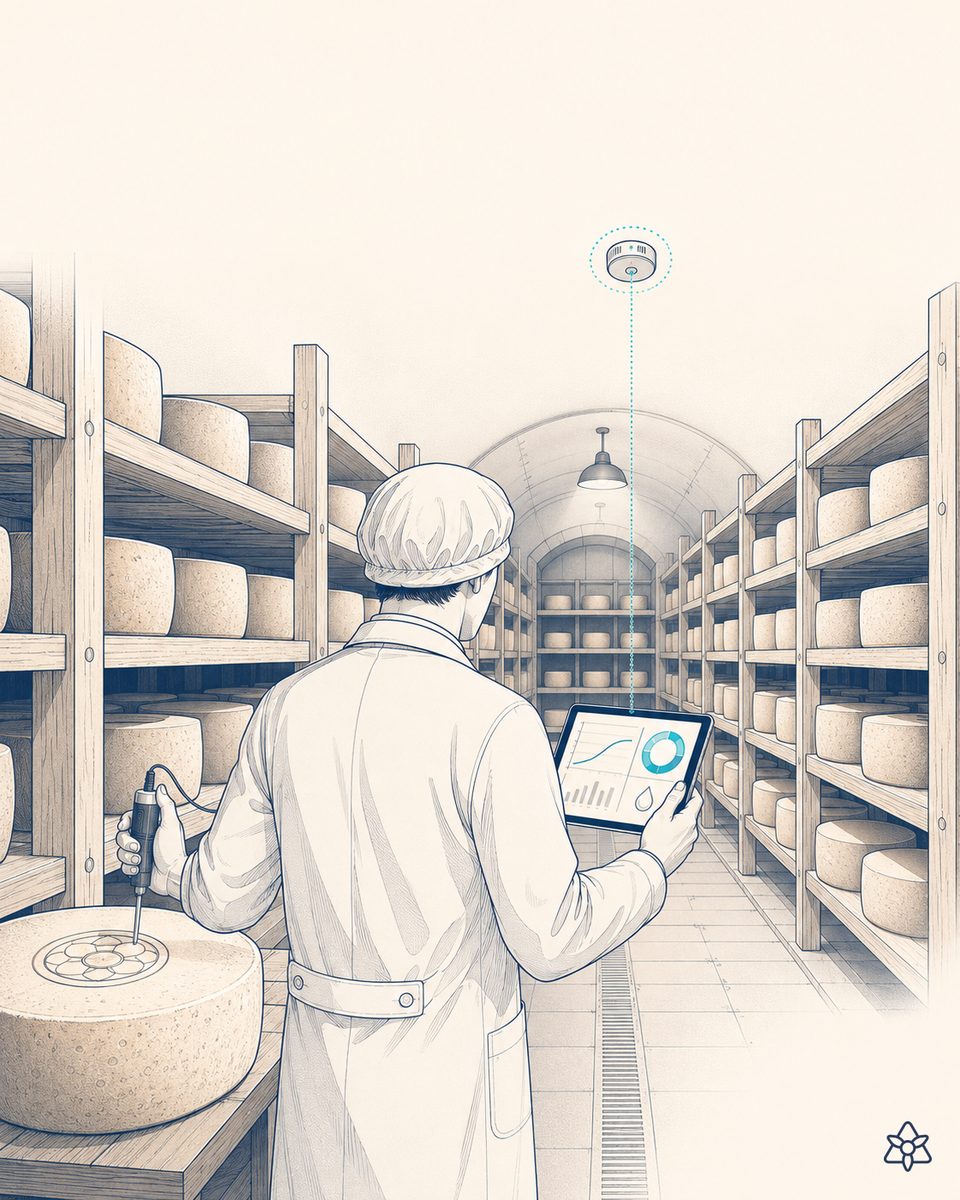
A test that proves everything and reaches nobody.
The post-pasteurization alkaline phosphatase test is one of the noblest checks in cheesemaking: fast, cheap, a direct indicator that pasteurization worked. The lab manager runs it several times per shift, writes it in the notebook and signs it. The system works — pasteurization is proven on the spot. The problem is not the test, it is what happens afterwards:
- The result lives in the notebook — and the notebook lives in a drawer in the lab.
- The pasteurizer temperature chart lives somewhere else — chart-recorder paper, a SCADA log or the operator's screen.
- The milk batch comes from several tankers — whose traceability lives in a third system.
When the IFS, BRC or FSSC 22000 auditor asks “show me that pasteurization for batch 4521 was correct”, the answer starts with “hold on, let me find that day's notebook” and ends, several hours later, with three photocopies held together by a paper clip. The classic system works 99% of the time. That 1% is the notebook lost when the lab manager changed — and the standard's non-conformity that a single link could have prevented.
iLEAN Connect does not change the kit — it gets the result out of the notebook.
The problem with alkaline phosphatase is not that the data is missing: it is that the data never connects with the rest of the batch file. iLEAN acts as the putty between the lab, the pasteurizer and milk receiving, without asking you to change your kit or your HACCP procedure.
The lab keeps running the test it knows. Connect captures the result by photo or digital reading and links it to the batch, to the pasteurizer temperature chart and to the person who signed. The file is complete at second zero. The person validates.
The iLEAN pieces applied to the alkaline phosphatase test:
- Connect — captures the kit result through three graded routes: a photo of the Charm/Petrifilm/Q-test kit from the app (the CNN extracts the data), a digital reading if the kit has a compatible reader, or assisted manual entry if everything else fails. In parallel it captures the pasteurizer temperature chart (whether it sits in SCADA, on an analog chart recorder or in an email) and the milk batch from the ERP. Three levels of capture. The putty fills whatever is missing.
- Agent — cross-references the test result with the pasteurizer curve and the tanker batch. If the combination does not add up (positive test + borderline curve, or a correct test + a curve with a deviation), it alerts the quality manager through whichever channel they use. It does not fire off an email at 10 pm: it raises the alert when the alert is due. The person signs.
- iLEAN Writer — drafts the batch file continuously, ready for the IFS/BRC/FSSC 22000 auditor. What is critical is never decided alone: the quality manager reviews, adjusts and signs. The dossier goes out signed.
The test in a notebook vs. the test linked with iLEAN
| Aspect | Alkaline phosphatase in a notebook | With iLEAN Connect |
|---|---|---|
| Capture of the result | Handwritten note by the lab | Photo of the kit + automatic reading |
| Link to the milk batch | “Batch of the day” — rebuilt afterwards | Linked at second zero |
| Link to the pasteurizer curve | None — separate records | Cross-referenced automatically by the agent |
| Search for an audit | Notebook + chart recorder + ERP, several hours | File ready, batch by batch |
| Risk of a lost notebook | Real — staff change, relocation | The data lives in the batch file |
| Compatibility with your current kit | n/a — it is the kit | Charm, Petrifilm, Q-test, equivalents |
Impact estimate for your plant — to be validated with your numbers.
The block below is an estimate to be validated with the specific data of your plant. We put it forward so the committee has an order of magnitude; we refine it during the diagnostic.
- Cheese dairy with 1–3 pasteurizers, alkaline phosphatase test run several times per shift in the lab notebook, current IFS/BRC/FSSC 22000 certifications.
- iLEAN Connect pilot in the lab (kit reading by photo + integration with the pasteurizer temperature chart + link to the milk batch). First value within a few weeks: the first complete batch file assembled automatically.
- Indicative payback between 4 and 9 months, depending on what preparing audits costs you today, on how often tests are run and on the risk of a documentation non-conformity.
- Hard lever: a reduction of ≥30% in qualified time spent rebuilding files for audits plus a lower risk of non-conformity from broken traceability.
And the lab manager's reasonable doubt
“What if the AI misreads the kit and we sign off a pasteurization that never happened?” — hallucination is a problem of free generation, not of anchored tasks. When the AI merely reads a kit and normalizes the data, the best models brought error below 1.5% [1]. And even so, what is critical is never decided alone: iLEAN proposes the reading and the lab manager signs. The file only reaches the auditor with a person's signature on it. The three safety rings exist precisely for this.
[1] OpenAI paper “Why Language Models Hallucinate”, 2025 — on the reliability of AI in anchored tasks.
What people ask about the alkaline phosphatase test in cheesemaking
What does the alkaline phosphatase test prove in cheese?
Alkaline phosphatase is an enzyme naturally present in raw milk that is inactivated by the time/temperature pairing of minimum pasteurization (72 ºC for 15 seconds). A negative alkaline phosphatase result on post-pasteurization product proves the milk was pasteurized correctly; a positive result points to insufficient pasteurization or cross-contamination with raw milk. It is the rapid check most widely used in cheesemaking to guarantee pasteurization, and it counts both for HACCP self-monitoring and for external audits.
Why is it still recorded in a lab notebook?
Because the kit (Charm, 3M Petrifilm, Romer, Q-test) gives a visual or numeric result that gets written down by hand, and it costs the lab manager less effort to jot it in the notebook than to open the LIMS, if there is one. The consequence is that the data exists — pasteurization was proven — but it lives disconnected from the milk batch, from the pasteurizer temperature chart and from the cheese batch file. If the auditor asks “show me the pasteurization test for batch 4521”, the answer starts with “hold on, let me find that day's notebook”.
How does iLEAN Connect link the test to the milk batch?
Three routes, depending on the kit you use: (1) photo of the kit — the lab manager takes a photo of the kit (Charm, Petrifilm, Q-test) with the app and Connect reads the result, associates it with the stated batch and links it to the pasteurizer temperature chart and the source tanker; (2) digital reading — if the kit has a reader, Connect integrates it; (3) assisted manual entry — if everything else fails, the lab manager fills in three fields in the app and Connect does the rest. The batch file is complete at second zero.
Is it compatible with commercial kits (Charm/Romer/3M)?
Yes. iLEAN does not force you to change kits: it works with the one you already have calibrated and validated in your HACCP system. The machine vision on the Edge terminal (or on the lab manager's phone via Connect) reads the result from the Charm, the Petrifilm, the Q-test or the equivalent test strip, and normalizes the data into a single traceable field. The lab keeps doing what it knows how to do — it just stops writing in the notebook.
Will an IFS/BRC/FSSC 22000 auditor accept it?
The auditor accepts it when the file is complete, traceable and signed by the responsible person. iLEAN does not sign on behalf of the plant: it prepares the evidence (photo of the kit + reading + batch + temperature chart + the person's signature) in a format the auditor can walk through. The standard (IFS, BRC, FSSC 22000) asks for proof of pasteurization + batch-by-batch traceability — iLEAN closes that loop automatically. The signature stays human.
More cases in food
- Real iLEAN use cases in empanada plants12 Connect, Edge, and Agents use cases applied to empanada manufacturing: capture, vision, and agentic…
- Empty container inspection — one particle in a bottle contaminates the whole product.Every empty bottle checked before filling: breakage, particles, residual contamination. iLEAN Edge at…
- European PDO cheeses — the specification is met in the vat, not on paper.Documented iLEAN cases in European cheese dairies: PDO/PGI specifications, vat and aging control, and…
- Brie and Camembert — the affineur's eye, extended to every piece in the cellar.iLEAN Edge uses AI vision to watch the progress of the Penicillium camemberti bloom on Brie and…
- Filatura control for PDO Mozzarella di Bufala Campana — the filatore's hands, assisted by vision.iLEAN Edge controls the filatura of PDO Mozzarella di Bufala Campana through whey temperature and curd…
- Industrial Cheddar — the belt never stops, and the acidity curve drifts before anyone has time to correct it.iLEAN Edge controls industrial Cheddar cheddaring — stacking, turning and the acidity curve on a…
Tell us your case and in 48h we'll send you the estimated ROI of this AI project for your cheese dairy.
We work on your plant's real data, not ours. Diagnostic with no commitment.
Request estimated ROI in 48h See European cheeses