Empty container inspection — one particle in a bottle contaminates the whole product.
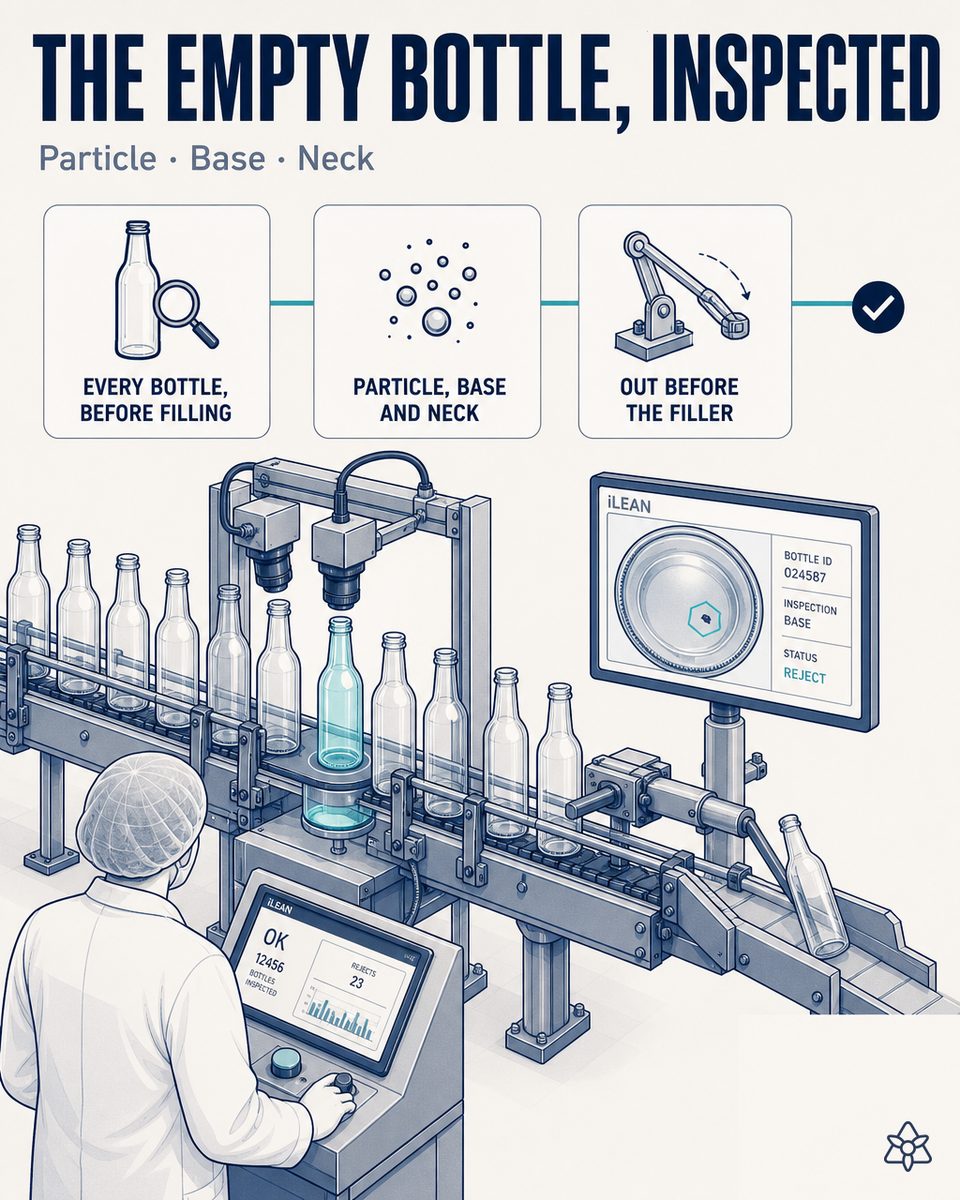
An empty container with a particle in it contaminates the entire batch, not just the bottle. iLEAN Edge inspects every empty bottle before the filler — particles, breakage, residual contamination — and ejects it in milliseconds. The line does not stop; the person supervises.
The empty container is the most underestimated link in bottling.
On a beverage line the focus is usually on the filler, the capper and the labeller. The empty container entering the line is assumed to be clean by default — and most of the time it is. The problem is what happens on the day it is not:
- Returnable glass — it comes back from the street. The washer does an enormous job, but a small percentage arrives with residue, a badly stripped label, a fragment of a previous cap or, occasionally, with whatever the consumer put inside and the washer failed to remove.
- New glass and PET — they come from the container supplier. Tracing a supplier defect is a classic problem: by the time the line discovers a defective series, three pallets have already gone in.
- A transparent particle — the worst case. A human operator, holding the bottle up to the light, catches most of them; a human operator at 36,000 bph catches nothing.
When a particle gets through, the cost is not the bottle: it is the whole batch pulled from the shelf, the brand damage, the AESAN/RASFF notification and the retailer audit. And the quality director's question is not "did it happen?", it is "how do you prove it will not happen again?". End-of-line inspection is necessary, but it arrives too late — the right place is before the filler, not after.
iLEAN does not add one more inspection — it puts the veteran's eye where nobody can stand.
The empty container problem is not a lack of method (the classic end-of-washer inspector exists) — it is speed. No human inspects every bottle at line speed. iLEAN acts as the putty that seals the crack between the washer and the filler: the veteran's eye, installed at the exact physical spot, working 24/7.
Edge sees every empty container on the conveyor. Connect reads the washer and warns when something upstream is wrong. The agent cross-references reject rate, pallet supplier and shift, and proposes the root cause. The person validates.
The iLEAN pieces applied to empty container inspection:
- Edge + Vision — a terminal with a CNN over the conveyor at the washer exit (or at the filler infeed). It reads every empty bottle: breakage, particles on the base and walls, label residue, residual contamination. An actuator (pneumatic ejector) fires in milliseconds. It works without a network: critical inspection does not depend on the plant's WiFi.
- Connect — captures the washer readings (temperature, caustic, cycles) — from a modern PLC, an old data logger or a photographed display — plus the pallet quality check at goods-in (a photo of the supplier's delivery note, the container batch). It seals the cracks between the inspection and the upstream systems.
- Agent — cross-references reject rate per minute + shift + container supplier + washer cycle. If the rate steps up, it identifies the common factor (a supplier batch, the washer start time with diluted caustic, one specific format) and alerts the shift lead before rejects become massive. The decision to stop the line is the person's.
Classic inspection vs. AI inspection with iLEAN
| Aspect | Human inspector + end-of-line control | With iLEAN Edge + Connect + Agent |
|---|---|---|
| Coverage per shift | Sampling + the attention of the operator at the head of the line | 100% of bottles, without fatigue |
| Transparent particle detection | Limited to human speed | Vision with structured lighting — at line speed |
| Traceability of rejects | Aggregate count at the end of the shift | Image + timestamp + reason, bottle by bottle |
| Detecting an upstream problem | Reactive — once rejects pile up | Anticipated — the agent flags the step change |
| Operation without a network | n/a | Edge keeps inspecting autonomously |
| Quality file per shift | Rebuilt by hand | Automatic dossier with the reject curve and causes |
Impact estimate for your plant — to be validated with your numbers.
The block below is an estimate to be validated with the specific data of your plant. We put it forward so the committee has an order of magnitude; we refine it during the diagnostic.
- Beverage bottling plant (soft drinks, beer, water, juices), returnable or new glass, 24,000-50,000 bph on the main line.
- Edge pilot at the washer exit or the filler infeed (CNN camera + lighting + pneumatic ejector). First value expected within a few weeks: detection above 90% on the typical defects identified during the diagnostic.
- Reduction in undetected particles / residual contamination of ≥ 30% versus the baseline — the real lever is eliminating the blind zone between the washer and the filler.
- Indicative payback between 4 and 9 months, depending on the frequency of documented contamination incidents and the average cost of a recall or rework.
- Additional hard lever: meeting the retailer's quality standard and IFS/BRC audits — bottle-by-bottle traceability with an image is exactly the kind of evidence being demanded more and more.
And the context that rarely gets quoted
The benchmark quality standard in automotive is of the order of 25 PPM defective[1]. Empty container inspection in beverages does not need to get there, but the ratio that decides a committee is not that one — it is the cost of a single particle getting through and ending up on social media. On the reasonable fear of AI: hallucination is a problem of free generation, not of anchored tasks — classifying an image of a bottle as "clean / with particle" is exactly an anchored task, and on that ground the best models brought error below 1.5%[2]. And the critical decision (stopping the line, checking the washer) remains the person's.
[1] Automotive quality standard of the order of 25 PPM — Symestic.
[2] OpenAI paper "Why Language Models Hallucinate", 2025 — on the reliability of AI in anchored tasks.
What people ask about empty container inspection with AI
Does iLEAN Edge detect small particles inside the empty container?
Yes. The convolutional neural network running on iLEAN Edge is trained with real samples from your plant — including glass fragments, insects, label remnants, washer residue and flake-type foreign particles. With the right lighting (dark field, backlight or ring light depending on the material), Edge detects particles of the order of fractions of a millimeter on the base and on the walls of the bottle. The rule of thumb: whatever a human operator would spot standing next to the washer, Edge spots at full line speed.
Does it work with returnable glass and with plastic (PET)?
Both. Returnable glass is the toughest case — it comes back from the street with marks, badly stripped labels, scuffs, base scoring and, occasionally, residue from whatever the consumer put inside. Edge is trained on the real zoo of defects in your own returns. PET is cleaner (empty from the factory) and inspection focuses on particles and deformation of the neck and thread. Optics and lighting are tuned to the material, but the terminal and the agent are the same.
What lighting do you need for reliable inspection?
For glass: a combination of backlight (to see suspended particles and wall defects) and structured front light (for finish breakage and burrs). For PET: a diffuse ring light for the thread and side light for the body. Industrial LED is usually enough — no exotic installations required. Lighting is the first thing iLEAN sizes during the diagnostic, because bad light kills any vision system however good the network is. Typically low investment, fast integration.
Is rejection automatic without stopping the line?
Yes. Edge fires the actuator (pneumatic ejector or diverter) within the same cycle as the inspected bottle — the line does not stop, the defective bottle leaves through the reject channel in milliseconds. If the reject rate jumps above a threshold (a sign that something upstream is wrong: a dirty washer, a change of returnable supplier), the agent alerts the shift lead before mass rejection reaches the bottling area. The critical operation of stopping the line remains the person's.
Does iLEAN replace the human inspector watching the washer?
No — it frees them up. Inspecting empty containers at industrial line speed is physically impossible for a human being (tens of thousands of bottles an hour). What a veteran inspector really did was look after the line: spot the subtle pattern, hear the odd noise, step in when the washer stopped working properly. iLEAN takes the mechanical part (every bottle, without fatigue) and frees the veteran for what only they can do: read the patterns of the upstream process. Assist and simplify, not replace.
More cases in food
- Carcass grading by weight and AI in the cutting room — the class cannot change with the shift.Automatic SEUROP grading with AI vision plus the scale. Consistent classification across shifts, without…
- Real AI cases in dairyReal AI cases in dairy: predictive pasteurizer maintenance, digital CCP/HACCP, cheese defect detection…
- Real iLEAN use cases in empanada plants12 Connect, Edge, and Agents use cases applied to empanada manufacturing: capture, vision, and agentic…
- European PDO cheeses — the specification is met in the vat, not on paper.Documented iLEAN cases in European cheese dairies: PDO/PGI specifications, vat and aging control, and…
- Alkaline phosphatase test after pasteurization — the data out of the lab notebook.iLEAN Connect captures the post-pasteurization alkaline phosphatase test and links it to the milk batch…
- Brie and Camembert — the affineur's eye, extended to every piece in the cellar.iLEAN Edge uses AI vision to watch the progress of the Penicillium camemberti bloom on Brie and…
Tell us your case and in 48h we'll send you the estimated ROI of this AI project for your packing line.
We work on your plant's real data, not ours. Diagnostic with no commitment.
Request estimated ROI in 48h ‹ All beverage cases See food industry