Carcass grading by weight and AI in the cutting room — the class cannot change with the shift.
SEUROP grading shifts with whoever is grading that day — and that is money lost on every misgraded carcass, whether it is graded down or graded up. iLEAN Vision plus the scale makes it consistent across shifts: the AI learns from the official inspector and signs the decision, and borderline carcasses always carry a human signature. We push it to the ERP at second zero.
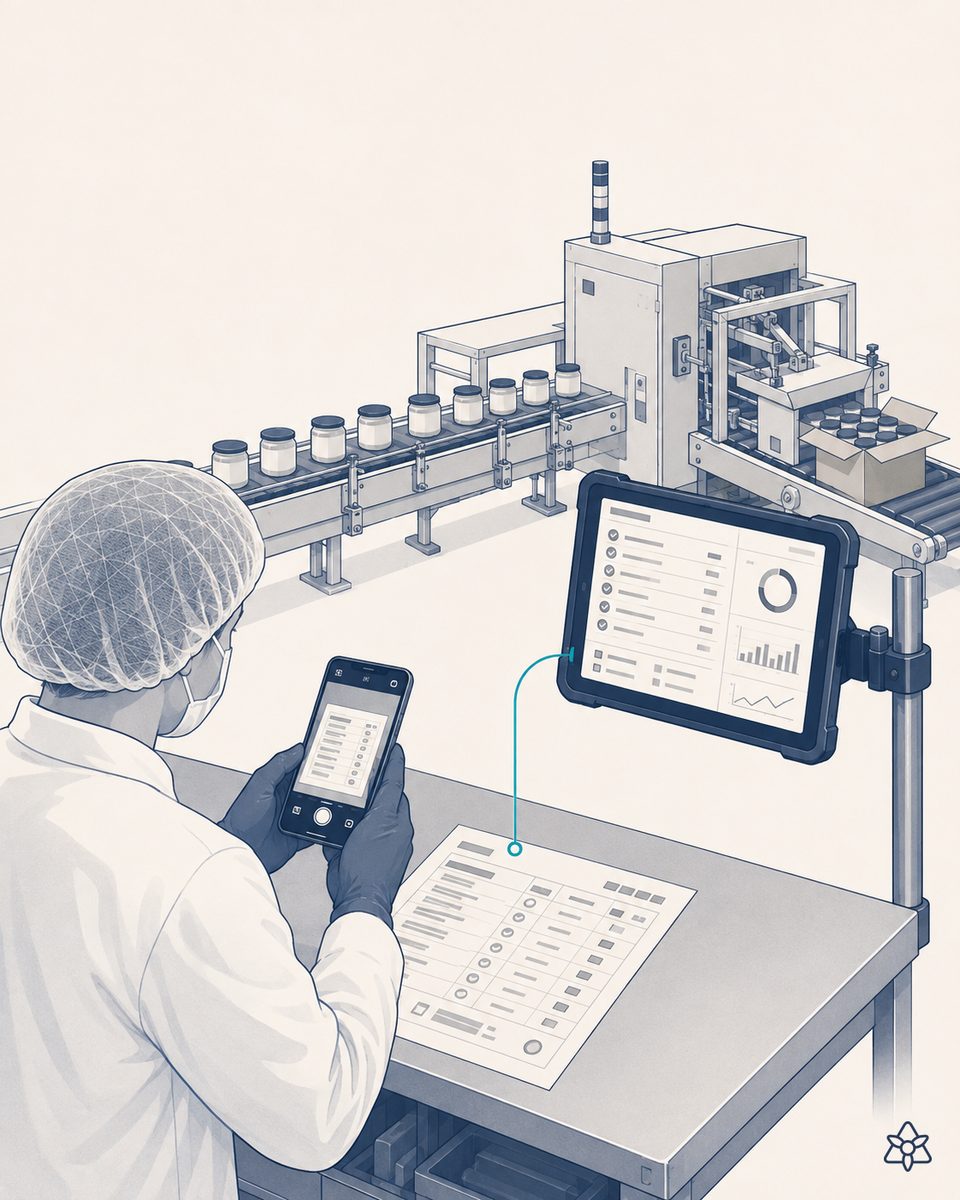
Monday's SEUROP is not Thursday's SEUROP.
Grading carcasses in the cutting room is the most frequently repeated economic decision in a meat plant: every carcass carries an assigned class that sets the price at which it is sold on to cutting, to a processor or to the market. And in most plants that decision depends largely on the eye of the grader on shift — backed by the official inspector where regulations require it, and by a scale.
The problem is not that the operator does not know how: he does. The problem is that fatigue, line-speed pressure and the differences between graders introduce a variance no end customer ever sees, but the margin certainly feels. A carcass sent down a class over a millimeter of fat thickness is margin given away; one sent up a class it did not earn is a complaint that lands a month later.
And the fine-grained trace — who graded what, on which shift, how the deviations are distributed — lives in a notebook or a spreadsheet that only gets opened when there is a complaint. Information that reaches the person who should act on it far too late.
iLEAN does not replace the official inspector — it carries him in the camera's head.
SEUROP grading is not a scale-calibration problem, it is a problem of shared judgment. iLEAN acts as the putty between the scale (which only knows how to weigh), the camera (which sees the whole carcass) and the ERP (which needs a signed class in order to invoice). The three sources are unified and the person signs where it matters.
Vision sees the carcass. The scale weighs it. The agent cross-references it against the SEUROP grid learned from the official inspector. Anything borderline goes to a human signature. The class reaches the ERP at second zero — not next Monday.
The iLEAN pieces applied to carcass grading:
- Vision + Edge — a terminal with a CNN camera over the grading line, right where the carcass passes the scale. The camera captures geometry, conformation, visible fat thickness and the morphological attributes that matter for SEUROP. The CNN is trained against carcasses signed off by the official inspector — so it learns his criteria rather than inventing its own. It works with no network.
- Connect — captures the official inspector's signature and feeds it into the learning model, captures the scale reading whether it is analog or digital, and publishes the assigned class to the ERP/MES. If the slaughterhouse receives a price-list change from a customer by email or WhatsApp, it enters the system at second zero and the agents recalculate the price without anyone having to forward anything.
- Agent — delivers the daily dossier to the cutting room manager: class distribution by shift, deviation between graders, borderline carcasses signed and why. It is not a report that arrives Monday at 9; it is there the moment the shift closes. The person decides what to do: a short training session, a model recalibration, a conversation with a carcass supplier.
Eye + scale + notebook vs. AI-assisted grading with iLEAN
| Aspect | Manual grading + scale | With iLEAN Vision + Connect + Agent |
|---|---|---|
| Consistency across shifts | Depends on the grader on duty | Same criteria, calibrated with the official inspector |
| Borderline carcasses | A quick call by the operator | Flagged for a human signature, full trace |
| Arrival in the ERP | Manual upload at the end of the shift | At second zero, with photo and signature |
| Trace of the decision | Notebook or spreadsheet, partial | Image + weight + class + signature, per carcass |
| Customer complaint | “We'll look into it”, with no evidence | Photo + data for the disputed carcass, in seconds |
| Learning | Occasional operator training | The model learns every time the inspector signs |
Impact estimate for your plant — to be validated with your numbers.
The block below is an estimate to be validated with the specific data of your plant. We put it forward so the committee has an order of magnitude; we refine it during the diagnostic.
- Mid-sized slaughterhouse / cutting room, one main grading line with a scale plus a human grader, a mix of external suppliers.
- Vision + Edge pilot over the line (camera + lighting + integration with the scale and the ERP). First value expected within a few weeks: full traceability per carcass (image + weight + class) and a real baseline of shift-to-shift variance.
- Reduction of shift-to-shift variance in the class mix of ≥ 30% in the first months, improving effective margin without touching the selling price. A conservative estimate; the ceiling is set by how much of today's variance is real (carcass-to-carcass variation) versus avoidable (the grader's judgment).
- Indicative payback between 4 and 9 months, depending on carcasses/day and the price gap between adjacent classes. The hard lever is the margin recovered on carcasses that today get graded down without deserving it, plus the time saved reconciling with the ERP.
And the cutting room manager's reasonable doubt
“What if the AI assigns the wrong class?” — hallucination is a problem of free generation, not of anchored tasks like comparing a carcass against a grid of classes. In anchored tasks the best models brought error below 1.5%[1]. And even so, what is critical is never decided alone: borderline carcasses go to a human signature, and the official inspector's signature remains the last word wherever regulations require it. iLEAN's three safety rings are designed for exactly this.
[1] OpenAI paper “Why Language Models Hallucinate”, 2025 — on the reliability of AI in anchored tasks.
What people ask about carcass grading by weight and AI
Does it recognize the 5 SEUROP classes?
Yes. The European grading scale for beef carcasses (Superior, Excellent, Good, Fair, Poor, Very poor — the SEUROP scale) and the pork scale based on lean meat percentage are codified enough that a CNN trained on enough carcasses labeled by official inspectors learns to tell them apart consistently across shifts. The customer brings the official inspector in as an anchor, not as a rival: the AI learns to agree with him, not to replace him.
How is it calibrated against the official inspector?
During the immersion, a mixed team (plant people plus an embedded iLEAN engineer) works alongside the official inspector for several shifts, capturing image plus scale reading plus the class he signed for each carcass, and builds the training set from that. The AI is calibrated against that ground truth; any borderline carcass in production is flagged for human validation until the model covers the full space of variation. Calibration is continuous: every time the inspector adjusts, the model learns.
What happens with borderline carcasses?
Borderline carcasses are exactly where the grader's eye varies most from shift to shift, and where the AI has to be most cautious. iLEAN flags them as “requires a human signature” and routes them to the inspector or quality manager, who signs the class. The carcass keeps moving down the line without breaking the pace; what gets signed is the class assignment, not the physical operation. Over time the share of borderline cases drops, because the model learns that band.
Does it send the classification to the ERP?
Yes. iLEAN Connect publishes the classification (SEUROP class, weight, carcass identifier) to the ERP/MES at second zero, with the photo and the human signature where it applies. That closes the common disconnect between what gets graded on the line and what reaches the invoicing system — a well-known gap that costs money, because a misgraded carcass is sold at the price of the class it was assigned, not the class it deserved.
Is it compliant with European regulations?
European regulations require SEUROP grading in slaughterhouses above a certain volume to be performed by a qualified inspector, either manually or through an approved automatic grading system. iLEAN does not replace the inspector and does not substitute for official approval: it operates as an assistance and traceability system that captures the inspector's decision, propagates it to the ERP and reduces shift-to-shift discrepancy. Where an approved system is required, iLEAN integrates with it as the traceability and intelligence layer.
More cases in food
- AI control of ham curing — the curve that decides whether the batch ships or is lost.iLEAN combines vision, weight, chamber humidity and temperature to secure the cooking and curing curve…
- AI control of the cheese curing chamber — quality stops depending on the shift.Continuous sensing in the curing chamber plus AI that predicts deviations before they happen. Cheese…
- Meat cutting traceability — holding the carcass → cut link is the foundation of the whole business.iLEAN Vision recognizes every cut as it leaves the cutting room and keeps its link to the original…
- Real AI cases in dairyReal AI cases in dairy: predictive pasteurizer maintenance, digital CCP/HACCP, cheese defect detection…
- Real iLEAN use cases in empanada plants12 Connect, Edge, and Agents use cases applied to empanada manufacturing: capture, vision, and agentic…
- Empty container inspection — one particle in a bottle contaminates the whole product.Every empty bottle checked before filling: breakage, particles, residual contamination. iLEAN Edge at…
Tell us your case and in 48h we'll send you the estimated ROI of this AI project for your cutting room.
We work on your plant's real data, not ours. Diagnostic with no commitment.
Request estimated ROI in 48h See food industry