Meat cutting traceability — holding the carcass → cut link is the foundation of the whole business.
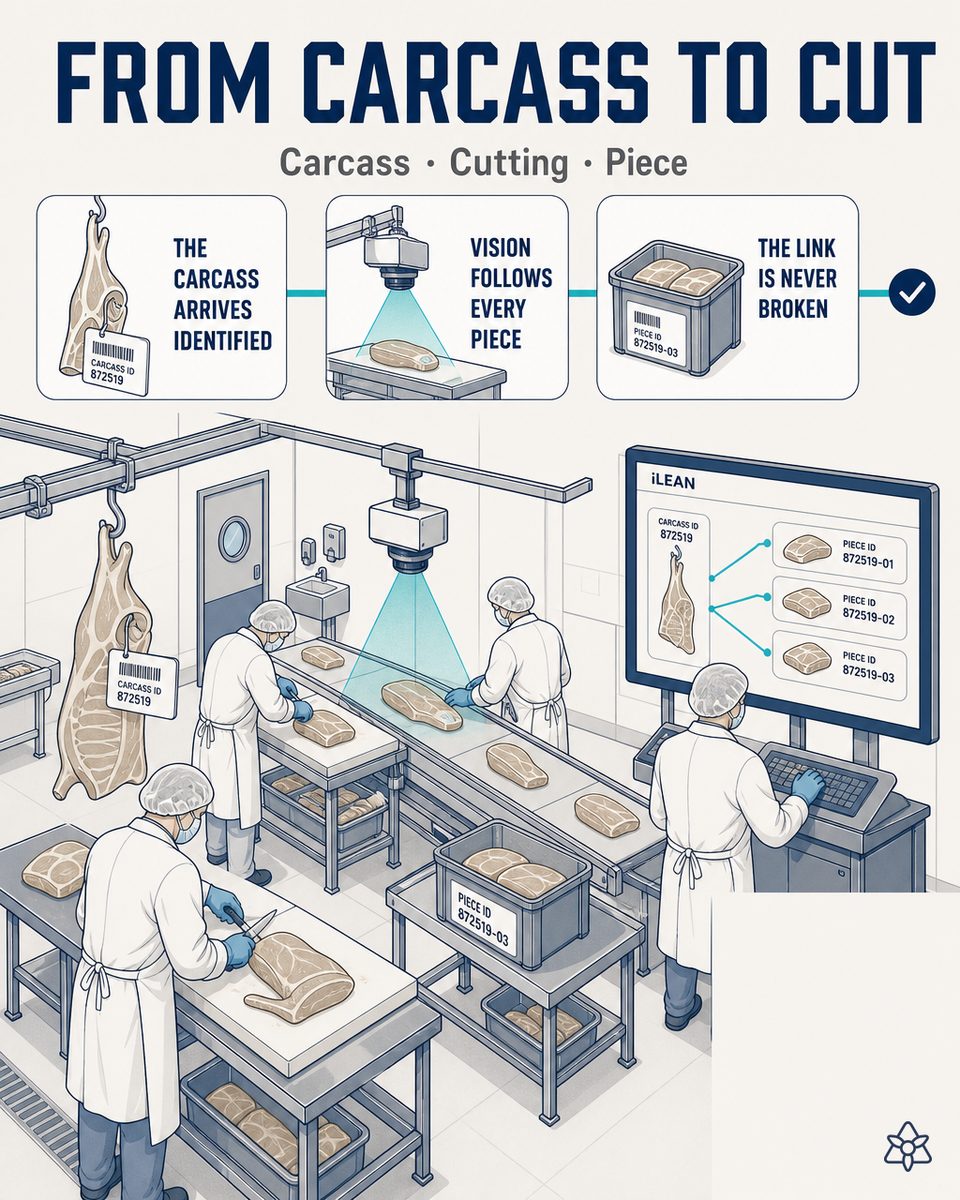
Holding the carcass → cut link through breakdown is the foundation of the meat business. iLEAN Vision recognizes every cut as it comes off the belt and preserves the link to the original carcass with no manual labeling and no extra operator. The day a food safety alert on a slaughter batch arrives, within minutes you know which cuts were produced, where they are and which customer they went to.
The carcass goes in whole and comes out as thirty cuts — and the link is held together by one operator and a shout.
A well-run cutting room is a small miracle of coordination. The carcass arrives hanging from the overhead rail, the operator lowers it onto the table, breakdown begins. Out of it come leg, shoulder, loin, rib rack, belly, trim… each to its own belt or cart, each with its own commercial destination. The problem: none of that is measured continuously.
- Identifying the carcass at the start of breakdown is done by scanning the hook or by the operator calling it out — and sometimes, at peak hours, the scan is missed and it gets assumed.
- Classifying each cut on the way out is done by the operator's eye — a veteran nails it; a seasonal temp, less so. And nobody records whether the cut was a leg or a shoulder, beyond what the weigh-labeler registers afterwards.
- The carcass → cut link is held in someone's head, in the flow, and translated into the label at the end. If things get mixed up along the way, the link breaks — and that does not surface until a food safety alert tied to the slaughter batch arrives and specific cuts have to be recalled.
The meat quality manager knows the risk. But asking the operator to scan every single cut means breaking the room's rhythm — and rhythm is cost. So it rests on the veteran's eye. Which leaves the day they retire.
iLEAN does not break the room's rhythm — it seals the crack between the carcass and the label on the cut.
The problem is not a lack of technology in the room: there is a weigh-labeler, there is an ERP, there is hook scanning. The problem is that those systems do not talk to each other continuously, and the carcass → cut link ends up hanging from the operator's memory. iLEAN acts as the putty that seals that crack, without asking you to change the scale, the ERP or your room's rhythm.
Vision recognizes every cut on the way out. Tracer holds the link to the carcass. The agent cross-checks with the scale and triggers the correct label. The operator carries on working exactly as before — the system only interrupts them if something does not add up.
The iLEAN pieces applied to meat cutting:
- iLEAN Vision (Edge with vision) — a terminal with an industrial camera above the outfeed belt or the sorting table. The convolutional neural network recognizes each cut in real time (leg, shoulder, loin, rib rack, belly…) without the operator doing anything differently. It processes locally — it works with no network. What is critical cannot depend on WiFi.
- Tracer — continuously maintains the carcass of origin → cut produced link. When a cut is recognized on the belt, it is associated with the carcass that was on the table at that moment (cross-referenced with the hook scan and the timing). If a food safety alert comes in for a slaughter batch, within minutes there is a complete list of affected cuts and their destinations.
- Labeling agent — cross-checks vision, scale weight, carcass of origin and commercial destination, and triggers the correct label on the weigh-labeler (Bizerba, Marel, Mettler Toledo). If something does not add up (the recognized cut is not the one selected manually, the weight is out of range for that category), the agent holds the label and the person validates. No label goes out until the system confirms that carcass, weight, category and destination all agree.
Traceability by the operator's eye vs. traceability with iLEAN Vision
| Aspect | Classic cutting + the operator's eye | With iLEAN Vision + Tracer + Agent |
|---|---|---|
| Recognizing the cut on the way out | Operator's eye + weigh-labeler | Continuous AI vision, without breaking the rhythm |
| Carcass → cut link | In the room supervisor's head | Recorded in Tracer at second zero |
| Mixed cuts on the same belt | Risk of mix-ups at peak hours | Cut-by-cut segmentation, whatever the order |
| The veteran's knowledge | Walks out the day they retire | Captured in the model, a permanent capability |
| Response to a batch food safety alert | Manual reconstruction, hours | List of affected cuts, in minutes |
| Mislabeling (carcass/category) | If it happens, the customer finds out | The agent holds the label before printing |
Impact estimate for your plant — to be validated with your numbers.
The block below is an estimate to be validated with the specific data of your cutting room. We put it forward so the committee has an order of magnitude; we refine it during the diagnostic, reviewing your cutting manual, your line speed and your weigh-labeler.
- Mid-sized cutting room (pork 500-2,000 carcasses/day or beef 80-300 carcasses/day), a mainstream weigh-labeler (Bizerba, Marel, Mettler Toledo), a vertical meat-industry ERP, and growing retailer pressure for cut-by-cut traceability.
- Vision pilot on one outfeed line (camera + Edge + integration with the scale and the ERP). First value expected within a few weeks: recognition above 90% on the main cuts and the carcass → cut link maintained with no manual scanning.
- Indicative payback between 4 and 9 months, depending on cutting volume, average cut value, historical frequency of labeling incidents and how much operator time goes into manual scanning today.
- The hard lever: the day a food safety alert on a slaughter batch arrives, the difference between recalling exactly the affected cuts and recalling, out of an abundance of caution, the entire day's output — that alone pays for the pilot several times over.
And the plant manager's reasonable doubt
“What if vision mistakes a shoulder for a leg and it gets labeled wrong?” — hallucination is a problem of free generation, not of anchored tasks. Recognizing a specific meat cut from a closed catalog, trained on cuts from your room, is the anchored task par excellence — the best models brought error below 1.5% [1]. And even so: the agent never fires a label on its own if vision, weight and the manual selection do not agree — it holds, and the person validates. The three safety rings exist precisely for this.
[1] OpenAI paper “Why Language Models Hallucinate”, 2025 — on the reliability of AI in anchored tasks.
What people ask about meat cutting traceability with AI vision
Which cuts does iLEAN Vision recognize out of the box?
The main commercial cuts in pork and beef: in pork, leg, shoulder, loin, belly, rib rack, trim from derinding; in beef, forequarter and hindquarter, shoulder clod, chuck, striploin, tenderloin, rump, eye of round, flank. The neural network ships pre-trained on a standard catalog, and it is fine-tuned during the initial immersion on the specific cuts and the specific breakdown used in your plant — a cutting manual is not the same in one region as in another, and the model adapts to yours.
Does the vision system work with mixed cuts on the same line?
Yes — it is one of the scenarios it was designed for. In a real cutting room, the outfeed belt carries cuts from several carcasses and several breakdowns alternating: leg, shoulder, loin, leg, rib rack… The vision-equipped Edge terminal segments each individual cut, classifies it by category and links it to the carcass that was on the cutting table at that moment (cross-referenced with the hook scan or the operator's reading when the carcass was started). The system does not need the belt to be sorted by type — it adapts to the room's real rhythm.
Does the cutting room need special lighting?
No. Cutting rooms are lit with uniform cool light as a sanitary requirement, and that is exactly what computer vision needs to work well. iLEAN Edge uses the existing lighting; in specific cases (a dark spot caused by the geometry of the belt, glare off a wet surface) a single LED lamp can be added, but that is the exception. The installation is discreet — one or two industrial cameras on a minimal frame above the belt, certified for a food environment (IP66 + washdown).
Does iLEAN keep the link to the carcass of origin when the cut is packed?
Yes — and it is the heart of the proposition. Every recognized cut is recorded with its carcass of origin (animal ID, slaughter batch, plant of origin), its category, its weight (cross-checked with the weigh-labeler) and its destination. When the cut is labeled for shipping, the EAN-128 or GS1-DataMatrix carries the corresponding batch code, and the system maintains downstream traceability. If a food safety alert linked to that slaughter batch comes in tomorrow, within minutes you know exactly which cuts were produced, where they are and which customer they went to — that is the foundation of the meat business.
Does iLEAN integrate with the weigh-labeler and the plant ERP?
Yes. iLEAN replaces neither the weigh-labeler (Bizerba, Marel, Mettler Toledo, etc.) nor the meat-industry ERP — it sits on top. Vision provides automatic cut classification; the scale provides the weight; the ERP provides the carcass of origin and the commercial destination. iLEAN cross-checks the three sources and triggers the correct label. If the recognized cut does not match what the operator selected manually, the agent flags it before the label comes out — and the person validates. The label is never printed until the system confirms that carcass, weight, category and destination all agree.
More cases in food
- Crushed tomato and concentrate control with AI — the grade is decided in line, not in the lab.How iLEAN cross-checks refractometer, colorimeter and evaporator vision to hold Brix, color and zero…
- AI control of ham curing — the curve that decides whether the batch ships or is lost.iLEAN combines vision, weight, chamber humidity and temperature to secure the cooking and curing curve…
- AI control of the cheese curing chamber — quality stops depending on the shift.Continuous sensing in the curing chamber plus AI that predicts deviations before they happen. Cheese…
- Carcass grading by weight and AI in the cutting room — the class cannot change with the shift.Automatic SEUROP grading with AI vision plus the scale. Consistent classification across shifts, without…
- Real AI cases in dairyReal AI cases in dairy: predictive pasteurizer maintenance, digital CCP/HACCP, cheese defect detection…
- Real iLEAN use cases in empanada plants12 Connect, Edge, and Agents use cases applied to empanada manufacturing: capture, vision, and agentic…
Tell us your case and in 48h we'll send you the estimated ROI of this AI project for your cutting room.
We work on your plant's real data, not ours. Diagnostic with no commitment.
Request estimated ROI in 48h See food industry