AI control of ham curing — the curve that decides whether the batch ships or is lost.
In a cured-ham drying room or cellar, a critical window running out of band through a few quiet days can compromise an entire batch — and the master ham curer, however good he is, cannot be in the chamber 24/7. iLEAN cross-references temperature, humidity, weight loss and vision piece by piece and raises the alert before the problem is irreversible. The person signs every corrective action.
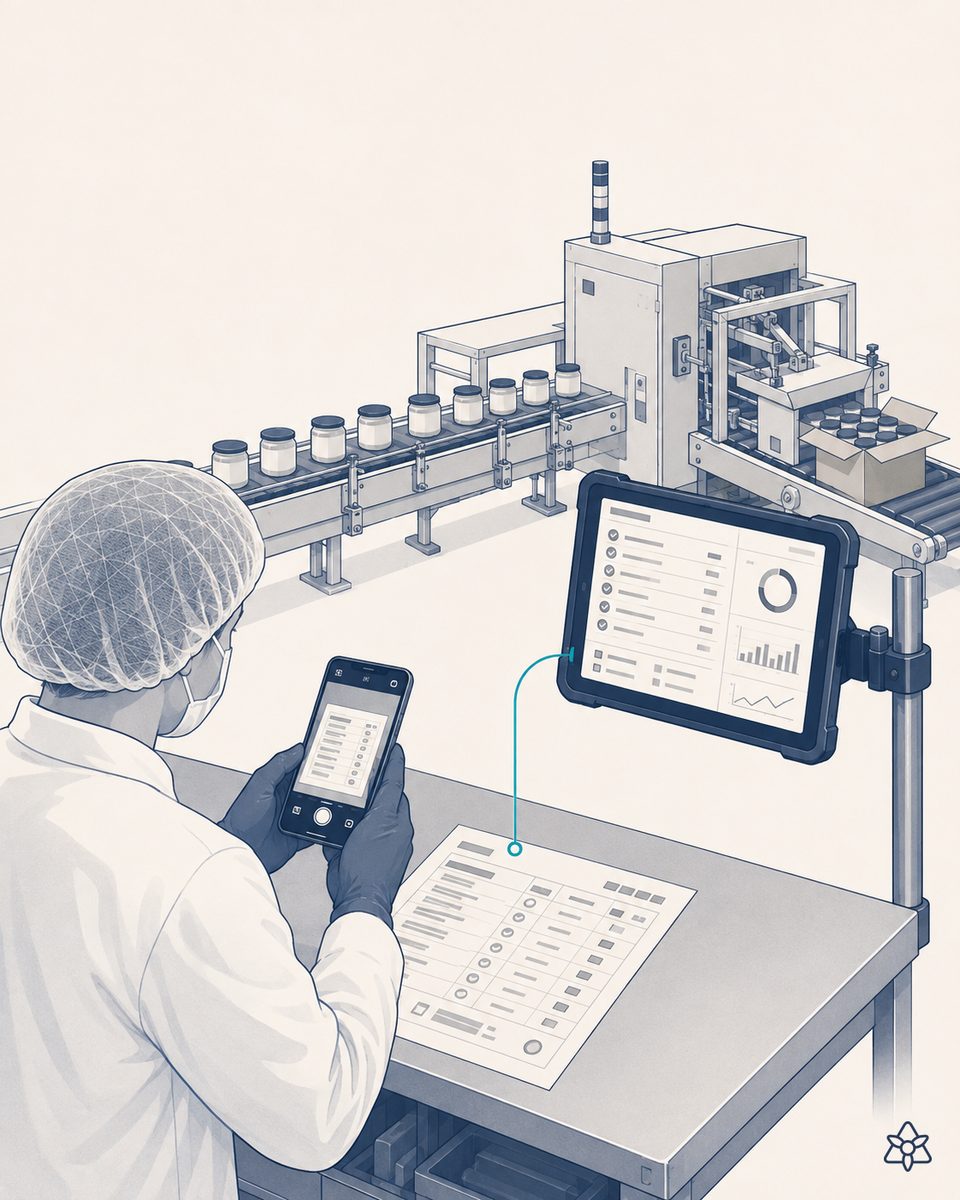
Curing is a long conversation — and almost nobody hears all of it.
A quality cured ham is not made in an oven: it is made in a conversation lasting months or years between the piece and the chamber. The piece asks for humidity when its outer layers dry too fast; it asks for cooler temperatures when it moves into the cellar; it asks for moving air when the surface is turning to a hard case. The master ham curer knows how to read that conversation — but there is one person, thousands of pieces and months ahead.
The reality on the floor: the PT-100 probe placed in the chamber measures one point, not the whole chamber. Weight loss is measured by sampling or on the walk-round, not continuously. Visual inspection happens when the master can get in, not when the piece needs it. And the data from the three sources (climate control, weight, sight) each lives on its own island — the climate control in the SCADA, the weights in a spreadsheet, the master's notes in a notebook.
The classic system (master + walk-round + chamber with a central probe) works 95% of the time. The remaining 5% are the lost batches — the ones that case-hardened, the ones that came out with out-of-band weight loss, the ones that had a deviation in a critical window that nobody saw. And one lost batch of acorn-fed Iberian ham is the economic equivalent of several months of margin for the whole chamber.
iLEAN does not replace the master — it captures his judgment and applies it to every piece, all the time.
The problem with curing is not a lack of knowledge: the master's knowledge exists, it lives in his head and it disappears the day he retires. What is missing is continuous capture of the chamber and of every piece, and a 24/7 cross-check against the master's judgment. iLEAN acts as the putty that fills those gaps — without asking you to replace the SCADA, the climate control or the way the cellar is organized.
Edge sees the piece from the outside and samples the chamber zone by zone. Connect digitizes the master's notebook and the weights. The agent cross-references against the program curve and, when a piece drifts during a critical window, raises the alert with time to spare.
The three iLEAN pieces applied to curing control:
- Edge — a terminal with machine vision (CNN) over the rows of hanging pieces, trained to recognize unwanted mold, case hardening and deformation; plus additional temperature/humidity probes by zone to get past the limitation of a single central probe. It works with no network. If the chamber loses connectivity, Edge keeps recording and raises alerts locally.
- Connect — captures the master's judgment (his notebook dictated by voice, his notes, the PDO specifications, the history of previous batches) and the scale data, whether it comes from a modern system or a manual spreadsheet. The knowledge drain when the veteran leaves becomes a permanent capability of the system.
- Agent — cross-references the four variables (temperature by zone, humidity by zone, weight loss per piece, vision per piece) against the curing program curve and against the master's judgment. When a piece or a zone drifts during a critical window, it opens an alert with room to correct and proposes the action (recalibrate the setpoint, adjust ventilation, reclassify the piece). The person validates — the agent never changes critical setpoints on its own; the safety rings are there for that.
Classic curing vs. curing assisted by iLEAN
| Aspect | Classic curing | With iLEAN Edge + Connect + Agent |
|---|---|---|
| Chamber measurement | A single central probe — the chamber is not homogeneous | Zone-by-zone mapping, several probes + visual reading |
| Traceability of weight loss | Sampling on the walk-round + spreadsheet — piece by piece is near impossible | Continuous weighing, a curve per piece, automatic alerts |
| Visual defect detection | Whenever the master walks in — every few days | Continuous; Edge sees the piece from outside all shift long |
| The master's knowledge | In his head — it leaves with him the day he retires | Captured by Connect, it stays in the system |
| Critical window off track | Spotted at the next check — several days later | Alert in hours, real room to correct |
| PDO dossier | Rebuilt by hand before the Regulatory Council visit | Automatic per-piece dossier with real curves |
Impact estimate for your plant — to be validated with your numbers.
The block below is an estimate to be validated with the specific data of your plant. We put it forward so the committee has an order of magnitude; we refine it during the diagnostic.
- Cellar or drying house with 3-6 chambers, batches of cured ham (acorn-fed Iberian, grain-fed Iberian, serrano) on 12-48 month curves depending on the product and the PDO.
- Pilot in one chamber (visual Edge + zone probes + integration with the program curve and the master's notebook). First value expected within a few weeks — zone mapping usually reveals undocumented variations the master had already sensed.
- Indicative payback between 4 and 9 months, dominated by the cost of a single avoided batch loss.
- Hard levers: a single avoided loss of an Iberian batch pays for the pilot several times over; less out-of-band weight loss; an automatic dossier for the PDO Regulatory Council; permanent capture of the master's judgment before he retires.
And the master ham curer's reasonable doubt
“What if the AI decides to change the chamber setpoint and ruins a batch by mistake?” — the agent never changes critical setpoints on its own. It proposes, with the evidence in plain sight (real curves against expected ones, photos of the piece, the literal quote from the program); the person validates and signs. In anchored tasks such as comparing a real curve against an expected one, the best models brought error below 1.5% [1]. And the underlying idea is not to replace the master: it is to free him from the dumb work (staring at a hundred chambers on a screen, walking rounds to see what the chamber could report on its own) so he can do the work that matters — deciding, in the critical cases, what happens to each piece. Assist and simplify, not replace.
[1] OpenAI paper “Why Language Models Hallucinate”, 2025 — on the reliability of AI in anchored tasks.
What people ask about AI control of ham curing
Which variables does iLEAN control in the curing chamber?
The four a good master ham curer would judge if he could be in the chamber 24/7: temperature and relative humidity point by point (chambers are not homogeneous — there are colder zones by the door and damper ones along the walls), weight loss of the piece (weight loss is the signature of curing — a specific curve is expected for each zone and type of ham) and external vision of the piece (Edge with a CNN detects unwanted mold, case hardening and deformation before they are visible to the naked eye). The agent cross-references all four against the expected curve of the curing program and raises a flag when a piece or a zone drifts.
Does it work for acorn-fed Iberian ham and for industrial serrano?
Yes — the curves are different, but the mechanism is the same. Acorn-fed Iberian ham has a long curve (24-48 months), with critical windows in pre-salting, post-salting, the drying room and the cellar — each with its own temperature, humidity and weight-loss range. Industrial serrano ham runs shorter, more tightly controlled curves. In both cases iLEAN is calibrated against the curve the plant already uses (the master's or the documented program) and detects deviations. It does not replace the master — it captures his judgment and applies it to every piece, all the time.
How is per-piece weight loss measured without stopping the process?
Three routes, depending on how modernized the chamber is: (1) a rack scale that weighs the hanging piece as it enters and leaves each stage, integrated with Edge so the piece is identified by RFID or by its engraved mark; (2) a mobile scale the operator pushes on every round, capturing the piece from a photo of the batch and weighing it; (3) statistical sample weighing of a representative percentage, with the agent extrapolating to the full batch. The capture level adapts to the investment the plant is willing to make today — you can always start with option (3) and move up.
What about the designation of origin / the PGI regulations?
Every designation (Jabugo, Guijuelo, Teruel, Trevélez, Dehesa de Extremadura, Los Pedroches) has its own specification with curing parameters and minimum times. iLEAN does not invent the rule — it captures it and turns it into alerts: if a piece under a PDO drifts out of its range during a critical window, the agent flags it with the literal quote from the specification so the quality manager can decide whether to recalibrate the chamber, reclassify the piece outside the PDO, or keep it under reinforced monitoring. Per-piece traceability (what temperature/humidity/weight loss each ham saw at each stage) is also the automatic dossier for the Regulatory Council auditor.
How much do batch losses and out-of-band weight loss go down?
In industrial curing, the two hard costs are lost batches (from a deviation during a critical window that goes unnoticed until it is too late) and excess weight loss (final weight below target because of an out-of-band curve, which cuts saleable kilos without cutting the cost of the raw material). Continuous cross-referencing + early alerting + a per-piece dossier together deliver batch-loss reductions in the order of ≥30% and much tighter weight-loss control — a conservative target, to be validated against your program. The exact number depends on the type of ham and on how mature your current control is.
More cases in food
- Confectionery glazing with AI vision — expensive chocolate does not get thrown away; it gets spread properly.How iLEAN sees coating, gloss and clumps at the coating pan outlet, adjusts dosing and time, and cuts…
- IFS/BRC audit always ready with AI — the quality team should not work three weeks for a one-day visit.iLEAN keeps every IFS/BRC evidence record alive. The audit stops being a sprint and becomes always ready.
- Crushed tomato and concentrate control with AI — the grade is decided in line, not in the lab.How iLEAN cross-checks refractometer, colorimeter and evaporator vision to hold Brix, color and zero…
- AI control of the cheese curing chamber — quality stops depending on the shift.Continuous sensing in the curing chamber plus AI that predicts deviations before they happen. Cheese…
- Meat cutting traceability — holding the carcass → cut link is the foundation of the whole business.iLEAN Vision recognizes every cut as it leaves the cutting room and keeps its link to the original…
- Carcass grading by weight and AI in the cutting room — the class cannot change with the shift.Automatic SEUROP grading with AI vision plus the scale. Consistent classification across shifts, without…
Tell us your case and in 48h we'll send you the estimated ROI of curing control for your cellar.
We work on your chambers' real data, not ours. Diagnostic with no commitment.
Request estimated ROI in 48h See food industry