IFS/BRC audit always ready with AI — the quality team should not work three weeks for a one-day visit.
Preparing for IFS means weeks of sprint that paralyze the quality team. iLEAN keeps the evidence alive at its source — from the PLC, from the line, from Connect — and leaves the audit in an "always ready" state. The auditor walks in, opens the screen and sees what they ask for. Zero folder-digging.
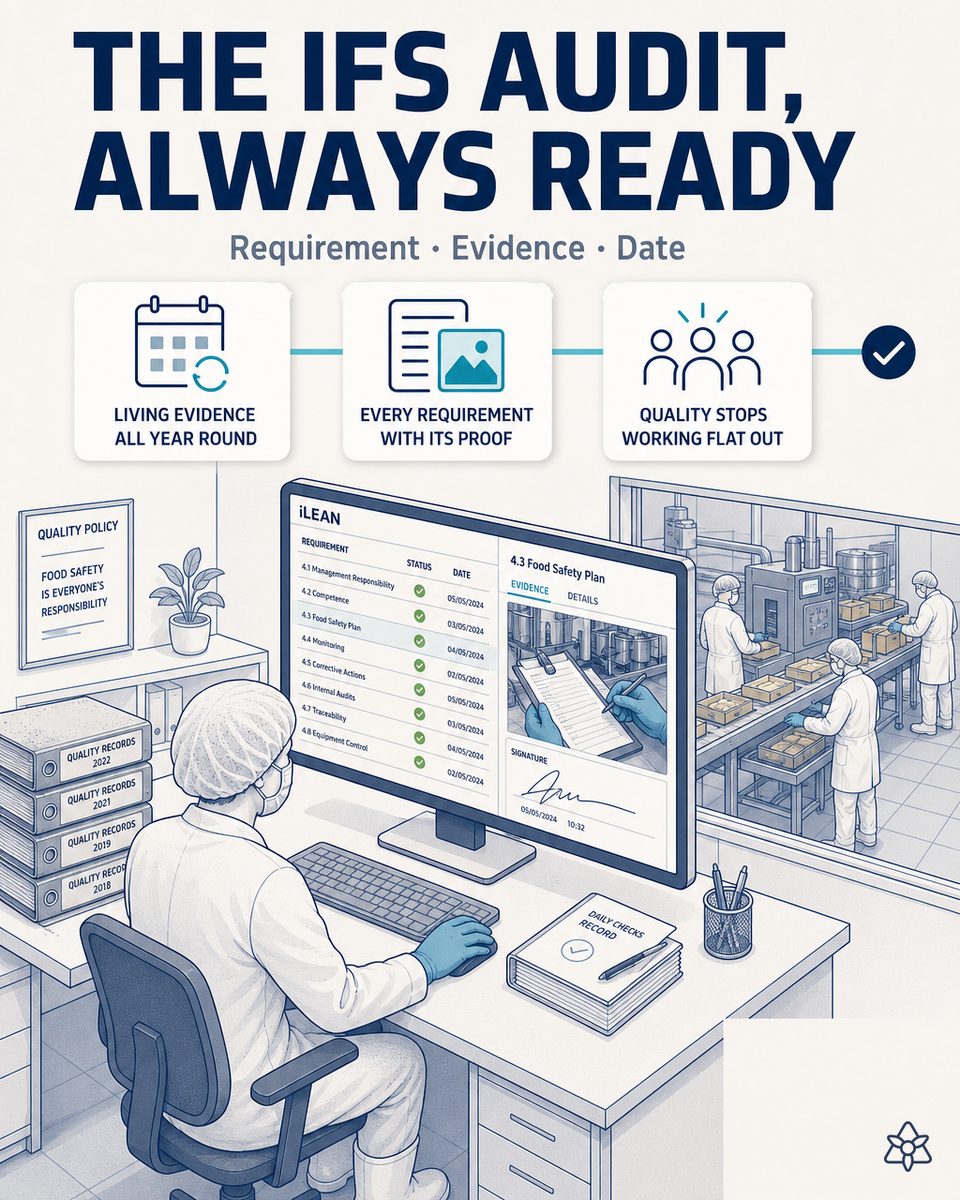
Three weeks of sprint for a one-day visit — and the plant pays the invisible surcharge.
The pattern repeats at every IFS- or BRC-certified plant, and hardly anyone questions it because "it's always been done this way":
- Three months before the audit, the quality manager starts circling the deadline on the calendar.
- Three weeks before, the team goes into sprint mode: rebuilding records that were kept on paper, scanning signatures, gathering cleaning reports, checking that spec sheets are on the latest version, verifying that the HACCP plan has not gone stale.
- The week before, everyone is consumed by it: production slows down, maintenance postpones tasks, HR hunts for the new hires' training certificates.
- On audit day, the auditor asks for "the intermediate cleaning between batch A and batch B" — and the team goes off to find the folder. Fifteen minutes later the report appears, scanned, hand-signed, without metadata.
- The day after, everyone exhales and goes back to their jobs. The evidence generated during the sprint gets archived… and starts aging until the next sprint.
The real cost of this model is not the audit: it is the invisible surcharge of paralyzing the quality team for several weeks a year, while the plant keeps producing NCs that get documented late, badly, or not at all. And in the long run, that evidence debt is exactly what the strictest auditor detects and penalizes.
iLEAN does not add another folder — it captures the evidence at second zero, where it is already happening.
The problem is not that the plant lacks evidence. It is all there — in the cold room's PLC logging the temperature every minute, in the metal detector rejecting the out-of-range unit, in the notebook of the operator who signed off the test-piece run. The problem is that this evidence lives on islands and only gets "assembled" during the pre-auditor sprint. iLEAN is the putty that captures each piece of evidence at its source and keeps it alive, ready to show when asked — without asking you to change your SCADA, your MES, or the quality team's habits.
Connect captures from the PLC, from the notebook, from the operator's photo. The Tracer agent keeps every piece of evidence indexed by IFS/BRC clause. The Writer agent prepares the dossier the auditor asks for. The person validates — the auditor looks; they do not search.
The iLEAN pieces applied to continuous IFS/BRC auditing:
- Connect — captures the cold room PLC's log, the line's CIP reading, the metal detector's test-piece run, the photo the operator took of the oven's analog panel, the training certificate the HR manager attached to an email. Everything enters the system at second zero, with a timestamp and traceability of origin.
- Tracer agent — indexes each piece of evidence by IFS Food / BRCGS Food Safety / FSSC 22000 / SQF clause. It keeps the HACCP plan alive, cross-referenced with the operational records. It detects when a piece of evidence has expired (an operator's training, an equipment calibration, a supplier review) and warns before it turns into an NC.
- Writer agent — prepares the dossiers the auditor will ask for (the "batch file", the "year's non-conformity map", the "verification log"). It generates the dashboard the quality manager presents at the monthly meeting, and the answer to the auditor in their preferred format. The person signs before sending.
The three safety rings guarantee that critical evidence lives in ring 1 at your plant and that auditor access is temporary and traceable (see IRIS architecture).
Pre-auditor sprint vs. always-ready audit with iLEAN
| Aspect | Classic model (sprint) | With iLEAN Tracer + Writer + Agent |
|---|---|---|
| Time spent on the pre-auditor sprint | 2-4 weeks of the quality team | Days — preparation, not reconstruction |
| Source of the evidence | Paper + Excel + shared folders | PLC, Connect, operator's photo — all at the source |
| State of the HACCP plan | Last revision, imprecise date | Alive, cross-referenced with real operations |
| Auditor access | "I'll find it and email it to you" | Temporary access with per-clause filters |
| NCs documented in time | Some — the ones people remember | All — opened by the agent as they happen |
| The plant's invisible cost | Production slowed during the sprint | Normal production — the team is not drained |
Impact estimate for your plant — to be validated with your numbers.
The block below is an estimate to be validated with the specific data of your plant. We put it forward so the committee has an order of magnitude; we refine it during the diagnostic.
- Plant certified under IFS Food and/or BRCGS Food Safety, quality team of 2-6 people, annual audit with a typical pre-auditor sprint of 2-4 weeks.
- Deployment of Connect + Tracer and Writer agents integrated with SCADA/MES + temporary auditor access. First value expected within a few weeks on a pilot block of clauses (for example, temperature records + intermediate cleaning + test-piece runs).
- Expected reduction of pre-auditor sprint time ≥30% (the pattern observed with documentation agents is considerably higher, but that is the defensible floor). The quality team is freed for real continuous improvement, not for rebuilding paperwork.
- Indicative payback between 4 and 9 months, depending on team size and audit frequency (IFS + BRC + retailer + end customer + internal can add up to several a year). The hard lever is freeing the quality team from the sprint so they can do their real job.
The CAIO's argument — a Deming cycle sustained by an agent that does not get tired
The plan-do-check-act cycle is the backbone of IFS/BRC. iLEAN does not invent it: it closes it at a speed and with a consistency that a three-person team cannot sustain month after month. The machine keeps the cycle turning; the person supplies the judgment. The audit stops being a sprint and becomes the natural consequence of an operation that runs well.
And the reasonable doubt about AI reliability — "what if the agent misclassifies a piece of evidence and I lose a point at the audit?" — has an answer: hallucination is a problem of free generation, not of anchored tasks. Indexing a temperature record by IFS clause is exactly an anchored task. In this kind of task, the best models brought error below 1.5% [1]. And the person validates every dossier before showing it to the auditor.
[1] OpenAI paper "Why Language Models Hallucinate", 2025 — on the reliability of AI in anchored tasks.
What people ask about continuous IFS/BRC auditing with AI
Which evidence does it automate?
The repetitive, traceable evidence gains the most from automation: temperature records (cold rooms, ovens, freezers), calibrated test-piece runs (metal/glass), intermediate CIP cleanings, equipment verifications (scale, dosing machine), staff training (procedure sign-off, attendance), pest control (the external company's visit), water control, approved-supplier control. iLEAN captures them at the source — from the PLC, from Connect, from an operator's photo — and keeps the file alive so the IFS/BRC auditor opens it and sees it without any reconstruction.
And real non-conformities?
Non-conformities are not "automated" — they get documented better. iLEAN opens the NC as soon as the agent detects the event (a temperature range out of bounds, a metal-detector rejection, a test piece not detected), assigns it to the responsible person, records the corrective action and the effectiveness verification, and keeps the closure cycle traced. The IFS/BRC auditor especially values an NC that is opened and worked in time, not one that "appeared the week before the audit". This is where we win the point that is hardest to win by hand.
How is it accessed during an audit?
A temporary auditor login with read-only permissions and filters pre-configured by IFS/BRC clause. The auditor asks "show me the intermediate cleaning between these two batches" and the CIP record appears with timestamp, operator, parameters and photo if there was one. They ask "show me the HACCP plan and its revisions" and the latest signed version appears with the change history. Zero folder-digging. Zero "I'll find it and email it to you". The access is time-limited and closes automatically at the end of the audit.
Does it work for FSSC 22000?
Yes. The logic is the same — traceable evidence, time-stamped records, a living HACCP plan, NC management, verification. FSSC 22000 (ISO 22000 + PAS 220) maps reasonably onto IFS and BRC across many clauses, and our system can generate views adapted to each scheme. The same applies to SQF, GFSI and the in-house schemes of many retailers (Tesco, Carrefour, Mercadona, Walmart) that add requirements of their own.
Does it improve the score?
The IFS/BRC score depends on the number and severity of NCs found and on the quality of the available evidence. Estimate to be validated: with a system that keeps evidence alive and NCs worked in time, the usual pattern is to climb 1-2 score levels (for example, from A+/B to Higher Level) in the first cycle after deployment. We do not promise it as a magic number — it depends on the baseline, the specific scheme and the auditor — but it is the pattern we see when the Deming cycle is closed by an agent that does not get tired.
More cases in food
- Industrial AI for coffee, culinary, snacks and foodservice groupsReal industrial AI cases for coffee roasting, canning, pasta and central kitchens: capture what is lost…
- Cold room inventory with AI vision — knowing what is there and where without opening the door.iLEAN Vision identifies pallets inside the cold room with no manual scanning and reconciles them with…
- Confectionery glazing with AI vision — expensive chocolate does not get thrown away; it gets spread properly.How iLEAN sees coating, gloss and clumps at the coating pan outlet, adjusts dosing and time, and cuts…
- Crushed tomato and concentrate control with AI — the grade is decided in line, not in the lab.How iLEAN cross-checks refractometer, colorimeter and evaporator vision to hold Brix, color and zero…
- AI control of ham curing — the curve that decides whether the batch ships or is lost.iLEAN combines vision, weight, chamber humidity and temperature to secure the cooking and curing curve…
- AI control of the cheese curing chamber — quality stops depending on the shift.Continuous sensing in the curing chamber plus AI that predicts deviations before they happen. Cheese…
Tell us your case and in 48h we'll send you the estimated ROI of this AI project for your quality team.
We work on your plant's real data, not ours. Diagnostic with no commitment.
Request estimated ROI in 48h See food industry